How to Quarantine Fish: A Cheap 10-Gallon Setup and a 30-Day Plan
Last reviewed · By Manel Vadillo
A new fish can bring in something your tank has never met, and the fish you already own may have no defense against it. A quarantine tank costs less than most people think, and the hard part is waiting. Here's the setup, how long to wait, and where the sources disagree.
Quick answer
Keep new fish in a separate tank for at least 30 days, the minimum Merck gives. A 10 gallon with a heater, an air pump and a sponge filter is the setup Merck describes. Seed that sponge in your main tank first. Watch daily for white spots, frayed fins or fish that stop eating. Move them over only if nothing shows up.
Why quarantine new fish at all?
Because the fish you already own meet whatever the new one carries with no warning. Merck says quarantine is most useful for catching external parasites and some internal parasites, the kind you find by examining droppings 1. UF/IFAS says to quarantine new fish for at least 30 days, and that ich symptoms can appear 1 to 3 weeks after shipping in warm water 2.
A fish that looks fine at the store can show spots two weeks later. In a quarantine tank, you deal with one fish. In your main tank, you deal with every fish that shares its water. We cover that disease in the ich treatment guide, and what goes wrong in new tanks in fish that die in a new tank.
We only cover freshwater. Saltwater quarantine has its own rules.
Quarantine tank setup
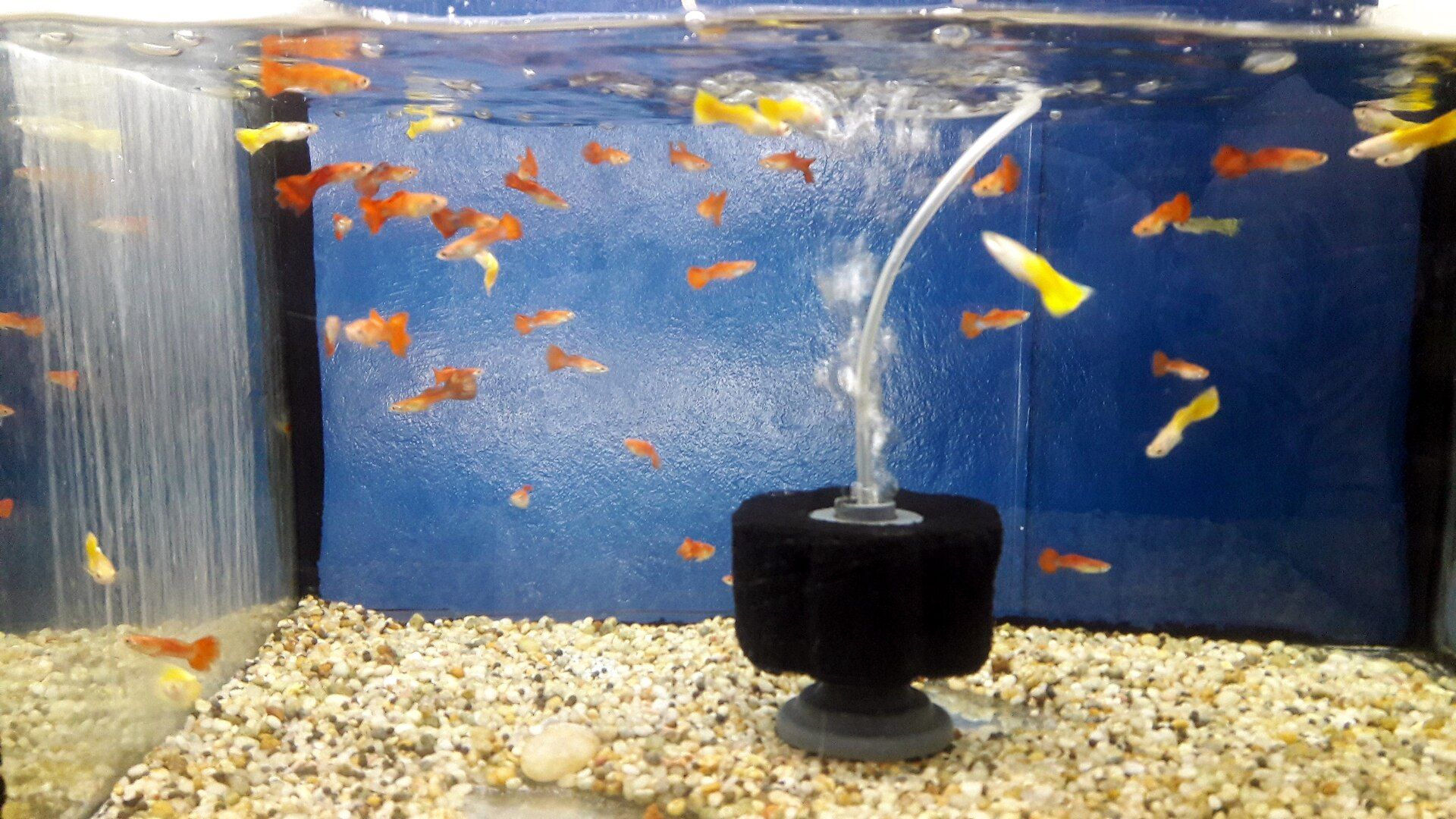
Merck’s hobbyist version is short: an inexpensive 10 gallon tank, a sponge filter, a small air pump and a heater 1. Aquarium Co-Op’s list is almost the same, with a lid, a thermometer, hides and water conditioner 4.
| Piece | What the sources say | Our note |
|---|---|---|
| Tank | 10 gallon 1. Co-Op says it needn’t be as big as the fish’s permanent home 4. sera says it can be somewhat smaller, but not densely stocked 3 | Fine for small fish. No source gives a size for bigger ones, so match it to the fish |
| Filter | A sponge filter on an air pump 1. Co-Op wants low flow 4 | Any small sponge filter works. Our filter size guide is for the main tank |
| Heater | Included in Merck’s and Co-Op’s lists 1 4 | Size it with the heater chart. Add a thermometer |
| Bottom | Bare. Co-Op says it makes cleaning and checking droppings easy 4. sera says no gravel unless the fish live on the bottom, such as corydoras or loaches 3 | Bare, unless you quarantine bottom dwellers. sera says a thin layer of sand works for them |
| Hides | Co-Op and sera both recommend them to reduce stress 3 4 | A few fake plants or a pipe segment |
| Cover | Co-Op lists a lid 4 | Yes. Fish jump |
Seed the filter before the fish arrive
An empty tank has no bacteria to handle waste, so new fish would be in an uncycled tank. Merck’s fix is to run the disinfected sponge filter in an established, disease-free tank before you buy the fish, so it picks up nitrifying bacteria. It says this helps avoid the water problems common in new setups 1. Merck gives no number of weeks. We’d leave it in the main tank for a few weeks before you shop, which is our estimate, not a sourced figure. If you want to understand why, our nitrogen cycle and fishless cycle guides explain it, and the fishless cycle calculator helps if you’d rather cycle the quarantine tank itself.
Keep it separate
Merck says quarantined animals should have their own nets, buckets and siphons, and be handled last, after you’ve finished with everything else 1. Co-Op adds that the tank ideally sits in a different room, and that you should wash your hands after touching it 4.
How to quarantine fish without a tank
Co-Op says any clean, food-safe container that’s large enough will work in an emergency, and prefers one with clear sides so you can see the fish from every angle 4. It also describes a clear plastic tub with a lid, drilling air-flow holes and a cut-out for cables and airline 4.
A tub still needs the same things: a filter, a heater, hides and conditioned water. Without a filter you have an uncycled container, so test for ammonia and be ready to change water. Our high ammonia guide shows what to do, and how often to change water covers the routine. Co-Op does weekly water changes after treatment to clear the medication 4. sera says to maintain a quarantine tank as usual, especially water changes 3.
How long to quarantine fish
The sources give different numbers.
| Source | How long |
|---|---|
| Merck Veterinary Manual | 30 days is the minimum, and longer may be necessary 1 |
| UF/IFAS Extension | At least 30 days 2 |
| sera (FAQ, answered by its Dr. Bodo Schnell) | About 4 weeks, longer if disease breaks out and is treated 3 |
| Aquarium Co-Op | 4 to 6 weeks since the last disease symptom or death was seen 4 |
Merck and UF/IFAS set 30 days as the minimum. sera says about 4 weeks. Co-Op adds a rule that matters: the clock runs from the last symptom or death, not from the day the fish arrived 4. So if a fish shows spots on day 25, don’t release the batch on day 30. By Co-Op’s rule you wait 4 to 6 weeks after the last spot. sera says the same more loosely: longer if disease breaks out and is treated 3. Our own advice is to keep one batch per quarantine tank, since a new arrival would reset the wait for the older fish. No source says that last part.
A 30-day plan
This calendar is our arrangement of the sources. The dates and tests are not from a single guide.
| When | What to do |
|---|---|
| Before day 0 | Run the sponge filter in your main tank. Set up the quarantine tank, heater and hides. Check the temperature |
| Day 0 | Acclimate and add the fish (how to acclimate fish). Fish are fed normally through quarantine, per sera 3 |
| Days 1 to 7 | Watch daily. Merck says to examine fish early in the period, and a visual check may be enough 1. Check ammonia if the tank isn’t cycled |
| Days 7 to 21 | The ich danger zone, since symptoms can appear 1 to 3 weeks after shipping 2. Do your weekly water change |
| Days 22 to 30 | Keep watching. Merck’s 30 days is a minimum 1 |
| Symptoms at any point | Treat (see below). The clock restarts from the last symptom, per Co-Op 4 |
| After day 30 | If nothing showed up and the fish eat and behave normally, they can go to the main tank. sera says to wait until symptoms have not occurred or have been fully cured 3 |
What to watch for, and what to do
| What you see | What it may be | Our guide |
|---|---|---|
| White spots like salt grains | Ich | Ich fish treatment |
| Ragged, shrinking fins | Fin rot | Fin rot |
| Gasping at the surface | Low oxygen, or water chemistry | Gasping at the surface |
| Lying on the bottom | Several causes | Lying on the bottom |
| Won’t eat | Stress or illness | Keep watching. sera says regular, careful observation is the most important measure 3 |
Ich treatment has its own guide: ich fish treatment.
Should you medicate in quarantine?
The sources split.
- sera says that as long as the fish look healthy you should not treat them at all, and should treat only when there are distinct symptoms, with the treatment chosen by diagnosis 3.
- Aquarium Co-Op says to consider proactive treatment for fish from an online retailer, pet store chain or untested source. It treats them with what it calls its quarantine trio (Maracyn, ParaCleanse and Ich-X), dosed per the label 4. Co-Op sells these products, so weigh that.
- Merck says prophylactic antimicrobials may be warranted in some shipments, especially recently imported marine fish, which this site doesn’t cover 1.
Our view: watch first, treat on symptoms. We wouldn’t dose a healthy fish without a reason. If you do medicate, follow the manufacturer’s label, and know that Co-Op says to remove carbon filtration and UV sterilizers first 4. For salt, see how much aquarium salt per gallon.
One more disagreement: sera advises swapping small amounts of water between the quarantine and main tanks, about 200 ml (7 fl oz) every other day in both directions, so each group slowly gets used to the other’s microbes 3. That moves quarantine water into your main tank before the weeks are up, which is what quarantine is meant to prevent. We wouldn’t do it.
Moving fish to the main tank
When the clock is up, acclimate them as you would any new fish. Our guide on how to acclimate fish compares float, drip and net-and-go. Merck says to disinfect the tank and equipment once fish clear quarantine and store them dry until needed 1.
Plants and hitchhikers
UF/IFAS says plants and structures can carry ich cysts, so keep plants in a fish-free tank before they go into the main one 2. Snails are another hitchhiker. See our pest snails guide.
A hospital tank is the same tank
Co-Op uses the same setup for new fish and for sick ones 4. If a fish in your main tank gets ill, you can move it into the quarantine tank to watch it and treat it away from the others. It won’t fix a water problem in the main tank, so test that too.
FAQ
How long should you quarantine new fish? At least 30 days per Merck and UF/IFAS 1 2. sera says about 4 weeks 3. Co-Op says 4 to 6 weeks from the last symptom or death 4.
Do I really need a quarantine tank? Merck strongly recommends quarantine for pet fish 1. The cost is a small tank, a heater and a sponge filter. It’s your call, but it’s the simplest way to protect the fish you already own.
How do you quarantine fish without a tank? A clean, food-safe container with clear sides, per Co-Op 4. Add a heater, a filter or frequent water changes, and watch the ammonia.
What size quarantine tank do I need? Merck’s example is 10 gallons 1. Co-Op says it needn’t be as large as the fish’s permanent home 4. Large fish need a larger container.
Is 1 or 2 weeks of quarantine enough? Probably not. UF/IFAS says ich symptoms can show up 1 to 3 weeks after shipping 2, and both Merck and UF/IFAS set 30 days as the minimum 1 2.
Should I medicate fish in quarantine? Only on symptoms, says sera 3. Co-Op suggests treating fish from untested sources 4. See above.
Can I quarantine a fish with ich in the main tank? Quarantine is for fish that haven’t entered the main tank yet. If ich is already there, see our ich guide.
All the numbers, with sources
| What | Value | Type | Source |
|---|---|---|---|
| Merck: minimum quarantine for pet fish | 30 days (longer may be necessary) | Stated by source | [1] |
| UF/IFAS: minimum quarantine for new fish | At least 30 days | Stated by source | [2] |
| UF/IFAS: when ich symptoms can appear after shipping in warm water | 1 to 3 weeks | Stated by source | [2] |
| sera: recommended quarantine length | About 4 weeks, longer if disease appears and is treated | Stated by source | [3] |
| Aquarium Co-Op: recommended quarantine length | 4 to 6 weeks since the last symptom or death | Stated by source | [4] |
| Merck: hobbyist quarantine tank size | 10 gal (38 L) | Stated by source | [1] |
Sources
- Merck Veterinary Manual (2026). Management of Aquarium Fish (quarantine and biosecurity)
- UF/IFAS Extension (n.d.). Ichthyophthirius multifiliis (White Spot) Infections in Fish (CIR920/FA006)
- sera (aquarium products maker; FAQ answered by Dr. Bodo Schnell) (n.d.). How do I carry out a proper quarantine?
- Aquarium Co-Op (fish and aquarium products retailer that sells the medications it names) (n.d.). How to Quarantine New or Sick Aquarium Fish the Easy Way