Fishless Cycle: The Exact Ammonia Dose and Day-by-Day Schedule
Last reviewed · By Manel Vadillo
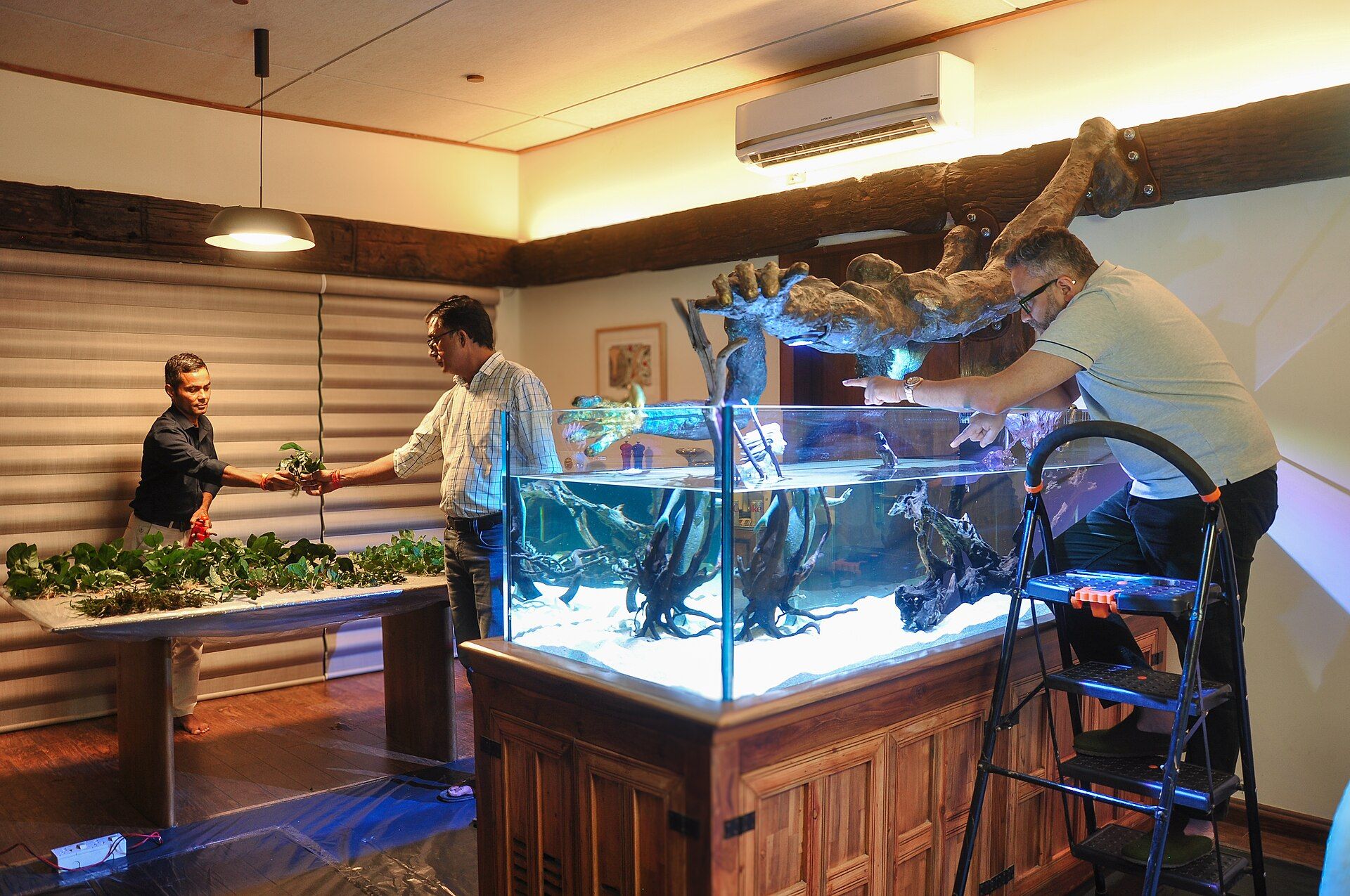
You don't need fish to cycle a tank, and it's easier on everyone if you leave them out. You feed the filter ammonia yourself, test every day and wait for the bacteria to catch up. This guide covers the dose for your tank, the day-by-day schedule and how to know it's done.
Quick answer
A fishless cycle grows the filter's bacteria before any fish go in. You add ammonia yourself, test every day and dose again only when ammonia and nitrite are both under 5 ppm. When both read under 0.5 ppm on day 7 or 8, the recipe says the tank is cycled. Our rule is stricter: zero ammonia and nitrite 24 hours after a full dose.
Why skip the fish
You can start a tank with fish and let their waste feed the bacteria. Aquaculture people call that a cold start. It works, but you have to keep ammonia and nitrite down with water changes and cut back on food until the filter catches up, and the fish carry the stress 4. Growing the bacteria first means less stress on the animals and better water from day one 4.
In a fishless cycle you play the fish. You add ammonia on a schedule and the bacteria grow on it. Levels that would kill fish don’t matter, because there are none in the tank 4. If the chemistry is new to you, the nitrogen cycle guide covers it.
What you need
Get the tank fully running first: filter, heater, substrate and tap water treated with a dechlorinator (not RO/DI water). Let it all run for 24 hours before you start 1.
The dose depends on how much water is in the tank. If you don’t know yours, the aquarium volume calculator works it out and takes off the substrate.
You also need:
- An ammonia source. Dr. Tim’s ammonium chloride is made for this. Unscented household ammonia, ammonium hydroxide and ammonium chloride powder all work 4, though Dr. Tim’s advises against household ammonia 7.
- Test kits for ammonia, nitrite and pH 1.
- Bottled nitrifying bacteria, if you want the fast schedule below. They aren’t essential, but they can shorten start-up 4.
How much ammonia to add
Dr. Tim’s standard dose is 4 drops per gallon, which gives 2 ppm ammonia-nitrogen 2. Bottles from before November 1, 2016 were stronger and called for 1 drop per gallon, so go by your label 3. For household ammonia or ammonium chloride powder, the dose depends on the concentration, so work it out:
A quick check on the math. An aquaculture rule of thumb says 60 mL of 10% household ammonia raises 1,000 gallons (3,785 L) by about 1.6 mg/L 4. Our calculator gets about 1.5 ppm NH3 for the same numbers, or 1.25 ppm as nitrogen 5,6. That fits if the fact sheet means the whole NH3 molecule. It doesn’t say which.
Fish food or shrimp instead of bottled ammonia
Some people drop in fish food, or a raw shrimp from the grocery store, and let it rot. The shrimp trick is popular, but you have no way to know how much ammonia it’s producing, and a rotting shrimp on the gravel doesn’t look great 9. Fish food has the same problem, in our view: you can’t measure what it releases. If you want to dose to a target, a liquid or powder you can measure is easier.
Day by day, with bottled bacteria
This is Dr. Tim’s recipe 1. Test at the same time each day and write the numbers down 4.
- Day 1Add bacteria + first dose
- Day 2Test
- Day 3Test. Dose if both under 5 ppm
- Day 4Test. pH under 7? Change 25–30%
- Day 5Test
- Day 6Test. Dose if both under 5 ppm
- Day 7Test
- Day 8Both under 0.5 ppm? Cycled
- Day 1. Add the whole bottle of bacteria, then one dose of ammonia. Test ammonia before the first dose, especially if you used live sand, and dose less if some is already there.
- Day 2. Test ammonia, nitrite and pH.
- Day 3. Test. If ammonia and nitrite are both under 5 ppm (as nitrogen), add another dose. If either is over, skip it.
- Days 4 and 5. Test. If pH has dropped below 7, change 25 to 30% of the water, taking it from near the top without stirring up the gravel or touching the filter.
- Day 6. Same check as day 3: dose again only if both are under 5 ppm.
- Days 7 and 8. Test. Once ammonia and nitrite both read under 0.5 ppm, the recipe calls the tank cycled. If not, keep testing daily until they are. We confirm it with the stricter 24-hour test: zero ammonia and nitrite a day after a full dose.
Don’t dose every day, and don’t try to lower pH during the cycle. Higher is better, up to 8.5 1.
Without bottled bacteria
The tank still cycles, just more slowly, and the day numbers above stop meaning much. How long to cycle a fish tank covers realistic timelines. The aquaculture method works like this 4:
- Raise total ammonia to 3 to 5 mg/L, adding it bit by bit and testing after it mixes in.
- Test ammonia, nitrite, pH and temperature regularly, from the same spot and at the same time of day.
- Plot the readings. Ammonia rises and falls first, then nitrite. The nitrite peak is the turning point: after it, nitrite keeps falling until it levels off.
That target is higher than Dr. Tim’s 2 ppm dose, and the fact sheet doesn’t say whether its mg/L is as nitrogen or as NH3. Either way, both sources keep ammonia under about 5 ppm.
Cycling a planted tank
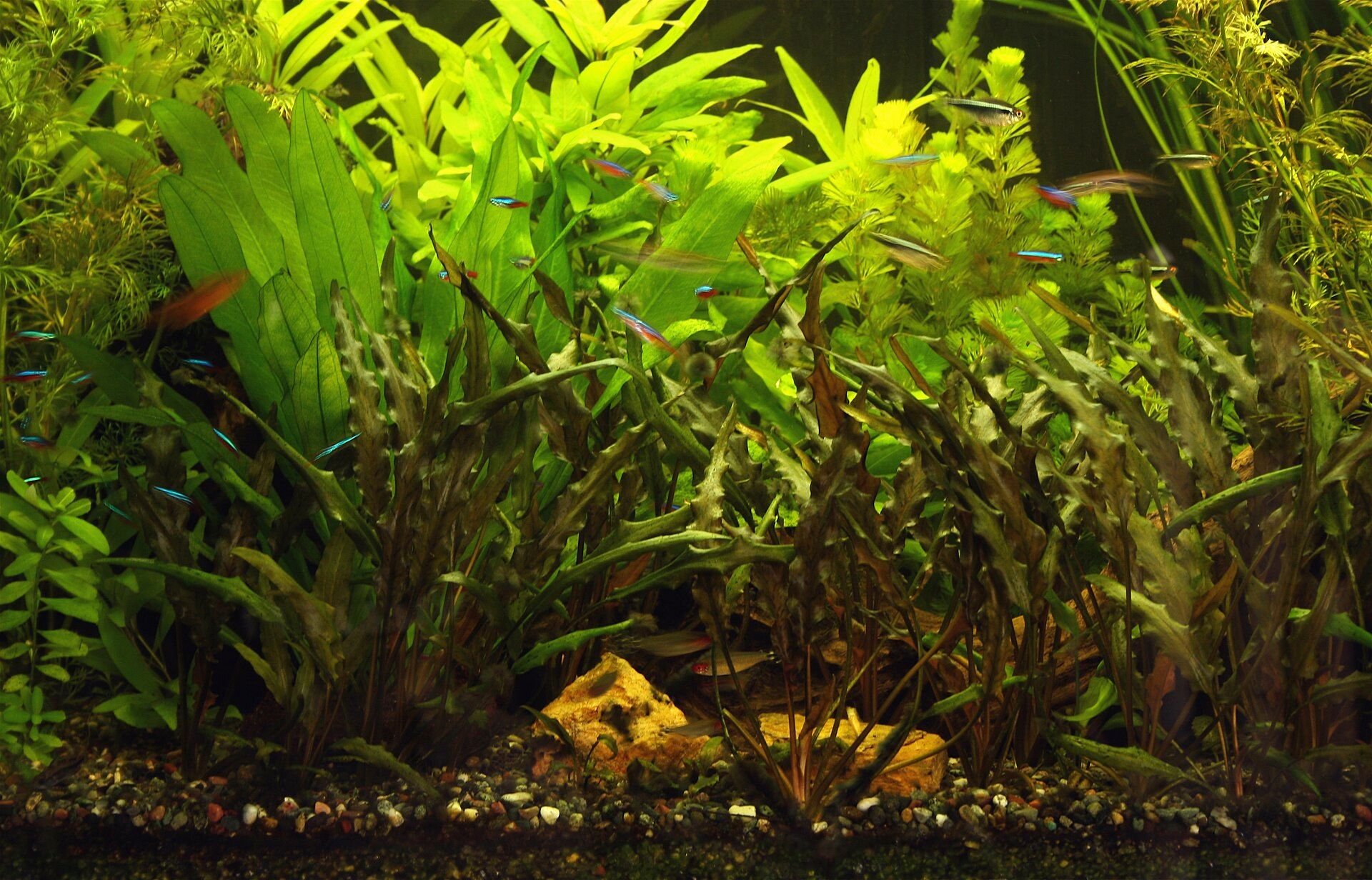
Plants take up nitrogen too, and some prefer ammonium. In a lab study, six duckweed species used ammonium first and only switched to nitrate once the ammonium ran out 10. That’s floating plants in a lab, not a test of planted aquariums. Our inference: in a heavily planted tank, some of the ammonia you add goes to the plants, so a falling ammonia reading doesn’t prove the bacteria are established. Look for nitrite rising and then falling, and nitrate showing up.
If the cycle stalls
The usual culprit is pH below 7.0. A 20 to 25% water change raises the pH and usually gets things moving again 9. Nitrification uses up alkalinity as it goes (the nitrogen cycle guide has the numbers). Our reading: soft water stalls more easily. If nitrite is the number that won’t move, see high nitrite in a fish tank. Our stalled cycle guide goes through each cause.
Small things that help
A little warmth speeds the bacteria up. Keep it within 3.6 to 5.4 °F (2 to 3 °C) of the temperature you’ll run the tank at, or you risk a die-off when you turn the heater back down 4. If your heater struggles to hold even that, check it against our heater size chart.
Brand-new filter media can be slow to colonize, possibly because the surface is still slick. The second time around usually goes faster 4.
After it’s cycled
On the recipe’s chart, the first fish go in on day 9, with a 25% water change on day 14 and every two weeks after that 1. Before buying fish, run the 24-hour ammonia test to be sure.
FAQ
Can I do a fishless cycle without bottled bacteria? Yes. The tank still cycles, just more slowly, and the day numbers in the recipe stop meaning much 4. Bottled bacteria aren’t essential, but they can shorten start-up 4.
How much ammonia do I add? Dr. Tim’s standard dose is 4 drops per gallon, which gives 2 ppm ammonia-nitrogen 2. Bottles from before November 1, 2016 were stronger and called for 1 drop per gallon, so go by your label 3. Don’t go over 5 ppm 3.
Do I dose ammonia every day? No. The recipe doses on day 1, then on days 3 and 6 only if ammonia and nitrite are both under 5 ppm 1. It also says not to dose every day 1.
Can I use fish food or a raw shrimp instead? People do, but you can’t know how much ammonia either one releases 9. If you want to dose to a target, a liquid or powder you can measure is easier.
Why has my fishless cycle stalled? The usual culprit is pH below 7.0. A 20 to 25% water change raises the pH and usually gets things moving again 9.
When can the first fish go in? On Dr. Tim’s chart, day 9 1. Run the 24-hour ammonia test first to be sure.
Disclosure: Dr. Tim Hovanec, whose recipe and products this guide uses, was Chief Science Officer of Aquaria Inc. (Marineland’s parent company) and is President of DrTim’s Aquatics 8. We have no relationship with the company.
All the numbers, with sources
| What | Value | Type | Source |
|---|---|---|---|
| Dr. Tim's standard dose | 4 drops per gallon = 2 ppm NH3-N | Stated by source | [2] |
| When to dose (Dr. Tim's recipe) | Day 1, then days 3 and 6 if ammonia and nitrite are both under 5 ppm (as nitrogen) | Stated by source | [1] |
| Limit during the cycle | Don't exceed 5 ppm ammonia | Stated by source | [3] |
| Cycled (Dr. Tim's recipe, looser than this site's rule) | Ammonia and nitrite both under 0.5 ppm (as nitrogen) | Stated by source | [1] |
| If pH drops below 7 mid-cycle | Change 25 to 30% of the water | Stated by source | [1] |
| Aquaculture start-up target | 3 to 5 mg/L total ammonia | Stated by source | [4] |
| Aquaculture rule of thumb | 60 mL of 10% household ammonia per 1,000 gal (3,785 L) raises ammonia about 1.6 mg/L | Stated by source | [4] |
| Same dose, run through our calculator | About 1.5 ppm NH3 (1.25 ppm NH3-N) | Our calculation | [5] |
| Warm-up limit while cycling | No more than 3.6 to 5.4 °F (2 to 3 °C) above your planned temperature | Stated by source | [4] |
Sources
- DrTim's Aquatics (2023). Prescription for Fishless Cycling a New Aquarium (PDF)
- DrTim's Aquatics (2026). Ammonium Chloride product page (4 drops per gallon, 40 mg/mL TAN, 100 drops = 5 mL)
- Bulk Reef Supply, quoting DrTim's Aquatics (2026). Ammonium Chloride for Fishless Cycles (November 1, 2016 concentration change; 5 ppm limit)
- DeLong DP, Losordo TM, Southern Regional Aquaculture Center (2012). How to Start a Biofilter (SRAC Publication No. 4502)
- Airgas Specialty Products (2016). Table IV: Density of Aqueous Ammonia Solutions at 20/4 °C (from the International Critical Tables)
- PubChem, NIH (2026). Ammonia (CID 222), molecular weight 17.031
- DrTim's Aquatics (n.d.). Fishless Cycling A New Aquarium, recipe hosted by Bulk Reef Supply (PDF)
- DrTim's Aquatics (2026). About Dr. Tim
- DrTim's Aquatics (2026). Fishless Cycling (methods and troubleshooting)
- Zhou Y, Kishchenko O, Stepanenko A, et al. (2021). The Dynamics of NO3- and NH4+ Uptake in Duckweed Are Coordinated with the Expression of Major Nitrogen Assimilation Genes. Plants 11(1):11 DOI: 10.3390/plants11010011