Aquarium Nitrogen Cycle: The Microbes Most Guides Get Wrong
Last reviewed · By Manel Vadillo
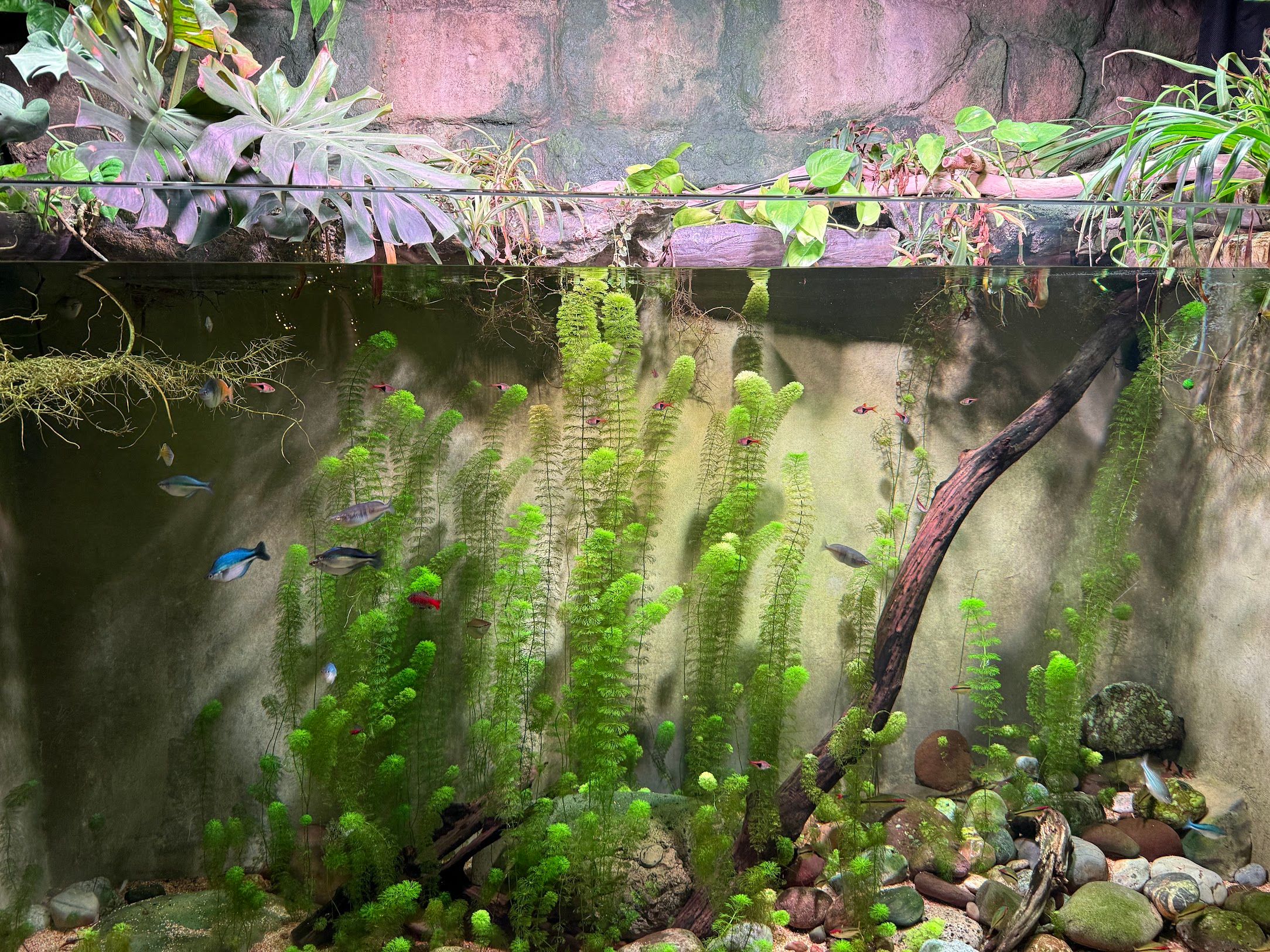
A new tank can poison its fish with their own waste. The nitrogen cycle is what stops that, and it all happens in a film of microbes you'll never see. You can still follow every step of it on a test kit.
Quick answer
The aquarium nitrogen cycle is how a tank makes fish waste safe. Microbes living in the filter and on every wet surface turn toxic ammonia into nitrite, then turn nitrite into nitrate, which you remove with water changes. A tank is cycled when ammonia and nitrite both read zero 24 hours after a full dose of ammonia.
The three steps, in order
Fish give off ammonia, mostly through their gills, and it dissolves straight into the water they breathe. Ammonia is toxic: at high levels it cuts appetite and growth and kills fish 5.
The nitrogen cycle is how the tank deals with it:
- Ammonia (NH3/NH4+) becomes nitrite (NO2-). Nitrite is also toxic.
- Nitrite becomes nitrate (NO3-). Nitrate is far less toxic 5, but it builds up over time.
- You remove the nitrate with water changes.
Living microbes do both conversions. They need oxygen and grow as a film on filter media, gravel, décor, even the inside of pipes and tank walls 5. Cycling a tank means growing that film. It sits on surfaces, not in the water, so a water change won’t wash it out. Chlorine is another matter. Fish farms disinfect with bleach, and it kills the nitrifiers along with everything else 5. Those bacteria can form a thin brown film, and diatoms on the glass of a new tank look almost the same. Our guide to brown algae in a new tank sorts out what’s normal.
What the cycle looks like on your test kit
Feed a new filter a steady supply of ammonia and the readings follow a familiar shape. Ammonia climbs, then drops as the first microbes multiply. Nitrite starts rising after a lag and falls once the second group catches up. From then on, nitrate creeps up.
In one aquaculture start-up run at 83 °F (28 °C), ammonia peaked first and nitrite second, and both came down within 10 days 5. That tank was warm and carefully managed, so don’t treat it as a promise. Bottled bacteria or media from an established filter can shorten start-up 5. Without them it takes longer. How long to cycle a fish tank has realistic timelines.
When a tank counts as cycled
Our rule: ammonia and nitrite both read zero 24 hours after a full dose of ammonia. Dr. Tim’s method page describes the same test: a full dose of 2 to 3 mg/L ammonia-nitrogen turns into nitrate overnight, with no nitrite left 12. The dose has to be fresh. A zero reading means nothing if nothing is feeding the tank ammonia.
Other sources set the line a little higher. Dr. Tim’s printed recipe calls the tank cycled below 0.5 ppm 6. Is my tank cycled? compares the cutoffs and walks through the test. This page is the reference for the rule, and the other cycling guides point back here.
Which microbes actually do it
Most aquarium guides, and plenty of aquaculture fact sheets, credit Nitrosomonas with eating ammonia and Nitrobacter with eating nitrite 5. When researchers sampled real freshwater aquarium filters and looked at the DNA, that’s not what they found.
The nitrite eaters were Nitrospira-like bacteria, nearly 5% of the biofilm’s rRNA while nitrification was getting going. Nitrobacter didn’t show up at all. Tanks dosed with a commercial product containing Nitrobacter grew Nitrospira instead 2.
On the ammonia side, the classic Nitrosomonas group turned up in only two freshwater samples, even in tanks that were nitrifying well 1. A later study isolated a Nitrosomonas marina-like strain, yet in well-established aquaria it made up 2% or less of the cells 3.
Then there are archaea. A 2011 survey found ammonia-oxidizing archaea outnumbering the bacteria in 23 of 27 freshwater biofilters. In 12 of them, archaea were the only ammonia oxidizers detected 4. Tanks with less ammonium had a bigger share of archaea 4.
You don’t need these names to cycle a tank. They’re useful when you read a bottle label, though. Besides the Nitrobacter product above, the two commercial supplements tested in the 2011 study had no detectable archaea 4. In lab reactors, ammonia concentration decided which ammonia-oxidizing strain took over 3. Bottled bacteria can shorten start-up 5, but the species list on the label doesn’t guarantee what ends up living in your filter.
Disclosure: the three bacterial studies above share an author, Timothy Hovanec, who was Chief Science Officer of Aquaria Inc. (Marineland’s parent company) and is now President of DrTim’s Aquatics 11, the company whose ammonium chloride and cycling recipe we reference. The 2011 archaea study 4 comes from an independent university lab.
What the microbes need
Nitrification needs oxygen 5. If you balance the overall reaction (NH4+ + 2 O2 → NO3- + 2 H+ + H2O), each mg of ammonia-nitrogen turned into nitrate uses 4.57 mg of oxygen. That’s our own calculation from the molecular weights 8. Real use is lower, since some nitrogen goes into new cells. In practice: keep water flowing through the filter and moving at the surface.
The same reaction releases acid, and that eats alkalinity, about 7.14 mg as calcium carbonate per mg of ammonia-nitrogen oxidized 7. It’s why pH drifts down in soft-water tanks during and after cycling. Fish farms raise alkalinity to about 150 mg/L with baking soda before seeding a biofilter 5. That’s a target for commercial systems, not for every home tank.
The ideal pH depends on who you ask. Fish farm guidance puts the best range at 6.8 to 7.2, with a lower limit around 6.8 5. Dr. Tim’s recipe leans higher (“the higher the pH the better,” up to 8.5) and calls for a 25 to 30% water change if pH drops below 7 6. Both agree that pH sliding under 7 mid-cycle is a warning sign. Our aquarium pH guide covers the rest of the pH picture.
Warm water speeds the microbes up. Just don’t go more than 3.6 to 5.4 °F (2 to 3 °C) above the temperature you plan to keep, or the bacteria can crash when you cool the tank back down 5.
More surface means more room for the film 5. And keep chlorine away from it. Treat all new water with a dechlorinator and never rinse filter media in untreated tap water; chlorine is what fish farms use on purpose to kill nitrifiers 5.
The unit trap: NH3 vs NH3-N
Test kits and guides don’t all report nitrogen the same way. Some give the weight of the whole molecule (ppm NH3, NO2 or NO3), others only the nitrogen in it (ppm NH3-N, NO2-N or NO3-N). Dr. Tim’s figures use the nitrogen form 6. Mix them up and a reading can look up to four times higher or lower than it is.
Conversion factors, calculated from molecular weights 8,9,10:
| If your kit reads… | Multiply by | To get… |
|---|---|---|
| ppm NH3-N | 1.22 | ppm NH3 |
| ppm NO2-N | 3.28 | ppm NO2 |
| ppm NO3-N | 4.43 | ppm NO3 |
To go the other way, divide. Your kit’s instructions say which form it uses. We don’t list brands because we haven’t checked each kit’s units.
Next step
Fish already in? Read cycling a tank with fish in it, and see high nitrite and safe nitrate levels for the two readings you’ll meet along the way. No fish in the tank yet? A fishless cycle is the safer route, and the fishless cycle calculator works out the dose. Log ammonia, nitrite, nitrate and pH every day or two. Without the numbers written down, you won’t see the curves above. Already cycled? How many fish fit in a 10 or 20 gallon tank covers what to put in it, and in what groups. Ammonia showing up in a tank that was already cycled? See high ammonia in a fish tank.
FAQ
What is the nitrogen cycle in an aquarium? Microbes turn toxic ammonia into nitrite, which is also toxic, and then into nitrate, which is far less toxic 5. You remove the nitrate with water changes.
When is a tank cycled? When ammonia and nitrite both read zero 24 hours after a full dose of ammonia 12. The section above has the looser cutoffs other sources use.
Is it Nitrobacter that eats the nitrite? Most guides say so, but in sampled freshwater aquarium filters the nitrite eaters were Nitrospira-like bacteria, and Nitrobacter didn’t show up at all 2.
What pH do the microbes need? Fish farm guidance puts the best range at 6.8 to 7.2 5. Dr. Tim’s recipe says the higher the pH the better, up to 8.5 6. Both treat a slide under 7 mid-cycle as a warning sign.
Why does pH fall during cycling? The reaction releases acid and uses up alkalinity, about 7.14 mg as calcium carbonate per mg of ammonia-nitrogen oxidized 7.
Do I need to keep chlorine away from the filter? Yes. Treat new water with a dechlorinator and don’t rinse filter media in untreated tap water. Fish farms use chlorine on purpose to kill nitrifiers 5.
All the numbers, with sources
| What | Value | Type | Source |
|---|---|---|---|
| Nitrite oxidizers found in freshwater aquarium biofilms | Nitrospira-like, about 5% of biofilm rRNA; Nitrobacter not detected | Stated by source | [2] |
| Freshwater biofilters where archaea outnumbered ammonia-oxidizing bacteria | 23 of 27 | Stated by source | [4] |
| Ammonia-oxidizing bacteria in established freshwater aquaria | 2% or less of detected cells | Stated by source | [3] |
| Best pH for nitrifying bacteria (aquaculture biofilters) | 6.8 to 7.2; lower limit about 6.8 | Stated by source | [5] |
| Alkalinity used up per mg of ammonia-nitrogen oxidized | 7.14 mg as CaCO3 | Stated by source | [7] |
| Oxygen used per mg of ammonia-nitrogen fully oxidized to nitrate | 4.57 mg O2 | Our calculation | [8] |
| When this site calls a tank cycled | Ammonia and nitrite both zero 24 hours after a full dose (2 to 3 mg/L ammonia-nitrogen) | Stated by source | [12] |
| Looser cutoff in Dr. Tim's printed recipe | Ammonia and nitrite both below 0.5 ppm (as nitrogen) | Stated by source | [6] |
| Example biofilter start-up at 83 °F (28 °C) | Ammonia peaked first, then nitrite, within 10 days | Stated by source | [5] |
| Unit conversions | 1 ppm NH3-N = 1.22 ppm NH3; 1 ppm NO2-N = 3.28 ppm NO2; 1 ppm NO3-N = 4.43 ppm NO3 | Our calculation | [8] |
Sources
- Hovanec TA, DeLong EF (1996). Comparative analysis of nitrifying bacteria associated with freshwater and marine aquaria. Appl Environ Microbiol 62(8):2888-2896 DOI: 10.1128/aem.62.8.2888-2896.1996
- Hovanec TA, Taylor LT, Blakis A, DeLong EF (1998). Nitrospira-like bacteria associated with nitrite oxidation in freshwater aquaria. Appl Environ Microbiol 64(1):258-264 DOI: 10.1128/AEM.64.1.258-264.1998
- Burrell PC, Phalen CM, Hovanec TA (2001). Identification of bacteria responsible for ammonia oxidation in freshwater aquaria. Appl Environ Microbiol 67(12):5791-5800 DOI: 10.1128/AEM.67.12.5791-5800.2001
- Sauder LA, Engel K, Stearns JC, Masella AP, Pawliszyn R, Neufeld JD (2011). Aquarium nitrification revisited: Thaumarchaeota are the dominant ammonia oxidizers in freshwater aquarium biofilters. PLoS ONE 6(8):e23281 DOI: 10.1371/journal.pone.0023281
- DeLong DP, Losordo TM, Southern Regional Aquaculture Center (2012). How to Start a Biofilter (SRAC Publication No. 4502)
- DrTim's Aquatics (2023). Prescription for Fishless Cycling a New Aquarium (PDF)
- California Water Environment Association (n.d.). How Alkalinity Affects Nitrification (Evans M, Sober G; published by WEF)
- PubChem, NIH (2026). Ammonia (CID 222), molecular weight 17.031
- PubChem, NIH (2026). Nitrite (CID 946), molecular weight 46.006
- PubChem, NIH (2026). Nitrate (CID 943), molecular weight 62.005
- DrTim's Aquatics (2026). About Dr. Tim
- DrTim's Aquatics (2026). Fishless Cycling (methods and troubleshooting)