How Often to Change Aquarium Water: 25% a Week, Then Test
Last reviewed · By Manel Vadillo
Every fish keeper gets a different answer to this one, and most of those answers are guesses. There's a simple starting schedule that works for most small tanks. After that, your test kit should decide, not a calendar.
Quick answer
For an established community tank, change 10 to 25% of the water every week and vacuum the gravel while you're at it. Small tanks and betta bowls need more, up to 50% a week. Then test nitrate before each change. If it reads 80 ppm or more, change 50% right away.
The short answer
For most beginner tanks, change 10 to 25% of the water once a week, siphoning the gravel as you drain 1. A bowl or a small betta tank needs bigger changes, as much as 50% a week 2. Treat the table below as a starting point.
Its rows don’t all come from the same school of thought. The weekly routine is the standard advice. The author of Aquarium Science thinks most people change far more water than they need to. That site suggests 50% every one to three months for most tanks, and says the only reason to change water is to keep nitrate in a reasonable range 4. We’d start with the weekly habit, since it’s hard to get wrong, and loosen it once your readings stay low.
What your schedule depends on
Filter bacteria turn fish waste into nitrate, which is far less toxic than the ammonia it came from 17. It doesn’t leave on its own, so it builds up until you take water out 4. How fast depends on a few things.
- Tank size. Merck says small tanks need larger, more frequent changes 2. The same waste in less water adds up faster.
- Number of fish. More fish, more waste. That’s the whole basis of the Aquarium Science schedule, from every two weeks in a packed tank to every five months in a lightly stocked one 4.
- Plants. Plants and algae use nitrate as food 2. We’d expect a well-planted tank to climb more slowly.
- Filter. A bigger filter clears ammonia faster, but its end product is still nitrate 17. Don’t expect a new filter to stretch your schedule.
- Your nitrate reading. This one overrides the others. The Merck Veterinary Manual’s reference range for freshwater is under 20 mg/L (the same as ppm) 3. Aquarium Science is far looser. Its author says adult fish can take at least 160 ppm with no long-term effects, recommends staying under 80 5, and calls for a 50% change at 80 ppm or more 4. The same author’s nitrate page is less relaxed: it likens 160 ppm to four beers a day and says it probably causes some health problems, and it lists research limits of 440 ppm and up 19. Check what your kit reports. Merck notes that some kits only report nitrate-nitrogen 3, which reads about four times lower for the same water. Our nitrogen cycle guide has the conversion, and safe nitrate levels compares the thresholds side by side.
Why a fixed weekly change levels off
If you change the same share every week, nitrate settles where the change removes what your fish added that week. The level just before each change works out to the weekly gain divided by the fraction you change. That’s our own calculation, not a figure from a source.
To find your own weekly gain, test right after a water change and again a week later. The difference is roughly what your tank adds. If your tap water has nitrate, test that too, because a change can’t take the tank below it. Splitting a change isn’t the same, either. Two 25% changes remove about 44% of the nitrate, not 50%.
Signs you’re not changing enough
The clearest sign is nitrate that keeps climbing from one test to the next, past 20 ppm and toward 80 3 4. Algae is another (our fish tank algae guide shows how to identify the type). Nitrate over 80 ppm is one of the fuels behind green water 18, which our cloudy water guide covers.
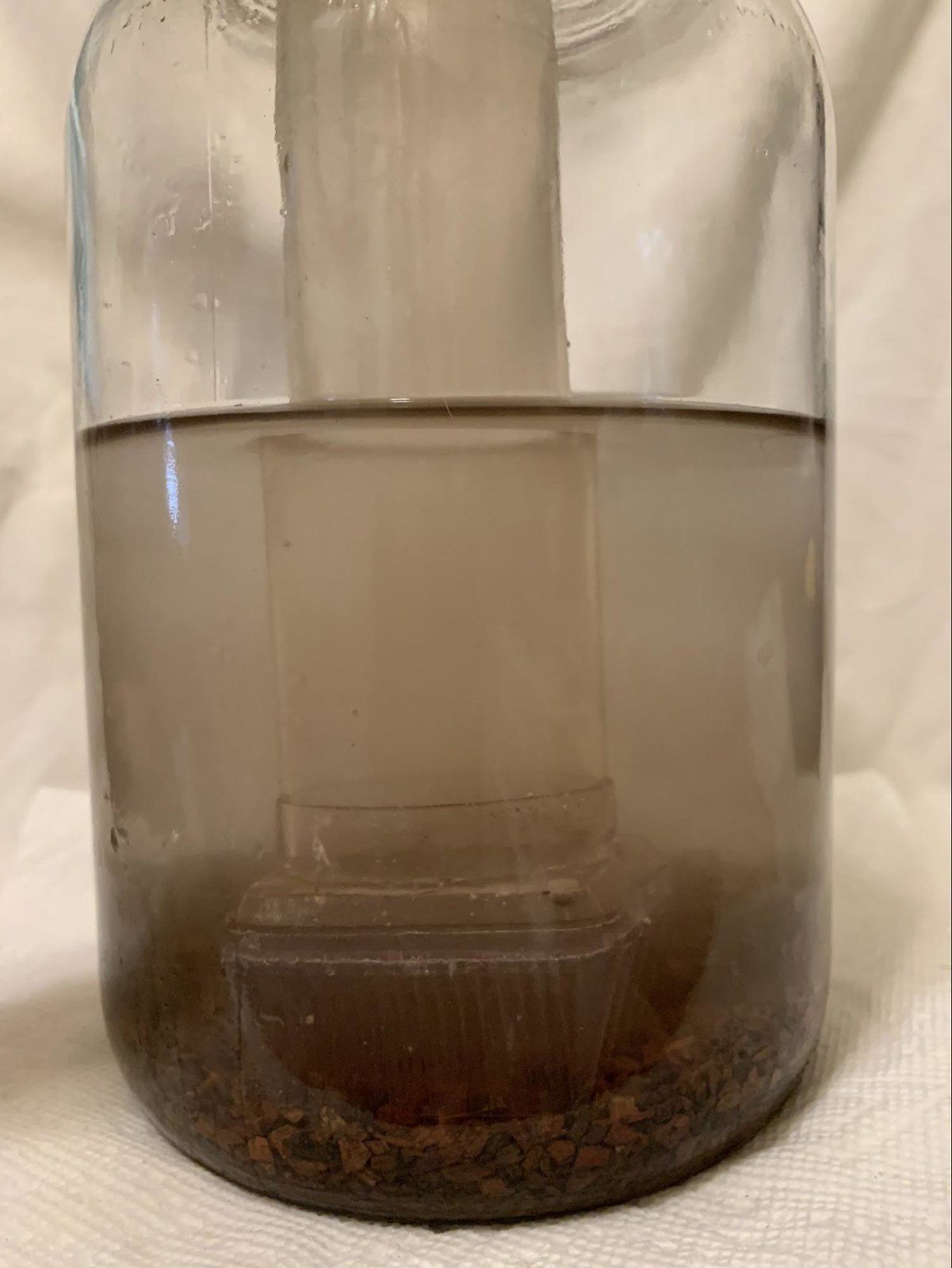
The extreme case is old tank syndrome. Merck ties it to small, infrequent water changes, and sometimes to just topping off what evaporates 7. Over time the filter bacteria use up the water’s buffering and make it acidic. You end up with very low pH, usually under 6, and total ammonia that can top 20 mg/L 6. Aquarium Science adds that it takes both a pH under 6.5 with alkalinity under 1 dKH and nitrate well over 200 ppm 5. It’s rare. It’s also the one case where a big change can backfire.
Can you change too much water?
Usually not, as long as the new water is treated and close in temperature. Your filter bacteria live as a film on the filter, gravel and glass, not in the water 17, so a big change doesn’t wash them out. Aquarium Science calls the idea that 40 to 95% changes kill fish a myth. The author says fish only showed stress hormones with huge jumps, like 80 °F to 60 °F (27 °C to 16 °C) or pH 8.0 to 6.0 4 5.
Merck is more careful about temperature. Its general rule is no more than 1 °F, or even 1 °C, of change per hour 6. Check both waters with a thermometer and get them within a degree or two. That keeps you inside both rules.
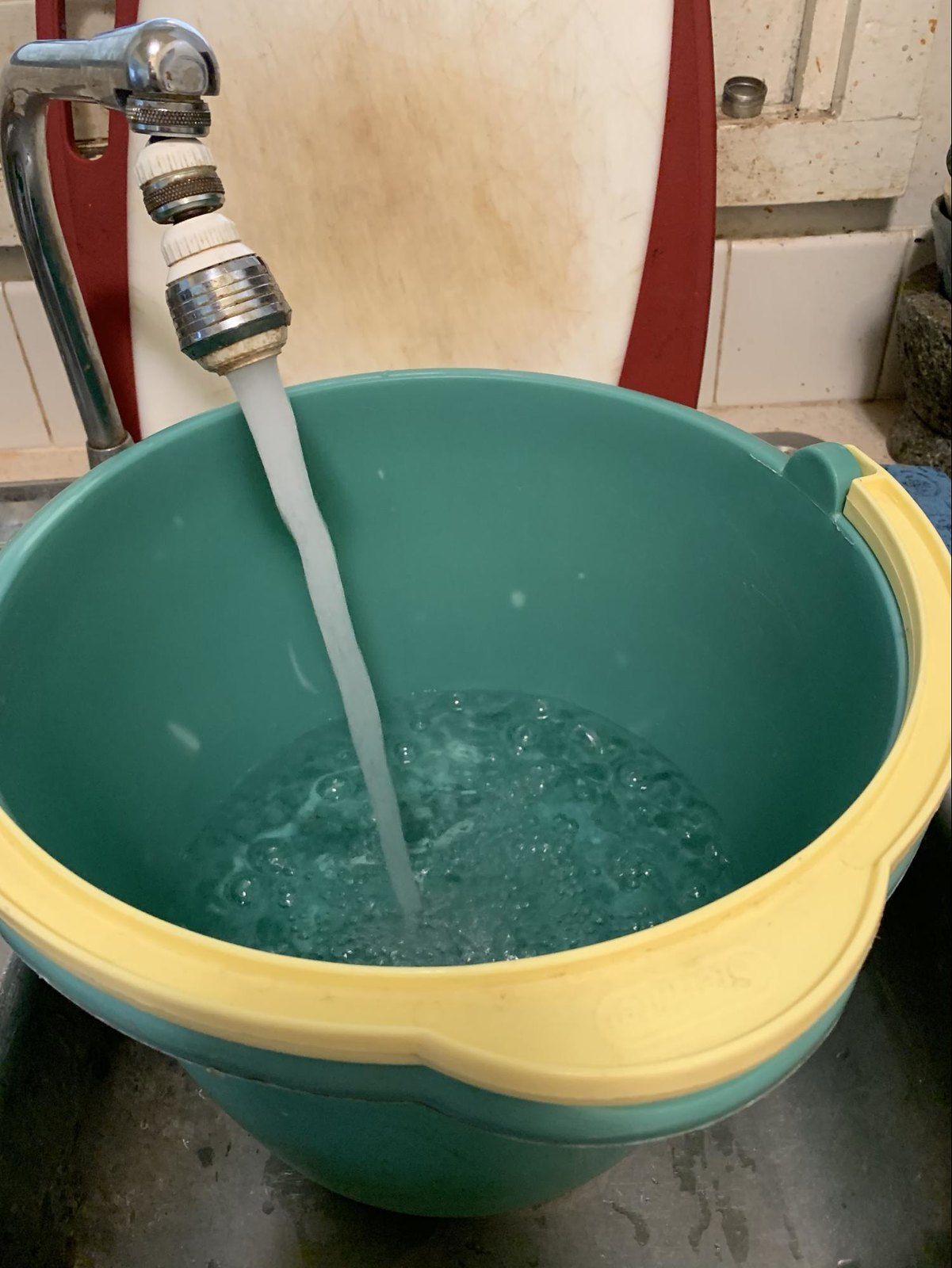
Chlorine and chloramine are both highly toxic to fish. Chlorine causes harm from 0.02 mg/L and deaths at 0.04 mg/L.
Dechlorinator in every bucket.
Raising the pH turns more of the ammonia into its toxic form. Large changes fix the problem, but neutralize the ammonia with an over-the-counter product first.
Total ammonia over 5 mg/L and pH under 7? Move the fish to clean water matched for pH and temperature instead.
It can hold almost no oxygen.
Change 25% at most, or aerate the new water for 24 hours first.
Special cases
Cycling a new tank. In a fishless cycle you don’t need routine changes. Dr. Tim’s recipe only calls for 25 to 30% if pH drops below 7 8. Once the tank passes the 24-hour ammonia test, change water before the fish go in. Aquarium Science suggests 50% if nitrate is over 80 ppm and 80% at 160 ppm 9. After that, Dr. Tim’s chart has a 25% change on day 14 and every two weeks 8. Cycling with fish in the tank is different. You’ll need water changes to keep ammonia and nitrite down until the filter catches up 17.
After a cloudy bloom. Hold off. Changing water during a cycling bloom tends to drag it out 10. If ammonia is climbing with fish in the tank, change water anyway. Cloudy aquarium water walks through it.
When you medicate. The label wins. For example, Hikari’s directions for Ich-X call for changing at least a third of the water before the first dose and 10 to 25% before each repeat dose, with carbon taken out of the filter 11. Other medicines have their own rules, so read yours.
Before a vacation. The admin of FishLore suggests a partial change right before you leave. According to that guide, fish are fine without food for a week, but more than two weeks with nobody checking is risky 12. We’d do it two or three days early, so if anything goes wrong you’re still home to see it. For how long fish can go unfed and how to set up a feeder or sitter, see our guide to leaving fish for a trip.
How to do it right
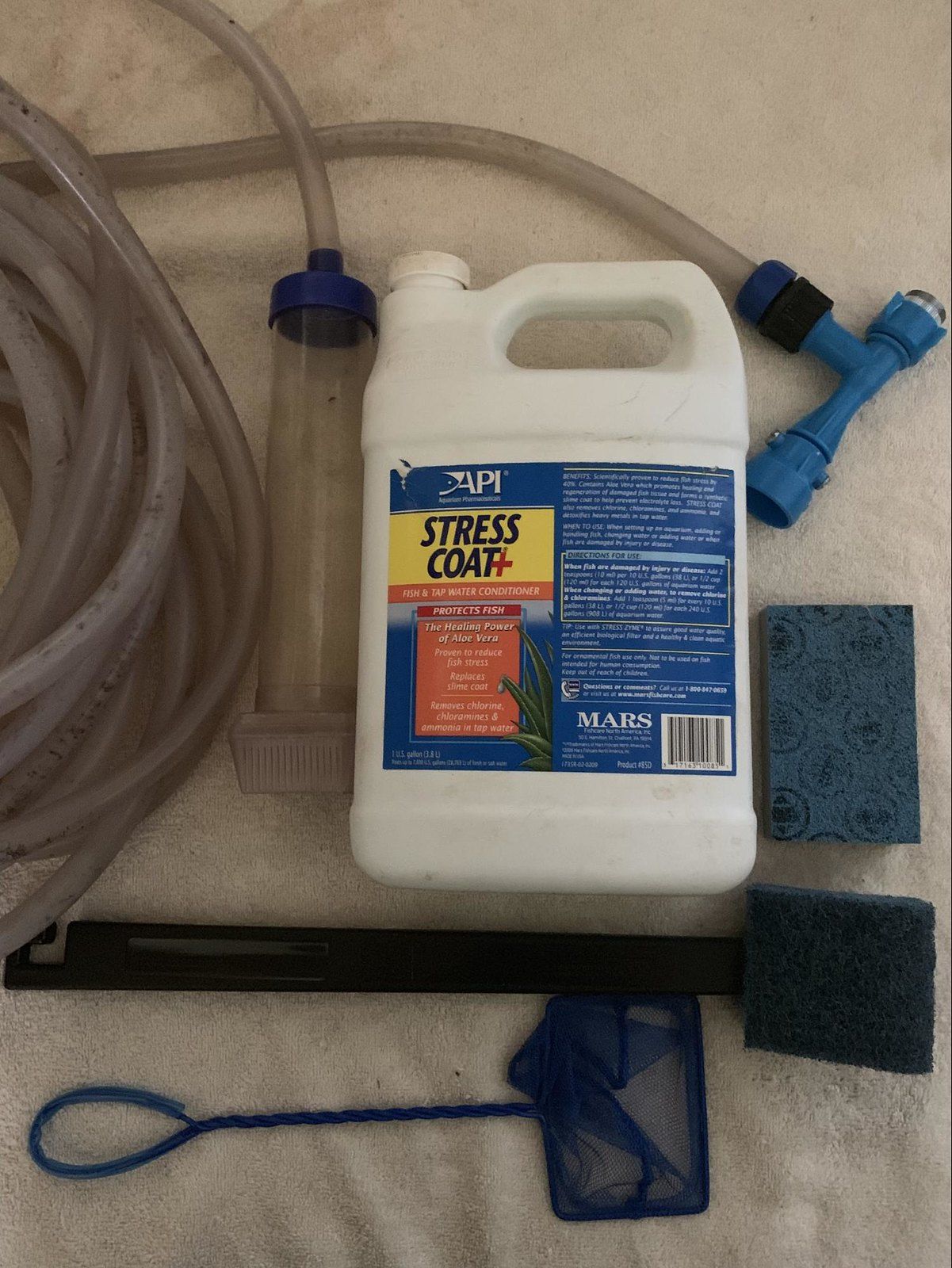
- Siphon the gravel. Push the gravel vacuum into the substrate and let it pull out waste and old food as you drain 1.
- Treat the new water. Add a conditioner that handles both chlorine and chloramine 1. Our chlorine and chloramine guide has dosing by water-change size. Letting tap water sit only helps with plain chlorine, which clears in a few days. Chloramine can take weeks 13. Check your bottle for how to dose. Seachem, for its Prime, says to dose for the new water you’re adding, not the whole tank 14. If ammonia shows up after your changes, test the tap.
- Match the temperature. Use a thermometer, not your hand, and stay within the 1 °F per hour rule above 6.
- Leave the filter alone for now. Our tank cleaning guide covers the rest of the job. When the filter does need cleaning, swish the media lightly in a bucket of old tank water, never under the tap 1 15. Clean it only partly, about every two to four months in a normally stocked tank. A thorough scrub can cause an ammonia spike 15.
On timing, keepers disagree. In one FishLore thread, members rinse filter media in tank water during their weekly change and report no mini-cycles. One who runs two filters on bigger tanks never deep-cleans both in the same session 16. In a tank under a few months old, we’d clean the filter a week apart from a big change. If something goes wrong, you’ll know which job caused it.
FAQ
How often should I change the water in my aquarium? For most beginner tanks, 10 to 25% once a week, siphoning the gravel as you drain 1. Aquarium Science argues most people change far more than they need to, and suggests 50% every one to three months for most tanks 4.
How much water can I change at once? A bowl or a small betta tank needs bigger changes, as much as 50% a week 2. Aquarium Science calls the idea that 40 to 95% changes kill fish a myth 4,5.
What nitrate level means I should change water? The Merck Veterinary Manual’s reference range for freshwater is under 20 mg/L 3. Aquarium Science is looser: it recommends staying under 80 ppm 5 and calls for a 50% change at 80 ppm or more 4.
Does the new water need to match the tank’s temperature? Yes. Merck’s general rule is no more than 1 °F, or even 1 °C, of change per hour 6. Check both waters with a thermometer.
Can I just let tap water sit instead of using a dechlorinator? Only for plain chlorine, which clears in a few days. Chloramine can take weeks 13, so use a conditioner that handles both 1.
Do I need water changes while cycling a tank? Not in a fishless cycle. Dr. Tim’s recipe only calls for 25 to 30% if pH drops below 7 8. With fish in the tank you’ll need changes to keep ammonia and nitrite down until the filter catches up 17.
All the numbers, with sources
| What | Value | Type | Source |
|---|---|---|---|
| Routine change, established tank | 10–25% weekly, with a gravel clean | Stated by source | [1] |
| Small tanks, bowls and betta tanks | Up to 50% per week | Stated by source | [2] |
| Nitrate reference range, freshwater | Under 20 mg/L (ppm) | Stated by source | [3] |
| Nitrate that calls for a water change (Aquarium Science) | 50% change at 80 ppm or higher | Stated by source | [4] |
| Stocking-based schedule (Aquarium Science) | Over 50% every 2 weeks if very heavily stocked; every 6 weeks moderate; every 5 months light | Stated by source | [4] |
| Nitrate adult fish handle with no long-term effects (Aquarium Science 18.1.1; its page 5.4 is less relaxed) | At least 160 ppm | Stated by source | [5] |
| Nitrate settles at, 10 ppm/week added, 25% weekly change | 30–40 ppm | Our calculation | [4] |
| Nitrate removed by two 25% changes vs one 50% | About 44% vs 50% | Our calculation | [4] |
| Maximum temperature change (Merck general rule) | 1 °F (or 1 °C) per hour | Stated by source | [6] |
| Chlorine that harms fish / kills fish | 0.02 mg/L / 0.04 mg/L | Stated by source | [6] |
| Old tank syndrome water | pH usually under 6, total ammonia can top 20 mg/L | Stated by source | [6] |
| Well water change without aerating first | 25% at most (or aerate 24 hours) | Stated by source | [5] |
| Fishless cycle, pH below 7 | Change 25–30% | Stated by source | [8] |
| After cycling (Dr. Tim's chart) | 25% on day 14, then every 2 weeks | Stated by source | [8] |
| Before adding fish, if nitrate built up | 50% at over 80 ppm; 80% at 160 ppm | Stated by source | [9] |
| Ich-X label: before first dose / before each repeat dose | At least 1/3 / 10–25% | Stated by source | [11] |
| Filter cleaning, normally stocked tank | Every 2–4 months, partial only | Stated by source | [15] |
| Monochloramine left standing in a bucket | May take weeks to dissipate | Stated by source | [13] |
Sources
- RSPCA Australia Knowledgebase (n.d.). Why is water quality important when setting up a fish aquarium?
- Merck Veterinary Manual (Pet Owner Version) (2026). Providing a Home for Fish
- Merck Veterinary Manual (2026). Table: "Normal" Reference Ranges for Routine Water Quality Analysis
- Aquarium Science (aquariumscience.org) (2026). 18.1. Aquarium Water Changes
- Aquarium Science (aquariumscience.org) (2026). 18.1.1. Water Changes in Depth
- Merck Veterinary Manual (2026). Environmental Diseases of Aquatic Animals in Aquatic Systems
- Merck Veterinary Manual (2026). Management of Aquarium Fish
- DrTim's Aquatics (2023). Prescription for Fishless Cycling a New Aquarium (PDF)
- Aquarium Science (aquariumscience.org) (2026). 2.1. Fish-less Cycling
- Aquarium Science (aquariumscience.org) (2026). 6.2.3. Cloudy Water
- Hikari USA (n.d.). Aquarium Solutions Ich-X product data sheet (PDF)
- FishLore (Mike, site admin) (2019). Aquarium Fish Care While On Vacation
- Tampa Bay Water (n.d.). Monochloramine Information for Pet Stores and Fish Aquarium Owners
- Seachem Laboratories (2026). Prime (product page and directions)
- Aquarium Science (aquariumscience.org) (2026). 18.4. Cleaning a Filter
- FishLore Aquarium Forum (n.d.). Water changes and filter maintenance on the same day? (forum thread)
- DeLong DP, Losordo TM, Southern Regional Aquaculture Center (2012). How to Start a Biofilter (SRAC Publication No. 4502)
- Aquarium Science (aquariumscience.org) (2026). 16.7. Aquarium Green Water
- Aquarium Science (aquariumscience.org, one hobbyist author) (n.d.). 5.4. Safe Nitrate Levels in the Aquarium