Algae in a Fish Tank: Identify It by Color, Then Fix the Cause
Last reviewed · By Manel Vadillo
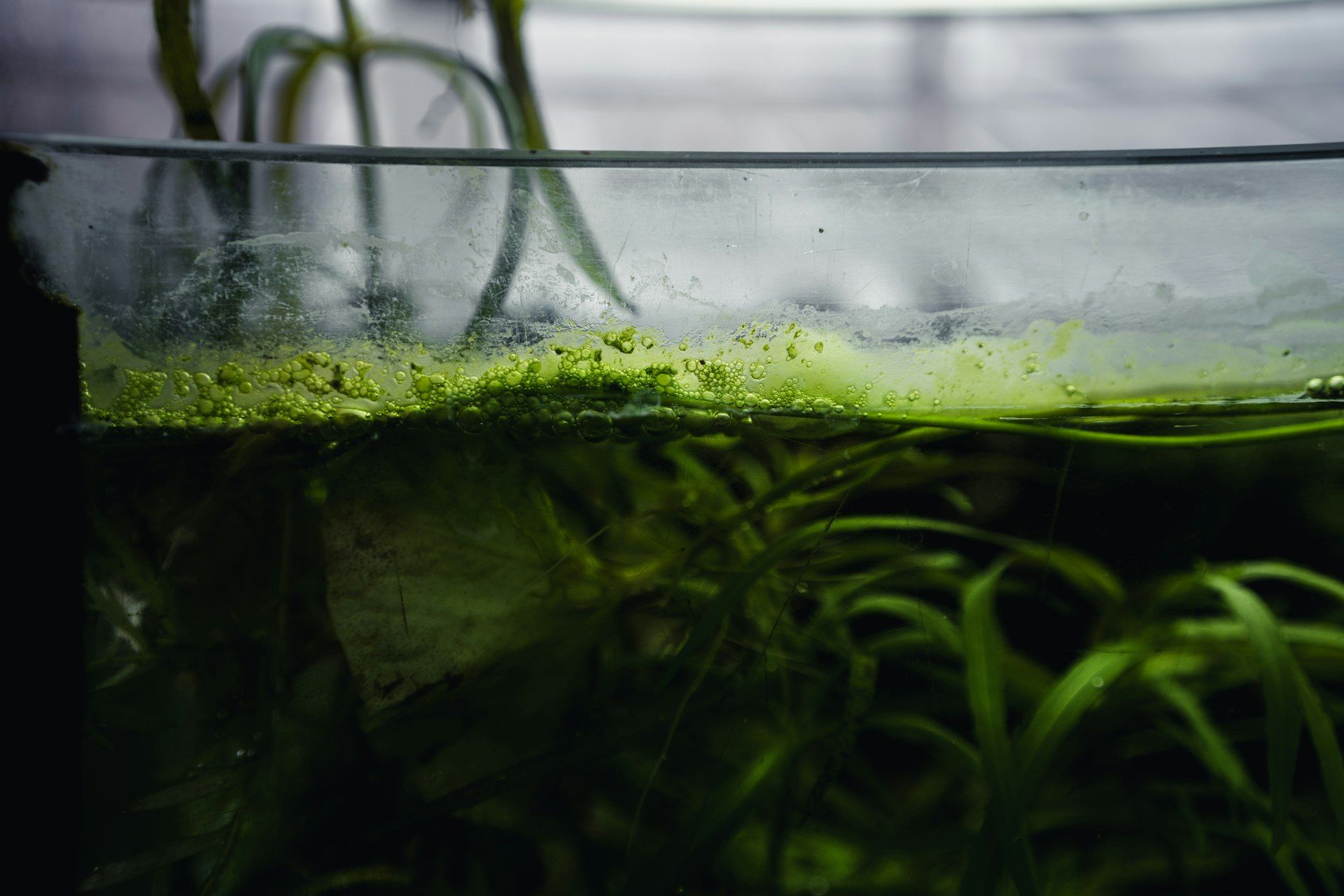
Some algae shows up in every tank that has a light on it. That part is normal. What you want to know is which kind you have, because a green film on the glass and a slimy blue-green sheet over the gravel have different causes and different fixes.
Quick answer
Most fish tank algae is harmless to fish and points to too much light or too many nutrients. Identify it first by color and texture, then cut the light, feed less, keep up water changes and scrape it off. Slimy blue-green sheets are bacteria, not algae, and green water needs care with oxygen.
What kind of algae is in my fish tank?
Start with what you see, not with a product. Color, texture and where it grows narrow it down fast. Tap a card to jump to its section or guide.
One warning before the table. Aquarium Science, a hobbyist site written by David Bogert, which we cite a lot below, says there are thousands of algae species and that sorting them into “types” is very inaccurate 2. Two tanks with the same “hair algae” can react differently to the same fix. Treat the names as a way to pick a first move.
| What you see | Probably | Usual driver | First thing to try |
|---|---|---|---|
| Green film or hard green dots on the glass | Green spot algae 4 | Light; heavy growth points to phosphorus and nitrate 4 | Scrape it. Check nitrate |
| Brown dust that wipes off, in a new tank | Diatoms | A tank that is still settling in | See our brown algae guide |
| The water itself is green | Free-floating algae 11 | Too many nutrients 11 | See our green water guide |
| Green threads or hair on plants and decor | Thread algae 5 | Varies by species 5 | Pull it out, change water more often 11 |
| Dark, soft tufts that cling to leaf edges and wood | Black beard algae 6 | High nitrate, phosphate or iron 6 | Heavy water changes 6 |
| Coarse gray-green strands like antlers | Staghorn algae 7 | High nitrate or iron 7 | Same as black beard |
| Slimy sheet that peels off, often blue-green | Cyanobacteria 8 | Low flow, warm water, phosphate, low oxygen 8 | More flow and big changes 8, less food 11 |
| White cotton on new wood or leftover food | Water mold, not algae 12 | Uneaten food, wood and other organics 12 | Feed less, remove the food |
Green film and green spot algae
This is the one on your front glass. Aquarium Science says green spot algae is found in every aquarium and grows slowly with almost no nutrients, so the only way to keep it out completely is to leave the lights off. It’s also easy to clean because it doesn’t cling the way red algae do. If it gets heavy, look at your phosphorus and nitrate levels 4.
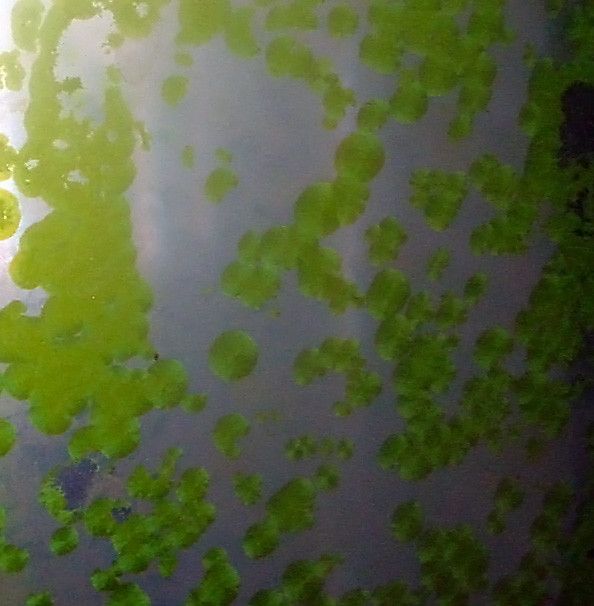
We’d call this maintenance, not a problem. A scraper once a week and you’re done.
Hair and thread algae
Long green strands that wrap around plants and carpet the decor. Aquarium Science says thread algae is usually, but not always, a filamentous green algae, and that controlling it is “a guessing game” because each species reacts to different things 5. Tropica’s treatment is more frequent water changes plus a large group of Amano shrimp, up to 2 shrimp per 1.3 gallons (5 liters) for a while, and it advises against chemicals for thread algae 11.
Twirl it out with an old toothbrush or a bamboo skewer before anything else. It comes out in long ropes. Our hair algae guide has the full step-by-step plan, including how temperature plays in.
One note: much of what you’ll read online about hair algae is written for saltwater reef tanks. This guide is freshwater only.
Black beard algae (BBA)
Dark, almost black tufts on leaf edges, driftwood and filter intakes. It feels soft and slippery but clings hard, and Aquarium Science says it can’t easily be removed by hand. Despite the color it’s a red algae. There’s an easy check: put a piece in rubbing alcohol and it turns reddish 6.
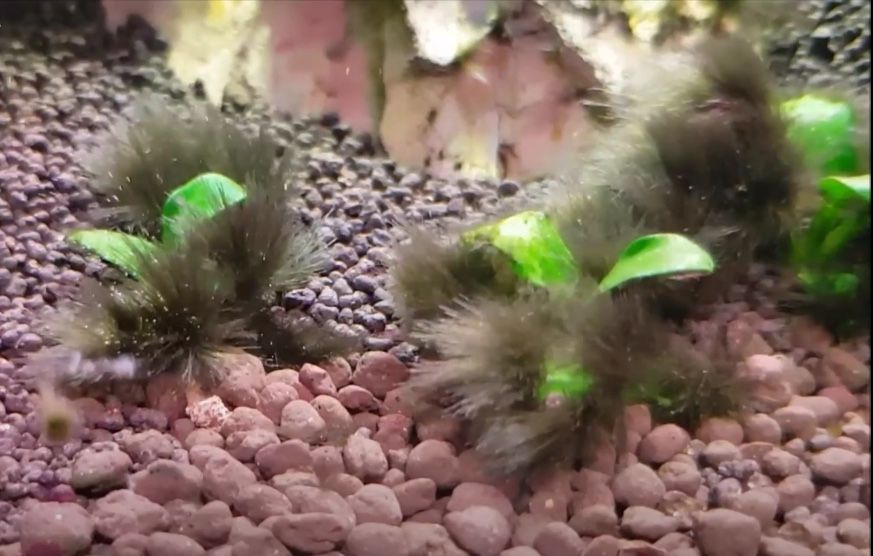
It generally comes with high nitrates, high phosphates or high iron, and heavy water changes can often control it 6. Staghorn algae is a close cousin, with coarser gray-green strands that can reach six inches or more. Beginners often mistake green staghorn for Java moss 7.
Blue-green algae (cyanobacteria)
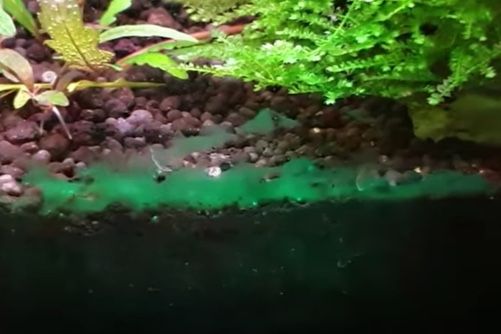
This one is not algae at all. It’s a bacteria, usually blue-green but sometimes yellow-green, reddish brown or purple, and it often (not always) has a smell 8. It grows as slimy sheets over substrate, plants and glass, and it lifts off in one piece when you pull at it.
Aquarium Science lists four usual causes: low water movement, high water temperature, high phosphates and low oxygen. Its fix targets all four: more flow, a cooler tank (staying within your fish’s range), large water changes and choppy water at the surface. It says you often need all four 8. Tropica adds that it usually appears with heavy feeding and fades when you feed less 11.
The types of cyanobacteria found in aquariums don’t produce toxins and are safe with fish, according to the same page 8. We’d still treat it as a sign that something in your tank is off, and fix the flow and the feeding.
Brown algae and green water
Both have their own pages, so we’ll keep this short. A brown, dusty film in a tank that’s a few weeks old is usually diatoms, and the sources disagree on how long it lasts. Our brown algae in a new tank guide covers it. If the water itself turns pea green, you have a bloom of floating algae. Our green water guide compares blackouts, UV and water changes, and our cloudy water guide explains why a bloom makes oxygen swing between day and night.
It’s not always algae
White cotton on new driftwood or on a pellet nobody ate is usually water mold. Aquarium Science says the mold itself is harmless, but the carbohydrates it feeds on are not, because they also feed bacteria that can make fish sick 12. So remove the food and feed less.
Tiny snails that seem to arrive on their own aren’t algae either, but they do eat it. Our pest snails guide covers them.
Is algae in a fish tank bad?
Mostly no. Susan Horton, a vet at Chicago Exotics Animal Hospital, writes that algae is not harmful to an aquarium and is mostly considered unsightly 1. Aquarium Science goes further: in a fish-only tank some algae is simply inevitable, and its author’s advice is to pick decor that looks good with a brown and green film on it 2.
The real risks are indirect. Thread algae grows over plants and decor in carpet-like layers 5. Green water makes oxygen swing between day and night, which our cloudy water guide explains. And the treatments can be worse than the algae, as you’ll see below.
Why does my tank suddenly have so much algae?
Algae needs light and food. A sudden outbreak usually means one of them changed.
Light. Horton says green algae starts to show when a tank gets more than 10 hours of light a day, and that room light counts too 1. Aquarium Science says fish-only tanks with sunlight from a window, even indirect, typically have big problems with algae 3. If the tank moved, the light got brighter or someone leaves it on overnight, start there. Our aquarium light hours guide shows how to set a timer and step it down.
Food and waste. Horton names nitrates from skipped water changes, and phosphates 1. Aquarium Science says severe outbreaks in established fish-only tanks are most often caused by excess phosphorus, from overfeeding, too few water changes, pH-lowering products (most are phosphates) and phosphorus in the tap water 3. If you test, test the tap water too.
Heat. Warm water speeds algae up, according to Horton 1. Aquarium Science says blue-green algae outbreaks almost always occur in tanks over 80 °F (27 °C), and puts the ideal for plants and fish at about 76 to 79 °F (24 to 26 °C) 3.
A new tank. In a tank that’s only weeks or a few months old, a brown dusty film or a green water bloom is part of settling in. Both pages explain why patience beats products there.
How to get rid of algae in a fish tank
Scrape off what you can, cut the light, lower nutrients with water changes and lighter feeding, then add plants or algae eaters. Chemicals come last, if at all.
Work through these in order. Change one thing at a time so you can tell what worked. The Aquarium Science author suggests giving each change two to six weeks 3.
1. Scrape and siphon it out
Use an algae scraper or pad on the glass, then siphon the loose bits out during your water change. Horton warns not to use anything from the supermarket on your tank, because it may contain soap, which she calls deadly to fish 1. Keep a sponge just for the tank. Our fish tank cleaning guide covers the order of jobs.
2. Cut the light
Put the light on a timer. Horton’s ceiling is 10 hours a day and no direct sun 1. We’d start at 6 to 8 hours; our light hours guide explains why. In a tank with no live plants, Aquarium Science suggests going further and switching the light on only when you want to watch or feed the fish 3.
3. Lower the nutrients
Feed only what the fish finish, and change water on a schedule. Horton recommends a third of the water every two weeks for an established tank 1. Our water change guide explains how to set your schedule from a nitrate test.
For a severe outbreak in a tank with only fish, Aquarium Science’s method is much bigger: six to eight 50% water changes over two days 3. Its author says large changes don’t shock fish, and that most deaths during water changes come from a chlorine pulse on city water or low oxygen on well water 3. So dechlorinate, match the temperature, and aerate well water first. One more check: if the tank hasn’t had a water change in months, test pH and nitrate before any big change. A very acidic tank with very high nitrate is the one case where a big change can backfire, as our water change guide explains. We’d try regular changes for a few weeks before going that far.
Don’t expect to starve algae out completely. Aquarium Science calculates that you’d need phosphorus below 0.050 ppm to stop all algae in a fish-only tank, which it calls virtually impossible because all fish food contains phosphate 3. You can keep it under control, not wipe it out.
4. Add plants or algae eaters, if the tank suits them
Live plants compete with algae for the same nutrients, Horton says 1. If you’ve never kept plants, Aquarium Science names a few that live under almost any conditions, with low light and no fertilizer: anubias, Amazon sword, Java fern and Java moss. Don’t bury the anubias rhizome in the substrate 2. Algae eaters help too, and get their own section below.
5. Chemicals and blackouts: last resort
We’d skip algaecides. Aquarium Science says every chemical that kills algae, except antibiotics used for cyanobacteria, can also kill fish and plants 2. It names several popular algae removers that share the same active ingredient and collects reports of whole tanks lost, some at the label dose. He usually avoids anecdotes but makes an exception here 10. Even when they work, the algae comes back in a week or two if the cause isn’t fixed 10.
Horton’s clinic doesn’t recommend chemicals either. It says they can stop some algae from starting but won’t get rid of algae that’s already growing 1. If you keep shrimp, also note that many algae treatments contain copper. Our cherry shrimp guide explains why that matters.
A blackout is for green water, not for algae stuck to surfaces. Read the oxygen warning in our green water guide before you try one.
Will algae go away on its own?
Some types will. The brown dust in a new tank fades as the tank matures, and green water in a new tank often clears with time (our brown algae and green water guides have the timelines). Green spot algae won’t. It grows in every tank with a light, so plan on scraping 4. We found no source saying black beard algae clears up without a change to the water.
Algae eaters: which one for which algae
Algae eaters are the fix most people buy first, and often the wrong one. Aquarium Science calls them a very good tool, but also says there’s no way to predict which fish will eat which algae, because some algae produce chemicals that fish won’t touch 9. With that caveat, here’s what our sources say about each.
| Algae eater | Adult size | What to know |
|---|---|---|
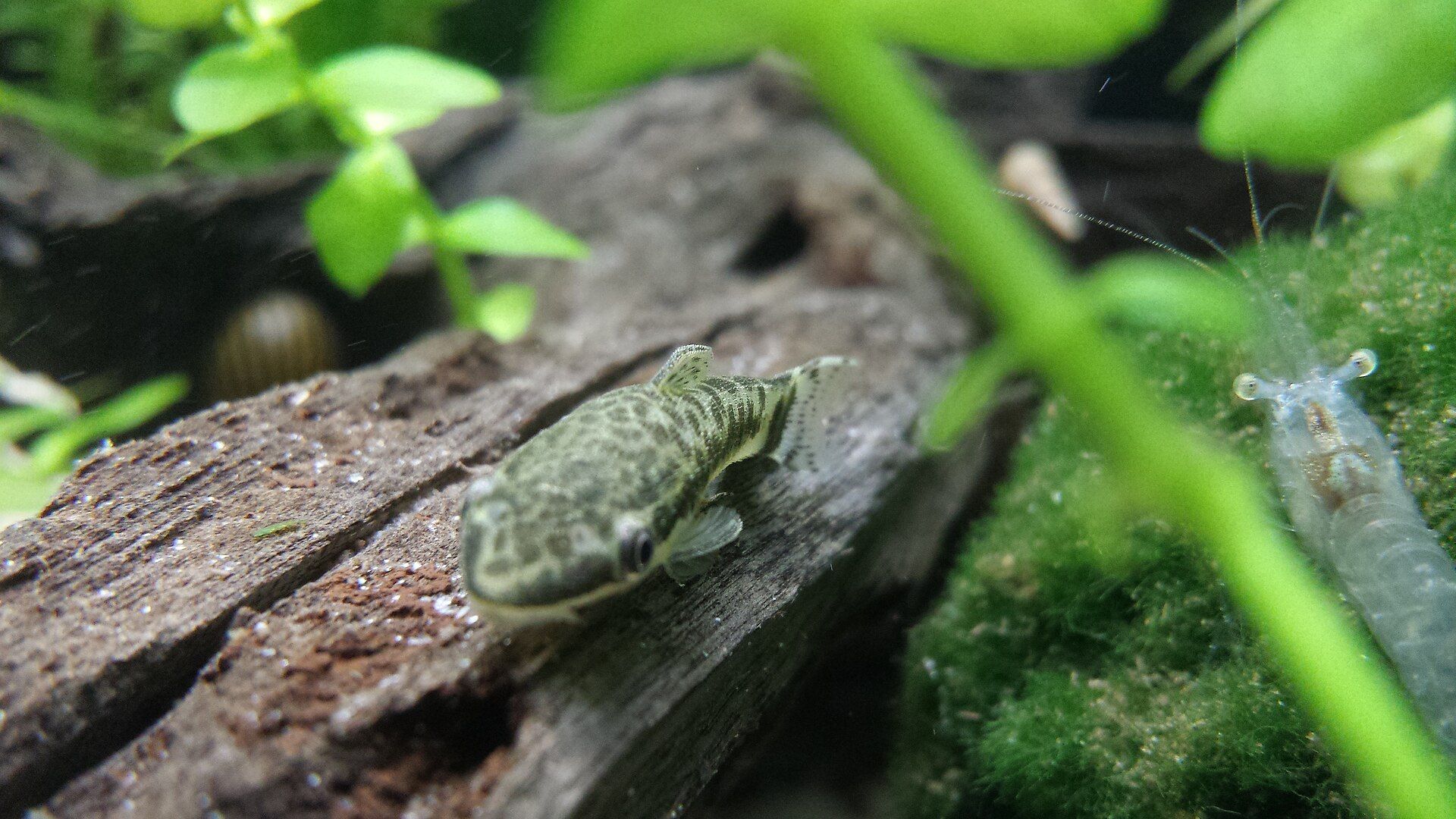
| Otocinclus | Small | Groups of at least six, very clean and well-aerated water 9. Our reading: not for a tank that’s still cycling |
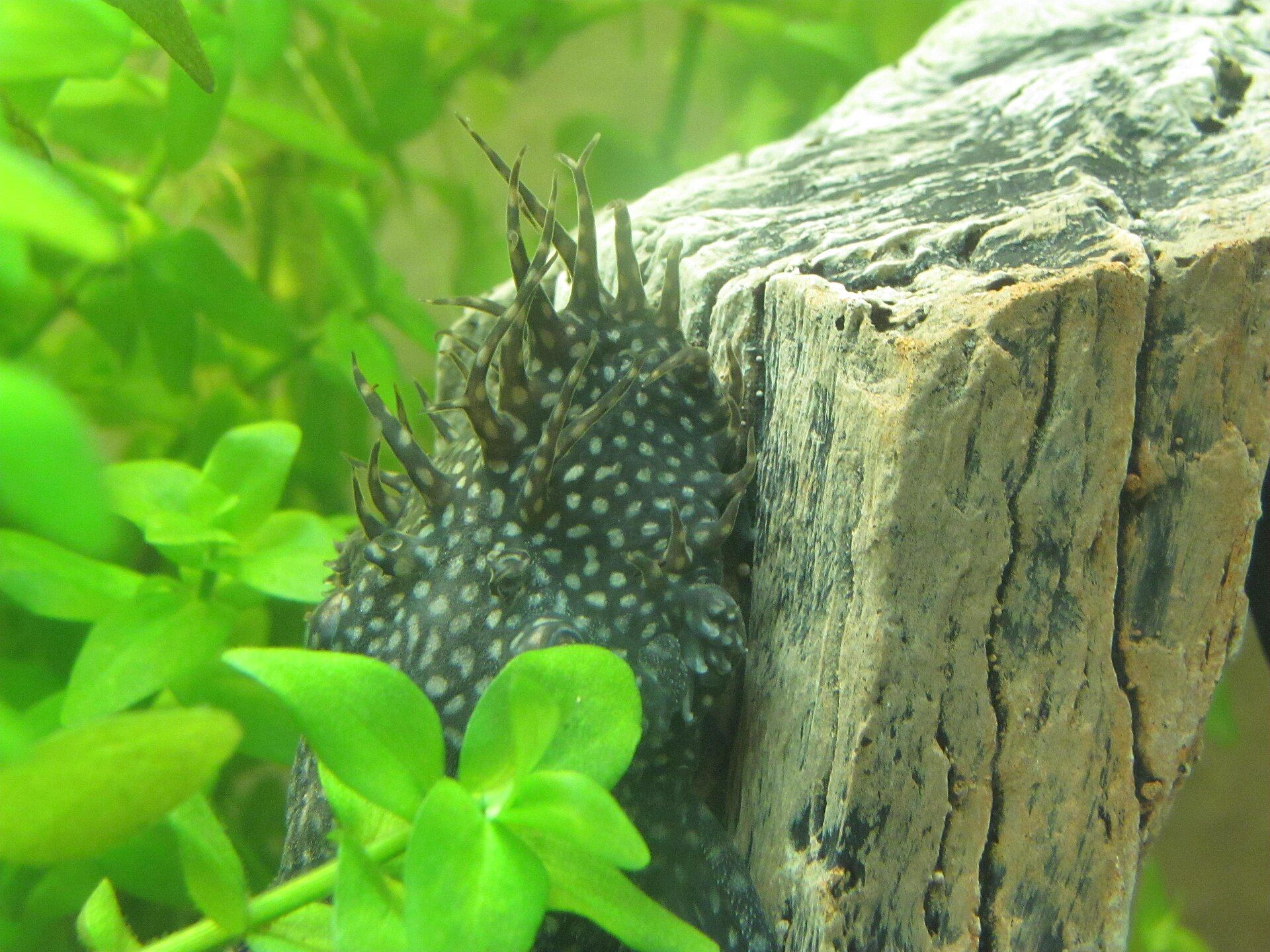
| Bristlenose pleco | About 5–6 in (13–15 cm) | Peaceful, comes out at night 9 |
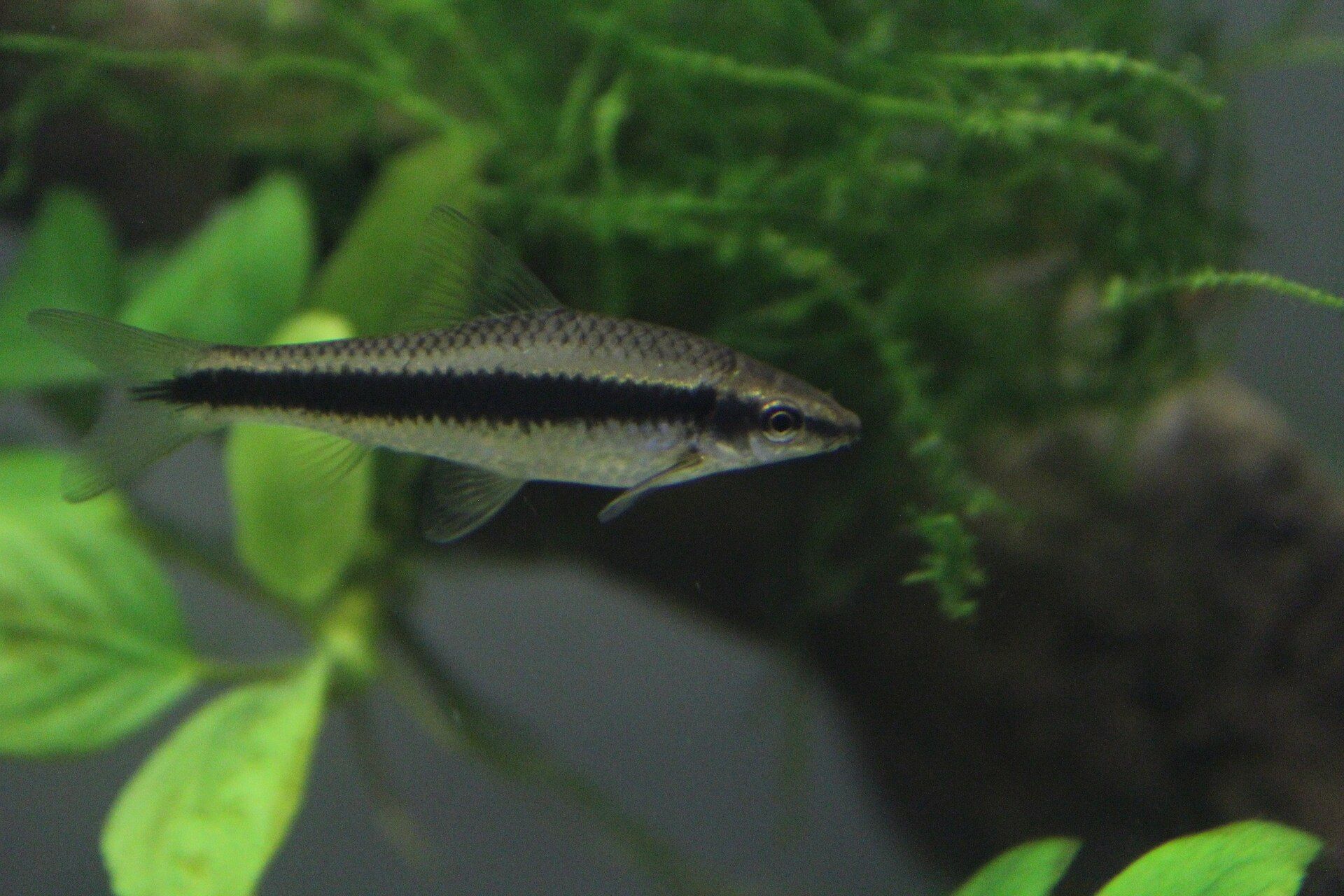
| Siamese algae eater | About 5–6 in (13–15 cm) | Keep one adult, or five or more in a large tank. Two to four can fight 9 |
| Nerite snail | Small | Eats a lot of algae and doesn’t breed in fresh water, but leaves white eggs on hard surfaces 9 |
| Amano shrimp | Small | Tropica’s pick for thread algae 11. Big fish will eat shrimp 9 |
Two to avoid, according to Aquarium Science. The common pleco reaches two feet (61 cm) over several years 9, so it doesn’t belong in most home tanks. The Chinese algae eater (Gyrinocheilus aymonieri) gets aggressive as an adult and stops eating algae once it passes about three inches 9. Flying foxes are often sold as Siamese algae eaters. You can tell them apart because the flying fox’s black stripe doesn’t run into the tail 9.
Fish are not a cleaning service, either. Each one adds waste, and that waste feeds algae. Check your stocking with our how many fish guide before you add a cleanup crew.
What not to use
- Dish soap or household cleaners, inside the tank or on anything that goes in it. Horton calls soap deadly to fish 1.
- Bleach or hydrogen peroxide in a tank with fish. Aquarium Science says hydrogen peroxide is not harmless to fish and can burn their gills 10.
- Algaecides as a first step. See above. They treat the symptom for a week or two 10.
- Antibiotics. Aquarium Science says they work on cyanobacteria only, the effect is temporary, and they can kill the bacteria in your filter and spike ammonia and nitrite 8. We wouldn’t use them in a beginner tank.
FAQ
Will algae go away on its own in an aquarium? Some does. Brown diatoms and green water in a new tank often fade as it matures; our guides to each give the timelines. Green spot algae on the glass keeps coming back as long as the light is on 4.
Is it bad to have algae in your fish tank? Usually not for the fish. Chicago Exotics says algae is not harmful and is mostly a looks problem 1. Watch for green water and for cyanobacteria, which point to a bigger imbalance.
Will algae in my tank kill my fish? The algae itself is not the danger. Chicago Exotics says algae is not harmful to an aquarium 1. The risks are indirect: green water swings oxygen between day and night (our cloudy water guide explains why), and algae killers can harm fish 10.
Do water changes kill algae? They don’t kill it, but they remove the nitrate and phosphate it feeds on. Horton recommends a third every two weeks 1, and Aquarium Science says heavy water changes can often control black beard algae 6.
Does Dawn dish soap kill algae? Never use it in or on anything that goes in your tank. Chicago Exotics warns that soap is deadly to fish 1. Use a scraper or a sponge that has only ever touched the tank.
Do LED lights cause more algae in an aquarium? Our sources point to hours and sunlight, not the type of bulb 1 3. Aquarium Science does say brown algae loves blue light, so a fixture that pairs only blue and white LEDs can be a problem, while white, crimson and blue together don’t seem to have the same issue 3. If you upgraded to a brighter light and algae followed, turn the hours down first.
What eats black beard algae? No algae eater is a sure thing 9. Aquarium Science names the Siamese algae eater among the best all-round algae eaters 9, but its answer for black beard algae is heavy water changes 6.
Will otocinclus eat green spot algae? Aquarium Science lists algae-eating catfish among the tools for green spot algae 4, but we found no source that tests otocinclus on it specifically. They’re also delicate: at least six of them, in clean, well-aerated water 9. For spots on the glass, a scraper is the quicker fix.
The short version
Fish tank algae is a symptom. Find the type, then look at what changed: hours of light, sunlight, feeding, water changes or temperature. Fix that, scrape what’s there, and give it a few weeks before you reach for a bottle.
All the numbers, with sources
| What | Value | Type | Source |
|---|---|---|---|
| Chicago Exotics (vet): light per day when green algae starts to show | More than 10 hours | Stated by source | [1] |
| Chicago Exotics: water change for an established tank | 1/3 every 2 weeks | Stated by source | [1] |
| Aquarium Science: phosphorus level that would stop all algae in a fish-only tank | Below 0.050 ppm ("virtually impossible", since all fish food has phosphate) | Stated by source | [3] |
| Aquarium Science: severe outbreak in a fish-only tank | Six to eight 50% water changes over two days | Stated by source | [3] |
| Aquarium Science: blue-green algae outbreaks almost always occur above | 80 °F (27 °C) | Stated by source | [3] |
| Aquarium Science: ideal temperature for plants and fish | About 76–79 °F (24–26 °C) | Stated by source | [3] |
| Tropica: Amano shrimp for thread algae, for a transitional period | Up to 2 shrimp per 1.3 gal (5 L) | Stated by source | [11] |
| Aquarium Science: adult size of Siamese algae eater, flying fox and bristlenose pleco | About 5–6 in (13–15 cm) | Stated by source | [9] |
| Aquarium Science: adult size of a common pleco | Up to 2 ft (61 cm), over several years | Stated by source | [9] |
| Aquarium Science: otocinclus group size | At least 6 | Stated by source | [9] |
| Aquarium Science: how soon algae returns after a chemical treatment if the cause isn't fixed | A week or two | Stated by source | [10] |
Sources
- Chicago Exotics Animal Hospital (Susan Horton, DVM) (n.d.). Algae in your Freshwater Aquarium
- Aquarium Science (aquariumscience.org, David Bogert) (n.d.). 16.2. Controlling Algae
- Aquarium Science (aquariumscience.org, David Bogert) (n.d.). 16.2.1. Controlling Algae in a Fish Only Aquarium
- Aquarium Science (aquariumscience.org, David Bogert) (n.d.). 16.9. Green Spot Algae
- Aquarium Science (aquariumscience.org, David Bogert) (n.d.). 16.3. Thread Algae
- Aquarium Science (aquariumscience.org, David Bogert) (n.d.). 16.5. Black Beard Algae
- Aquarium Science (aquariumscience.org, David Bogert) (n.d.). 16.6. Staghorn Algae
- Aquarium Science (aquariumscience.org, David Bogert) (n.d.). 16.4. Blue-Green Algae
- Aquarium Science (aquariumscience.org, David Bogert) (n.d.). 16.2.4. Algae Eaters
- Aquarium Science (aquariumscience.org, David Bogert) (n.d.). 16.2.6. Chemical Algae Control
- Tropica Aquarium Plants (plant grower) (n.d.). Types of algae
- Aquarium Science (aquariumscience.org, David Bogert) (n.d.). 16.10.1. White Fuzz