Cherry Shrimp Care: Water, Copper and Which Fish Are Safe
Last reviewed · By Manel Vadillo
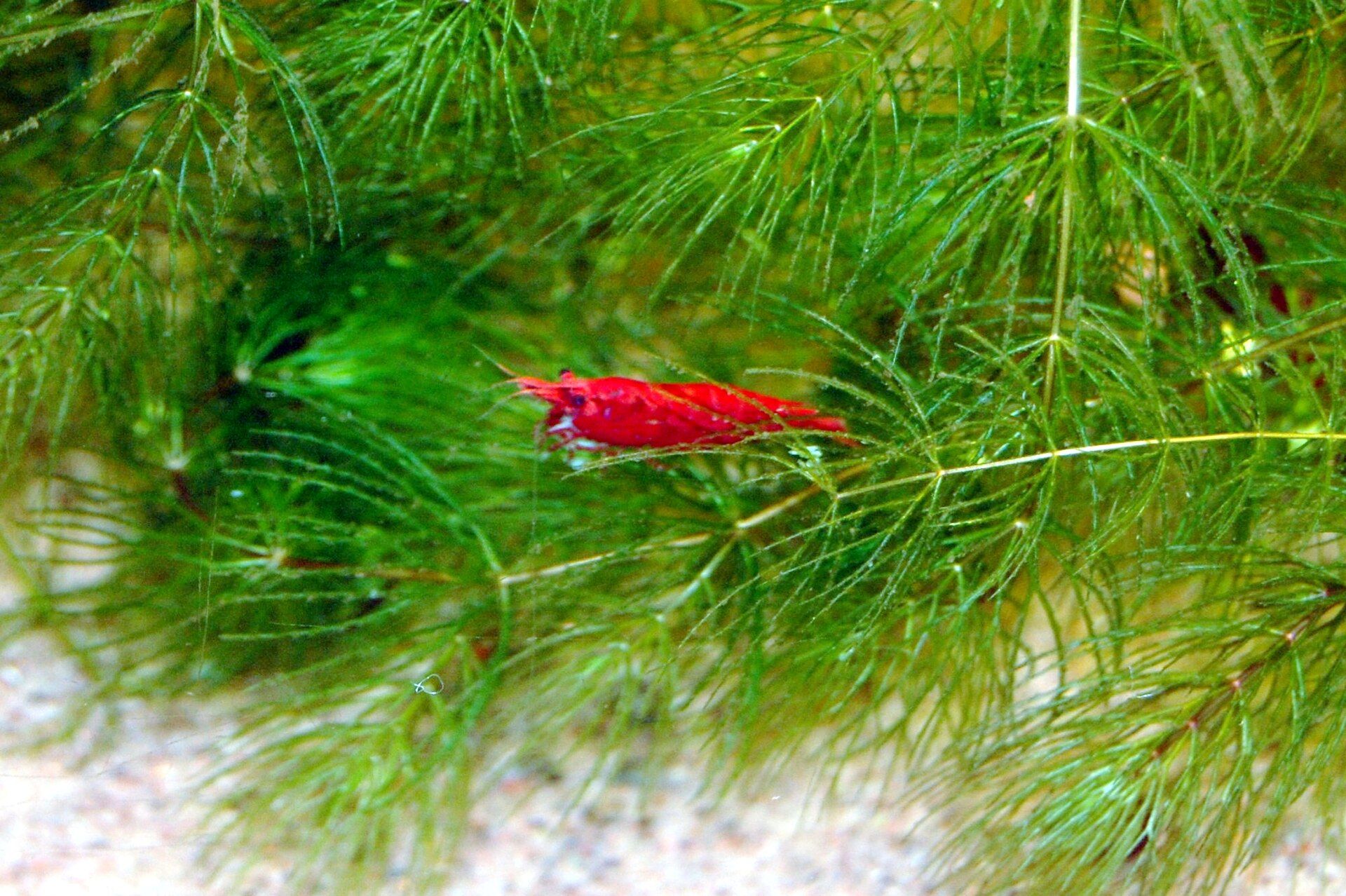
Cherry shrimp take a wide range of water and breed on their own. What kills them is usually something you added: a fish medicine, an algae treatment, a fertilizer or a tank mate. Copper is the one to read labels for.
Quick answer
Cherry shrimp live in 60 to 82 °F according to Aquarium Co-Op, with pH 6.5 to 8.5, and need some hardness to molt. Copper is toxic to shrimp: skip medications and algae treatments that contain it, and check fertilizers. Almost any fish will eat baby shrimp, so a shrimp-only tank breeds best.
What you’re keeping
Aquarium Co-Op says Neocaridina davidi is native to China and Taiwan, with a translucent, speckled wild form and many color morphs, red being the most popular. Females grow to 1.5 inches (4 cm) and are brighter. Males are 1 to 1.25 inches. It calls them detritivores that eat algae, biofilm and leftover food 1. Co-Op sells shrimp supplies, and so does Flip Aquatics, another source below. We flag it where it matters.
Water: the ranges don’t match
| Measure | Range | Source |
|---|---|---|
| Temperature, survivable | 60 to 82 °F (16 to 28 °C) | Co-Op 1 |
| Temperature, comfortable | 72 to 76 °F (22 to 24 °C) | Co-Op 1 |
| Temperature, other guides | 72 to 84 °F (Flip); 70 to 80 °F (FishLore, 2009) | 9 8 |
| pH | 6.5 to 8.5 (Co-Op); 6.5 to 8.0 (Flip); 7 to 8 (FishLore) | 1 9 8 |
| Hardness | GH 6 dGH or more, KH 2 dKH or more (Co-Op); kH 3 to 10 (Flip) | 1 9 |
FishLore’s article gives hardness as 3 to 15 “dkh”, and we’d treat that figure loosely.
Two lab studies of cherry shrimp add some data. In one, shrimp were held at 75, 82 and 90 °F (24, 28, 32 °C) for 90 days. Survival and growth were good at all three. The authors concluded the species tolerates a wide range, with 28 °C (82 °F) optimal for culture. They also found the highest share of egg-carrying females at 28 °C, and every female that matured at 32 °C lost her eggs 4. In the other, females spawned at 28 °C and none spawned at 33 °C (91 °F). Moving high-temperature females back to 28 °C let them spawn again 5.
Co-Op’s comfortable range is cooler than the lab optimum. Co-Op says warmer water speeds growth and shortens life, and cooler water lengthens life but slows breeding 1. Our reading: 72 to 78 °F suits a display tank, and above the low 80s is where breeding is at risk.
Why hardness matters
Shrimp molt as they grow. Co-Op says they need enough GH and KH to build the new shell, and that soft water can cause failed molts, sometimes called the “white ring of death”. It suggests crushed coral to raise KH, a GH mineral supplement, and calcium-rich food 1. Co-Op’s figures are a minimum of 6 dGH (it writes 110 ppm) and 2 dKH (it writes 40 ppm) 1. Its ppm are rounded: by the usual conversion of about 17.9 ppm per dKH, 2 dKH is about 36 ppm (our arithmetic). The shrimp hide while the new shell hardens. A translucent shell with a split down the back is a molt, not a dead shrimp, and shrimp often eat it for calcium 1. If you’re dosing remineralizer, test the water. Our pH guide covers what the readings mean. Shrimp are also small and sensitive to how they’re moved between waters: our acclimation guide covers the catch cup Co-Op suggests for them, and a case where a slow method went wrong.
Tank, filter and group
Co-Op says they can live in a 2 gallon tank, but prefers 10 gallons or more for a colony, in a mature tank with mulm to graze on. It covers filter intakes with a pre-filter sponge or uses a sponge filter so babies aren’t sucked up, and recommends at least 10 shrimp to get both sexes 1. Flip’s page says about 40 L (roughly 10.5 gallons) for a colony, with 10 L (about 2.6 gallons) as the minimum for a small group 9. The 2009 FishLore article says one gallon or more, and 10 to 15 shrimp per gallon if water changes keep up 8. That density is the most generous figure we found, and the others suggest a lower one.
Copper
Copper is the specific reason shrimp die in tanks where fish are fine. Aquarium Co-Op’s overview says traces of heavy metals, copper from pipes or hot water boiler coils among them, are highly toxic to invertebrates. Even tiny amounts can be lethal, especially in soft water. Conditioners reduce the danger only to a certain extent, so it recommends water that is completely free of copper in a shrimp tank 3.
Where it comes from, according to the sources:
| Source | What the sources say | What we’d do |
|---|---|---|
| Fish medications | Co-Op: many contain copper, never use them with shrimp 3. FishLore: never use copper medications; if you did before, run a copper remover before adding shrimp 8. Flip: treat fish in a separate tank 6. | Read the label. Treat sick fish in a bare hospital tank. |
| Algae treatments | Co-Op: many algae conditioners contain copper 3. | Same: check the active ingredient. |
| Plant fertilizer | Flip: some contain copper at unsafe levels 6. | Flip sells a copper-free fertilizer, so weigh that. Ask the maker for the copper amount in a normal dose. |
| Tap water | Co-Op: copper pipes and boiler coils 3. Flip adds tap water as a source 6. | Flush the line before filling. A copper test kit settles it (FishLore suggests one 8). |
| New plants | Co-Op: nursery plants grown above water may carry sprays, so water them for several weeks first 3. | Co-Op doesn’t name copper here. The point is pesticides. |
| Food | Flip: traces in food and vegetables are harmless and necessary 6. A hobbyist blog says copper is part of shrimp blood and that diet supplies it 7. | No need to avoid commercial shrimp food. |
On numbers, there’s no consensus we could verify. Flip calls 0.02 to 0.03 ppm safe for most shrimp 6, and it sells shrimp products. The hobbyist blog we found says there’s close to no information on dangerous levels for Neocaridina. The only study it found giving a direct answer, from 1979, tested copper sulphate on a freshwater prawn and a Caridina shrimp. The blog’s reading is a 48 hour LC50 near 0.3 mg/L of copper sulphate, which it converts to roughly 0.06 to 0.08 mg/L of copper 7. That’s the blog’s own conversion of a study we did not read, on other species. Our search of the research literature found copper tests on other shrimp and prawns, but no published safe level for Neocaridina davidi. So treat any figure as unverified and avoid copper rather than aiming for a level.
Our water conditioner guide explains what dechlorinators do and don’t remove.
Which fish can live with them
Co-Op says almost all fish eat baby shrimp, so the best way to breed is a species-only tank. If you only want adults and a few survivors, certain peaceful, small species can work, and it recommends lots of cover. None of its list is guaranteed 1 2.
| Group | Co-Op’s examples | Notes |
|---|---|---|
| Probably fine | Nerite, mystery and bladder snails; amano and ghost shrimp; otocinclus, Stiphodon gobies, clown plecos | Snails compete for food; otos may eat a baby 2 |
| Small, peaceful fish | Ember and green neon tetras; chili and neon green rasboras; pygmy corydoras | Small mouths 2 |
| Mixed | Guppies and Endler’s livebearers in a 20 gallon with a mass of java moss | Co-Op kept them successfully 2 |
| Avoid | Goldfish, cichlids, rainbowfish, big plecos; bettas, dwarf cichlids, dwarf gouramis, pea puffers; zebra danios, silver tip tetras | Meat eaters, or fast and hungry 2 |
Sources disagree on how strict to be. FishLore’s 2009 article says most community fish are fine, but not bigger or aggressive fish 8. Flip says even small fish like Apistogramma can nip shrimp 9. Co-Op also says Caridina shrimp often want very different water and may not suit a cherry colony 2.
Our guppy guide, neon tetra guide and betta care guide cover those fish. Co-Op lists betta fish among the fish to avoid with cherry shrimp 2. On guppies, Co-Op says it has kept guppies and Endler’s livebearers with cherry shrimp in a 20 gallon tank with a large mass of java moss, and that dense foliage gives baby shrimp and fry places to hide 2.
Feeding and breeding
Co-Op says to feed shrimp-specific foods enriched with calcium and minerals, plus vegetables like blanched zucchini, and to include enough protein for juveniles and egg-making females. Powdered foods and leaves such as catappa help the newborns, which are about 1/16 inch 1. Females carry 20 to 30 eggs for about a month, per Co-Op, and the adults don’t eat their young 1.
FAQ
Can cherry shrimp take aquarium salt? We found no study on shrimp and salt. Our aquarium salt dose chart shows what the sources say and where they stop.
Do cherry shrimp need a heater? Co-Op says they live in 60 to 82 °F and are most comfortable at 72 to 76 °F, so many tanks need none. A heater helps if your room is cooler and you want more breeding 1.
Is copper always deadly? The sources say trace copper is a nutrient and excess copper is toxic 6 7. No verified safe threshold for cherry shrimp exists in what we found. Skip copper treatments.
Can I keep cherry shrimp with a betta? Co-Op lists bettas among fish to avoid 2.
Can cherry shrimp live with neon tetras or guppies? Co-Op’s tank mate list doesn’t name the common neon tetra (Paracheirodon innesi). It names ember tetras and green neon tetras as small enough to leave adults alone. A photo caption in its care guide mentions neon tetras living with cherry shrimp and guppies in a community tank, without naming the species 1. Co-Op has kept guppies with cherry shrimp in a planted tank, with the expectation that some babies get eaten 2.
Why did my shrimp die after a molt? Co-Op says soft water can cause failed molts 1. Test GH and KH.
All the numbers, with sources
| What | Value | Type | Source |
|---|---|---|---|
| Aquarium Co-Op: survivable temperature / most comfortable | 60 to 82 °F (16 to 28 °C) / 72 to 76 °F (22 to 24 °C) | Stated by source | [1] |
| Lab study (Tropea et al.): temperature giving best culture result | 82 °F (28 °C); survival good from 75 to 90 °F (24 to 32 °C) | Stated by source | [4] |
| Lab study (Baliña et al.): females spawned at 28 °C, none at 33 °C | 82 °F spawned / 91 °F did not | Stated by source | [5] |
| Aquarium Co-Op: pH / minimum GH / minimum KH for molting | 6.5 to 8.5 / 6 dGH (110 ppm) / 2 dKH (40 ppm) | Stated by source | [1] |
| Aquarium Co-Op: minimum group for a breeding colony | 10 shrimp | Stated by source | [1] |
| Flip Aquatics (shrimp seller): copper level it calls safe for most shrimp | 0.02 to 0.03 ppm | Stated by source | [6] |
Sources
- Aquarium Co-Op (fish and aquarium products retailer) (n.d.). Care Guide for Cherry Shrimp: Tank Setup, Food, and Breeding
- Aquarium Co-Op (fish and aquarium products retailer) (n.d.). Top 12 Tank Mates to Keep With Cherry Shrimp
- Aquarium Co-Op (fish and aquarium products retailer) (n.d.). Overview of Freshwater Dwarf Shrimp
- PLoS ONE 10(3), 2015 (2015). Effect of temperature on biochemical composition, growth and reproduction of the ornamental red cherry shrimp Neocaridina heteropoda heteropoda (Tropea, Stumpf and López Greco) DOI: 10.1371/journal.pone.0119468
- The Biological Bulletin 234(3), 2018 (2018). Losing Reproduction: Effect of High Temperature on Female Biochemical Composition and Egg Quality in the Red Cherry Shrimp Neocaridina davidi (Baliña, Temperoni, López Greco and Tropea) DOI: 10.1086/698266
- Flip Aquatics (shrimp and fertilizer seller) (n.d.). Is Copper Bad for Shrimp? Copper Free and Shrimp Safe Plant Fertilizer
- Shrimp and Snail Breeder (hobbyist blog) (n.d.). How Copper Affects Dwarf Shrimp
- FishLore (aquarium magazine article, September 2009) (2009). Red Cherry Shrimp Care
- Flip Aquatics (shrimp and fertilizer seller) (n.d.). Cherry Shrimp Care Guide