Neon Tetra Care: Tank Size, Temperature, Group Size and Common Problems
Last reviewed · By Manel Vadillo
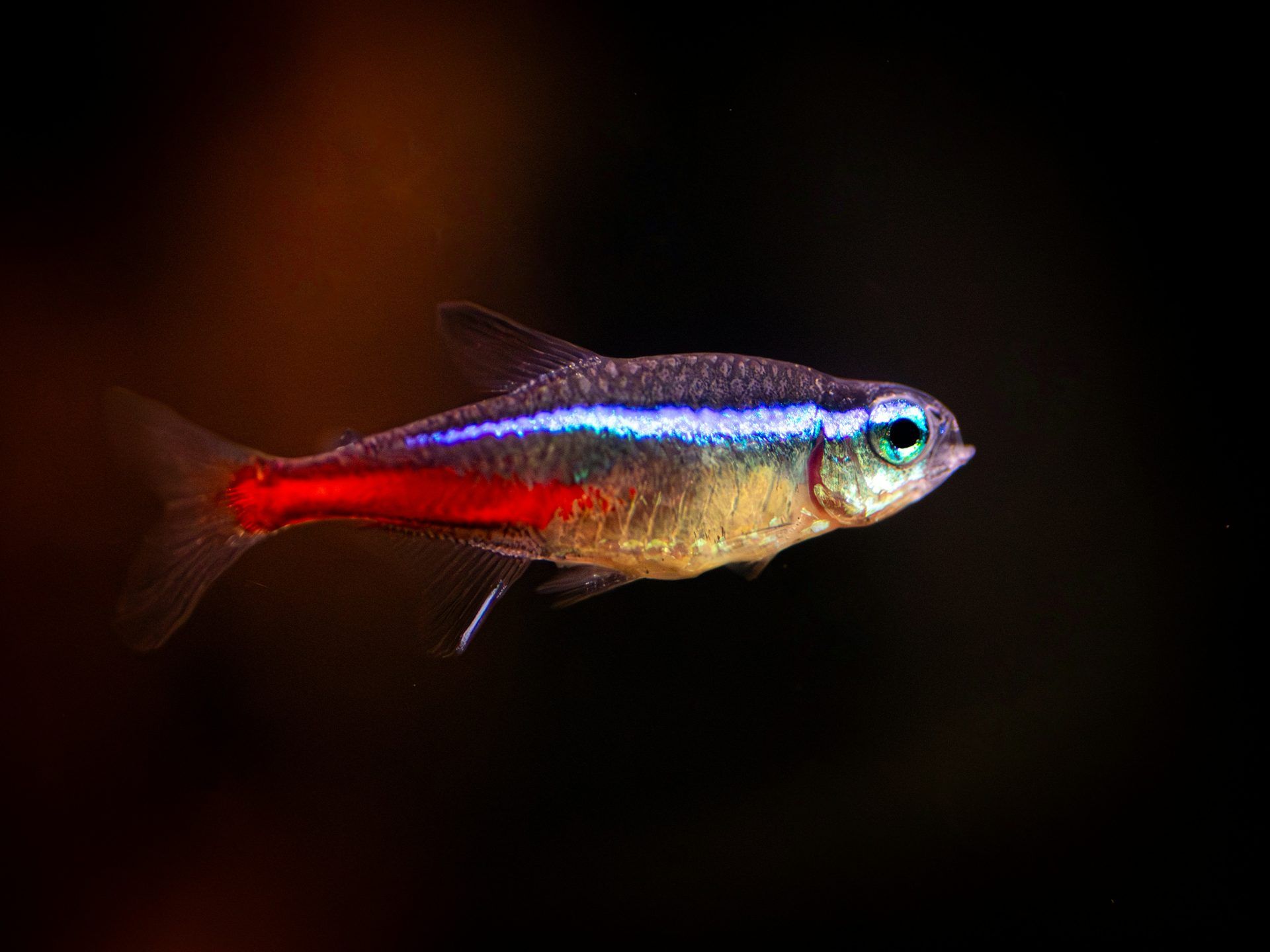
Neon tetras are small, peaceful and cheap, which is why people buy six on impulse. Seriously Fish suggests a group of 8 to 10, and says years of commercial breeding have weakened the ornamental strain. The care sheets also disagree on temperature.
Quick answer
Neon tetras reach about an inch. Seriously Fish suggests a group of 8 to 10 in a tank at least 24 by 12 inches, about 14 gallons, at 70 to 77 °F. FishBase gives 68 to 79 °F and a narrower pH. Both describe a peaceful fish that needs company.
What you’re buying
Seriously Fish describes the neon tetra, Paracheirodon innesi, as a small characid from acidic forest streams in the Amazon basin of Colombia, Brazil and Peru. It reaches 1.2 inches 1. FishBase gives 1 inch (2.5 cm) 2. Seriously Fish rates it easy and peaceful, a fish that needs a group and steady temperature 1.
One more thing on the same page that most care sheets skip. Seriously Fish says years of commercial breeding have weakened the ornamental strain, defects and ill health are widespread, and stock needs choosing with care 1.
The numbers, with two sources
We checked the ranges against FishBase as well, and they don’t match.
| Measure | Seriously Fish | FishBase |
|---|---|---|
| Temperature | 70 to 77 °F (21 to 25 °C) 1 | 68 to 79 °F (20 to 26 °C) 2 |
| pH | 4.0 to 7.5 1 | 5.0 to 7.0 2 |
| Hardness | 1 to 12 dGH 1 | dH 1 to 2 2 |
| Group | 8 to 10 or more 1 | 5 or more 2 |
| Tank | 24 x 12 in base, about 14 gal 1 | 24 in or longer 2 |
Seriously Fish’s ranges are wider on pH and hardness, which fits its note that the species is flexible about water. FishBase’s are narrower, and its hardness figure is very soft. Neither tells you what happens at the edges. Our reading: the pH ranges overlap at 5.0 to 7.0, so a tank in that band sits inside both. Harder, more alkaline tap water takes you outside what FishBase describes, though not necessarily outside what Seriously Fish does. For the underlying numbers, our pH guide explains what a reading means. One dGH is about 17.9 mg/L as calcium carbonate.
Temperature: where people argue
The Seriously Fish range tops out at 77 °F. Aqueon’s guide for tetras in general says 75 to 80 °F, though it isn’t specific to neons 4. That’s a manufacturer, and a tetra-wide page. The overlap of the two neon-specific sources is 70 to 77 °F, and we’d aim inside it.
The practical reason it comes up: the tropical fish people want to keep with neons often prefer warmer water. A FishLore thread asked exactly that, about 78 to 79 °F. Members split. Some had kept neons at 78 to 82 °F or higher for years. One reported 8 or more years, another 5 to 6. A longtime member said neons kept hot live shorter lives, breed around 73 to 74 °F and live well at 70 to 72 °F. Another said fluctuations matter more than a degree or two 6. That’s a handful of keepers, not a study. Our heater guide covers how to set and check the temperature.
Tank size and group size
Seriously Fish wants a base of at least 24 by 12 inches, about 14 gallons, and a mixed group of at least 8 to 10 with other schooling fish for security 1. FishBase says groups of 5 or more and a minimum length of 24 inches 2. Aqueon says 10 to 20 gallons for tetras generally, and 6 or more 4.
So the floor is a 24 inch tank. We’d treat that as a minimum for the group itself, not for the group plus other fish. Our stocking guide for 10 and 20 gallon tanks shows how that adds up with other species.
Setting up the tank
The wild habitat is acidic, soft and often stained brown by leaves 1. Seriously Fish says a sandy substrate with driftwood roots and branches looks best. It adds that dried leaf litter gives cover, and that neons seem to do best under fairly dim lighting, with plants that tolerate low light and floating plants appreciated 1. A dark substrate and decor, plus a lid, are Aqueon’s suggestions for tetras in general 4.
Cycle the tank before the fish go in. Our guide to cycling with fish in the tank covers what to do if you didn’t.
Feeding
Seriously Fish says neons are probably omnivores in nature. In a tank they may survive on dried food, but it recommends a varied menu with live and frozen foods such as bloodworm, mosquito larvae and Daphnia 1. Aqueon’s rule for tetras is to feed only what they finish in under 2 minutes, once or twice a day 4.
Tank mates
Seriously Fish describes a peaceful fish that’s best kept with similar-sized characids, smaller catfishes and non-predatory small-to-medium cichlids 1. Its angelfish profile warns that angelfish may eat small fish such as tetras 7, so a neon group is a poor match for adult angelfish. Aquarium Co-Op’s guppy guide names neon tetras among the peaceful tank mates for guppies 5. If you plan cherry shrimp, our cherry shrimp guide covers which fish are safe with them, and why almost any fish will eat baby shrimp. Aquarium Co-Op’s list of safe tank mates names ember tetras and green neon tetras, not the common neon tetra.
Health: neon tetra disease and its lookalike
Seriously Fish says neon tetra disease is caused by a microsporidian parasite, Pleistophora hyphessobryconis, and is virtually untreatable once advanced. Mortality can be high, and the only way to treat the tank is to remove fish showing signs 1. Merck says the parasite attacks the skeletal muscle of neon tetras, angelfish and other freshwater fish. Muscle damage causes abnormal movement. It needs a microscope to confirm, there is no treatment, and infected fish should be removed 3.
Seriously Fish adds one useful point: columnaris, a bacterial infection, can look the same and is sometimes called false neon tetra disease. It can be treated with antibacterial products, so it’s worth isolating and treating a fish before assuming the worst 1.
What hobbyists report
On FishLore, the temperature thread above showed how little agreement there is on neons. One member said they would not keep the species at all, because they find captive stock genetically weak. Another said most aquarium fish tolerate harder water than their wild habitat suggests, and that fish from the local store would be fine in the owner’s pH of 8.2. A third recommended harlequin rasboras if the water was hard 6. These are opinions. Seriously Fish’s warning about weak stock is the only published backing.
FAQ
How many neon tetras should I keep? Seriously Fish says at least 8 to 10 1. FishBase says 5 or more 2.
How big a tank do they need? Both Seriously Fish and FishBase give 24 inches as the minimum length, about 14 gallons by Seriously Fish’s reckoning 1 2.
What temperature is best? Seriously Fish says 70 to 77 °F 1 and FishBase says 68 to 79 °F 2. Hobbyists argue about anything above that.
Can neons live with guppies? Aquarium Co-Op’s guppy guide lists neon tetras as peaceful tank mates for guppies 5.
Is there a cure for neon tetra disease? No. Seriously Fish and Merck both say there is no treatment for the parasite 1 3.
All the numbers, with sources
| What | Value | Type | Source |
|---|---|---|---|
| Seriously Fish: maximum size (standard length) | 1.2 in (30 mm) | Stated by source | [1] |
| FishBase: maximum size (standard length) | 1 in (2.5 cm) | Stated by source | [2] |
| Seriously Fish: temperature | 70 to 77 °F (21 to 25 °C) | Stated by source | [1] |
| FishBase: temperature | 68 to 79 °F (20 to 26 °C) | Stated by source | [2] |
| Seriously Fish: pH / hardness | 4.0 to 7.5 / 1 to 12 dGH | Stated by source | [1] |
| FishBase: pH / hardness | 5.0 to 7.0 / dH 1 to 2 | Stated by source | [2] |
| Seriously Fish: minimum tank base and volume | 24 x 12 in, about 14 US gal | Stated by source | [1] |
| Group size: Seriously Fish / FishBase / Aqueon (tetras in general) | 8 to 10 / 5 or more / 6 or more | Stated by source | [1] |
Sources
- Seriously Fish (2026). Paracheirodon innesi (Neon Tetra)
- FishBase (n.d.). Paracheirodon innesi, Neon tetra
- Merck Veterinary Manual (n.d.). Disorders and Diseases of Fish (Pet Owner Version)
- Aqueon (aquarium equipment maker) (n.d.). Tetras Care Guide (all tetras, not neon-specific)
- Aquarium Co-Op (fish and aquarium products retailer) (2026). Care Guide for Guppies
- FishLore Aquarium Forum (n.d.). Is 78-79 Degrees Too Warm For Neon Tetras? (forum thread, hobbyist experience)
- Seriously Fish (2026). Pterophyllum scalare (Angelfish)