Guppy Care: Tank Size, Water, Temperature and Why They Die
Last reviewed · By Manel Vadillo
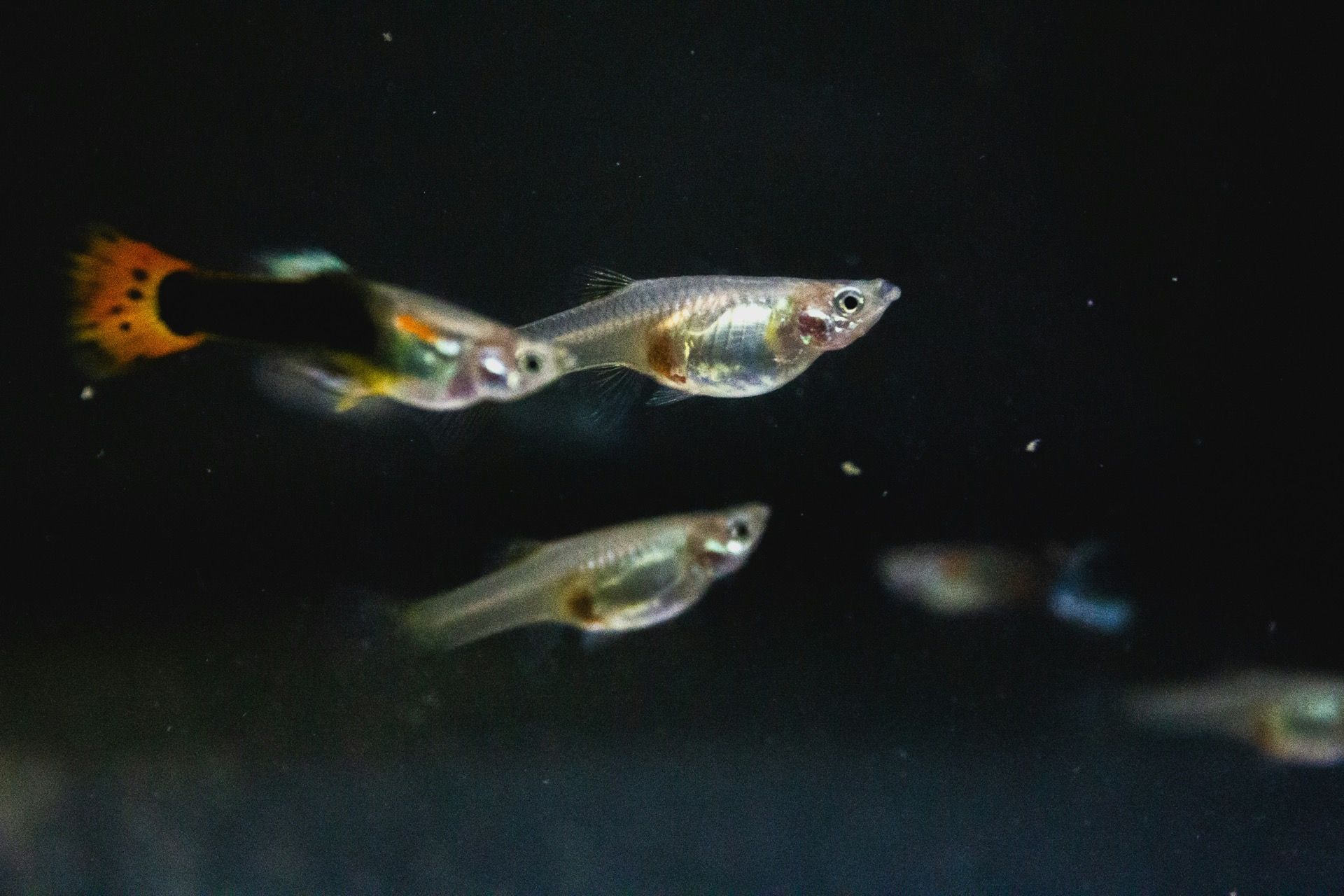
Guppies are sold as beginner fish, and the fish are easy to keep alive in good water. The ones in the shop are the problem. Seriously Fish says many commercially bred guppies are inbred and not very hardy, and Aquarium Co-Op says they are shipped around the world and often weak when they arrive.
Quick answer
Guppies stay under 2.5 inches. Seriously Fish gives a 45 x 30 cm base (about 11 gallons), 63 to 82 °F and pH 7.0 to 8.5; FishBase gives 64 to 82 °F and pH 7.0 to 8.0. They need hard water, not soft. Seriously Fish advises several females per male and warns that many store guppies are not hardy.
What the two sources say
Seriously Fish calls the guppy, Poecilia reticulata, a peaceful livebearer from northeastern South America and the southern Caribbean, and one of the most popular aquarium fish in the world 1. FishBase agrees on the basics. The numbers differ a little.
| Measure | Seriously Fish | FishBase |
|---|---|---|
| Size | 2.4 in (60 mm) | 2.0 in male, 2.4 in female |
| Temperature | 63 to 82 °F (17 to 28 °C) | 64 to 82 °F (18 to 28 °C) |
| pH | 7.0 to 8.5 | 7.0 to 8.0 |
| Hardness | 8 to 30 dGH | dH 9 to 19 |
| Tank | 18 x 12 in base, about 11 gal | 60 cm (about 24 in) minimum, groups of 5+ |
Sources: Seriously Fish 1, FishBase 2.
Where they differ, FishBase’s ranges are narrower, so a tank in the overlap (pH 7.0 to 8.0, 9 to 19 dGH, 64 to 82 °F) satisfies both. Both put guppies firmly on the hard, neutral-to-alkaline side. Seriously Fish says the species can manage in soft or acidic water, but long-term it wants moderately hard or harder water 1. Aquarium Co-Op agrees that guppies enjoy pH 7.0 or above and hard water with calcium and magnesium 3. Aquarium Co-Op says that if your water is soft, a mineral supplement raises hardness and adds minerals 3. Our pH guide explains how to read the numbers.
Tank size
Seriously Fish gives a minimum base of 18 by 12 inches, about 11 gallons. FishBase says a minimum aquarium size of 60 cm (about 24 inches) and groups of five or more 1 2. The two don’t match. Our reading: the second figure is a database note, not a stocking study. Guppies are small, but a group needs room, so 10 gallons is the smallest tank we’d call reasonable, and 20 gives you room for mistakes. Our stocking guide shows how guppies fit alongside other fish.
Seriously Fish adds that strong currents should be avoided and that a planted tank with floating plants is appreciated 1.
Temperature changes lifespan
This is the part of guppy care that sheets rarely explain. Aquarium Co-Op, a fish retailer, says to use a heater at 76 to 78 °F because the fancy strains aren’t as resilient as wild fish, and gives an average lifespan of 2 to 3 years there. At 82 °F they grow faster and breed more but live about 18 months. At 72 °F they may live 3.5 years or longer but mature slowly, and may only have young every six months 3.
That is one retailer’s account, not a measured study, and we found no experiment to cite. Both reference ranges (63 to 82 °F and 64 to 82 °F) cover all three temperatures. Our heater guide covers how to hold a stable temperature.
Feeding
Seriously Fish says wild guppies are mostly insectivorous, but tank-bred fish accept most foods 1. Aquarium Co-Op’s rule for adults is once or twice a day, as much as they eat in one minute. Guppies beg, owners overfeed them, and that can lead to constipation and other problems. Fry can eat three to five small meals a day 3.
Males, females and fry
Seriously Fish advises several females per male, since males chase constantly. It adds that adult fish eat their young, and females can produce broods for six months or more without a male 1. Our guide to how to tell if a guppy is pregnant covers the gravid spot, gestation and what to do before and after birth, so we won’t repeat it. If you don’t want a tank of fry, Seriously Fish says to buy fish of one sex 1.
Tank mates
Seriously Fish says to avoid fin nippers such as tiger barbs and serpae tetras. It names other livebearers, rasboras, corydoras, small loricariid catfishes and tetras as good company 1. Aquarium Co-Op names cory catfish and neon tetras and warns against aggressive fish that may nip fins or eat guppies, such as tiger barbs or bala sharks 3. Our neon tetra guide covers that pairing. Bettas are the other case: Seriously Fish’s betta profile warns that a male betta may treat long, trailing fins as rivals 5. That is a reason to be careful with fancy-tailed male guppies, and plain-tailed ones are the safer try (our reading). Guppies and cherry shrimp are a mixed case, because baby shrimp are small enough to be eaten. Our cherry shrimp guide goes through it.
Why store guppies die
Seriously Fish says many commercially bred guppies aren’t very hardy because of inbreeding and over-production, and are prone to disease and early death. It recommends buying from breeders or society auctions 1. Aquarium Co-Op says store guppies are highly inbred, mass-produced and crowded, and pick up diseases at every stop on the way. It treats incoming fish with a trio of broad-spectrum medications and advises owners to be ready for clean water, a good diet and possibly medication 3.
Our reading: if guppies die soon after you bring them home, check the water first. Our guide to fish that die in a new tank walks through ammonia, nitrite and chloramine, and if long fins start to fray, our fin rot guide explains how to tell rot from nipping. Merck recommends at least 30 days of quarantine for new pet fish 4.
FAQ
How big do guppies get? Seriously Fish says up to 2.4 inches (60 mm) 1. FishBase gives 2.0 inches for males and 2.4 for females 2.
What water do guppies need? Hard, neutral to alkaline: pH 7.0 to 8.5 per Seriously Fish, 7.0 to 8.0 per FishBase 1 2.
How long do guppies live? Aquarium Co-Op says 2 to 3 years at 76 to 78 °F, with shorter lives when warmer 3.
Do guppies need a heater? Both reference ranges start in the low 60s °F, so the question is whether your room stays above that. Aquarium Co-Op recommends a heater and 76 to 78 °F 3.
Can guppies live with neon tetras? Aquarium Co-Op and Seriously Fish both name tetras as suitable company 1 3.
All the numbers, with sources
| What | Value | Type | Source |
|---|---|---|---|
| Seriously Fish: maximum size (standard length) | 2.4 in (60 mm) | Stated by source | [1] |
| FishBase: maximum size (standard length), male / female | 2.0 in (5.0 cm) / 2.4 in (6.0 cm) | Stated by source | [2] |
| Seriously Fish: temperature | 63 to 82 °F (17 to 28 °C) | Stated by source | [1] |
| FishBase: temperature | 64 to 82 °F (18 to 28 °C) | Stated by source | [2] |
| Seriously Fish: pH / hardness | 7.0 to 8.5 / 8 to 30 dGH | Stated by source | [1] |
| FishBase: pH / hardness | 7.0 to 8.0 / dH 9 to 19 | Stated by source | [2] |
| Seriously Fish: minimum tank base and volume | 18 x 12 in, about 11 US gal | Stated by source | [1] |
| Aquarium Co-Op: average lifespan at 76 to 78 °F (82 °F / 72 °F) | 2 to 3 years (18 months / 3.5 years or more) | Stated by source | [3] |
Sources
- Seriously Fish (2026). Poecilia reticulata (Guppy)
- FishBase (n.d.). Poecilia reticulata, Guppy
- Aquarium Co-Op (fish and aquarium products retailer) (2026). Care Guide for Guppies: The Most Popular and Colorful Livebearer
- Merck Veterinary Manual (n.d.). Management of Aquarium Fish (quarantine)
- Seriously Fish (2026). Betta splendens (Siamese Fighting Fish)