Chlorine and Chloramine in Tap Water: Do You Need a Dechlorinator?
Last reviewed · By Manel Vadillo
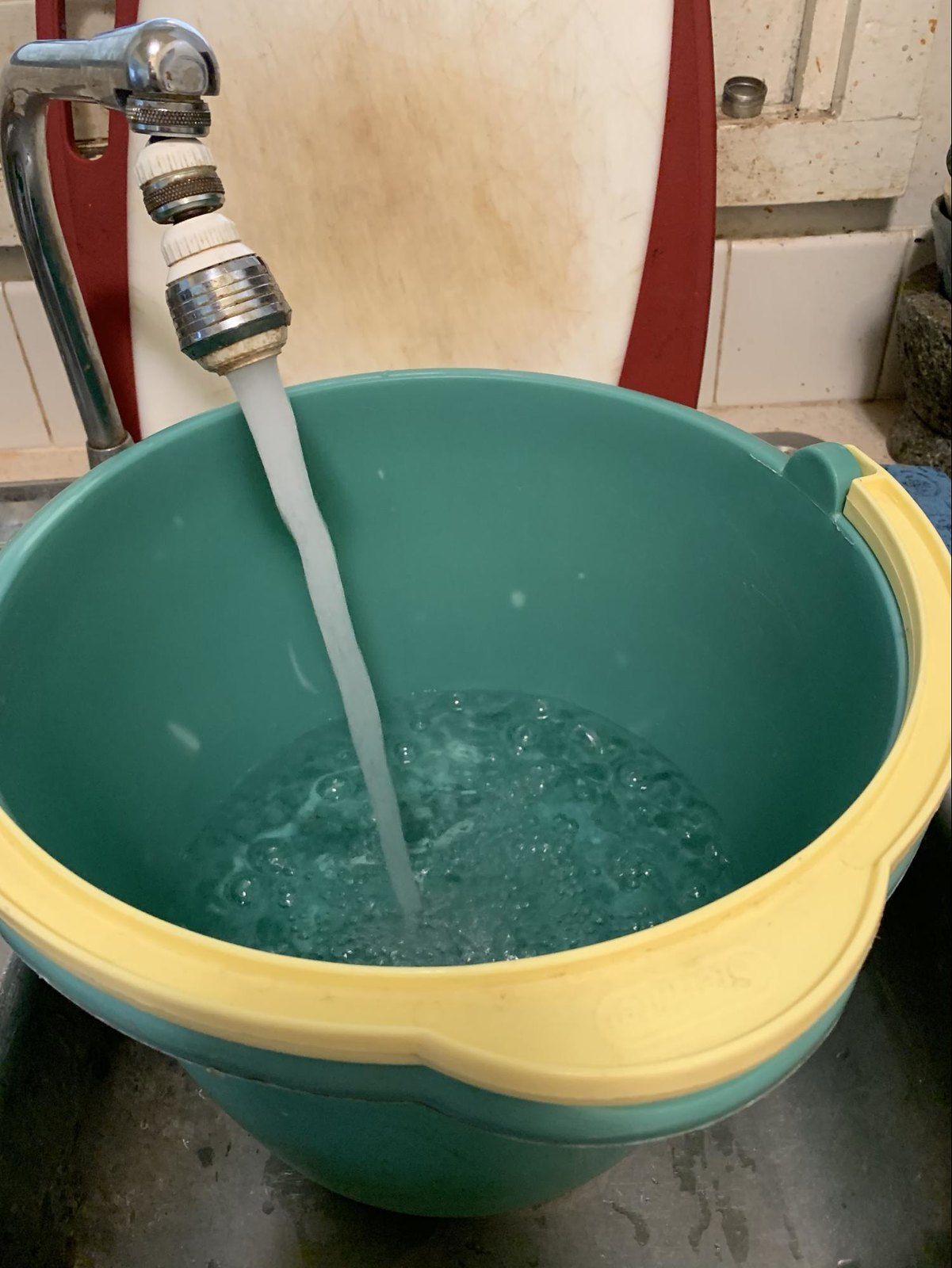
Almost every fish tank that's filled from the tap needs a water conditioner, and the reason is a disinfectant most people never think about. Chlorine fades if you let water stand. Chloramine, which many utilities use instead, doesn't.
Quick answer
Treat all tap water for fish. Merck says no chlorine or chloramine should be detectable when live animals are present, with harm from about 0.02 mg/L. Chloramine doesn't leave by standing, and a free-chlorine test can't see it. Use a conditioner rated for chloramine and dose it for the water you add.
Why tap water needs treatment
Utilities add disinfectant so the water stays safe through miles of pipe. Merck says both chlorine and chloramine are highly toxic to fish, with adverse effects at chlorine concentrations as low as 0.02 mg/L and mortality at 0.04 mg/L 1. Its reference table says the target for any tank filled from a municipal supply is 0 mg/L of both free and total chlorine 2. Tampa Bay Water, a Florida utility, adds that the same applies to shrimp, snails, frogs and turtles 4.
The damage can be slow. Merck says chronic exposure to low chlorine is a surprisingly frequent problem, even for experienced aquarists. The signs are non-specific: ragged fins, excess mucus on the skin and gills, cloudy eyes, lethargy, and ongoing deaths 1.
Chlorine versus chloramine
The EPA describes chloramines as disinfectants formed when ammonia is added to chlorine, and says they give longer-lasting disinfection as water moves through pipes 3. That durability is exactly why they cause trouble in a tank.
| Question | Chlorine | Chloramine |
|---|---|---|
| Does it fade if water sits? | Yes, in a few days 4 | No. It can take weeks 4 |
| What a test shows | Free chlorine reads positive 1 | Free chlorine reads zero and total chlorine reads positive 1 |
| What treating it leaves behind | No ammonia is released | Ammonia, from the ammonia half of the molecule 1 |
Because Tampa Bay Water treats this as a safety issue, it says plainly that a conditioner or a carbon filter designed to remove monochloramine must be used, and that you should read the label to confirm your product handles it 4.
How to find out what’s in your water
Ask your utility. Aquarium Science makes the point that once you’ve neutralized the chlorine part of chloramine with conditioner, an ammonia test can’t give you a clean answer, so you can’t reliably test your way to the answer at home. Calling the supplier is the reliable route 7. Your utility also publishes a Consumer Confidence Report, and the EPA has a page for finding yours 8.
If you do test, get a kit that reads total chlorine. Merck says a chloramine-only supply reads negative for free chlorine and strongly positive for total chlorine, which is why both tests matter 1. Aquarium Science tells of keepers who used a free-chlorine kit, saw zero, stopped adding conditioner and lost tanks 7.
Chlorine pulses
Utilities sometimes send a short, stronger dose through the system. Merck says boluses of chlorine or chloramine may be sent through water lines as part of maintenance, and that in rare cases more is present than expected 1. Aquarium Science says some suppliers add up to 4 ppm at these times and that a normal conditioner dose neutralizes only 1 to 2 ppm 10. It also says chloramine systems pulse often, as often as weekly 7. We couldn’t confirm that frequency anywhere else, so we’d treat it as that author’s claim.
What to take from it: a conditioner dose that works for months can fail once. Merck says to follow label instructions, which usually works, and to test free and total chlorine before and after treating if you have a reason to doubt your water 1.
How to dose it
Dose for the water you’re adding, not the tank. Seachem’s directions for Prime are 1 capful (5 mL) for each 50 US gallons (200 L) of new water. You can add it to the tank directly, but it’s better to add it to the new water first. If you do dose the tank directly, base the amount on the aquarium’s volume. For exceptionally high chloramine, Seachem says a double dose is safe 5. Merck lists an inaccurate volume calculation as a reason dechlorination fails 1.
Here is what Seachem’s label rate works out to for common water changes. This is our arithmetic, not a table from Seachem.
| Water you add | Label dose | Double dose |
|---|---|---|
| 5 gal (19 L) | 0.5 mL | 1 mL |
| 10 gal (38 L) | 1 mL | 2 mL |
| 20 gal (76 L) | 2 mL | 4 mL |
| 50 gal (190 L) | 5 mL | 10 mL |
The math is 5 mL ÷ 50 gal = 0.1 mL per gallon, then doubled. Seachem notes that each thread on its cap is about 1 mL. Check your own bottle, since concentrations differ between products.
The ammonia left behind
When a conditioner removes chlorine from chloramine, ammonia is what remains. Merck explains the risk: repeated water changes, each of which requires dechlorination, each release more ammonia, and a new or damaged filter can’t cope. The fix it gives is a dechlorinator designed to handle chloramine by also binding the ammonia 1.
Seachem says Prime does this: it removes the chlorine, then binds the ammonia until the filter can use it, and it won’t halt cycling. The same FAQ warns that some liquid ammonia tests give false positives on bound ammonia, and says to wait 24 hours before testing or to use a kit that isn’t affected by reducing agents 5.
Aquarium Science disagrees. It says no conditioner detoxifies ammonia, not even Prime 6. We couldn’t find independent testing on either side. If you see ammonia right after a water change, test the treated tap water separately, and see our guide on high nitrite for a case where tap-water ammonia kept a cycle stuck.
Letting water sit, boiling and carbon
Letting water stand works for chlorine, which dissipates in a few days. It doesn’t work for chloramine, which may take weeks 4. That makes it an unsafe method unless you know your supply has plain chlorine.
An activated carbon filter “specifically designed” to remove monochloramines is the other route Tampa Bay Water names, to be used according to the product instructions 4. We read that as meaning ordinary filter carbon doesn’t qualify.
We haven’t found a source that endorses boiling for a tank, so we leave it out.
A word of caution on higher doses
Aquarium Science recommends conditioners whose ingredient list says sodium thiosulfate and suggests five times the label dose 6. That’s one hobbyist’s rule, based on that author’s view of pulses, and it goes beyond the maker’s directions. Seachem’s own limits are a double dose for high chloramine and up to five times for a nitrite emergency 5. We’d stay with the label and double it if you know your utility is pulsing.
What hobbyists report
A new owner on FishLore lost six fish in three hours in a freshly set-up 10 gallon. Their test said free chlorine was zero, so they assumed the water was fine. Members pointed out that a yellow-liquid free-chlorine test can’t see chloramine and that some cities use it. The owner later found their water utility’s notice and concluded chloramine was to blame, then switched to a conditioner. One member said they routinely doubled the dose because they didn’t trust their city to treat the water consistently, and noted that Seachem’s label rate is for a “national average” of treatment levels 9.
If you’ve already lost fish after a change or a new setup, our guide to fish that died in a new tank walks through the other causes.
FAQ
Do I really need a conditioner? Yes, for tap water on a municipal supply. Merck’s target is zero chlorine and chloramine whenever animals are present 2.
Can I let the water sit overnight instead? Only for plain chlorine, and only if you know that’s all you have. Chloramine can take weeks 4.
My chlorine test says zero. Am I safe? Not necessarily. A free-chlorine test misses chloramine. You need a total chlorine reading, or a call to your utility 1 7.
I got an ammonia reading right after a water change. Why? Chloramine leaves ammonia behind, and some test kits read bound ammonia as free. Wait 24 hours, or test the treated tap water on its own 1 5.
Does chloramine hurt shrimp and snails? Yes. Tampa Bay Water lists shrimp, snails, clams and frogs among the animals chloramine kills 4. Our cherry shrimp guide covers copper, the other water problem shrimp are sensitive to.
All the numbers, with sources
| What | Value | Type | Source |
|---|---|---|---|
| Merck: target for chlorine and chloramine in tap-fed tanks | 0 mg/L total chlorine and free chlorine | Stated by source | [2] |
| Merck: adverse effects on fish from chlorine begin at | 0.02 mg/L (mortality at 0.04 mg/L) | Stated by source | [1] |
| Tampa Bay Water: chloramine takes to dissipate when water sits | Weeks (chlorine: a few days) | Stated by source | [4] |
| Seachem: Prime dose | 5 mL per 50 gal (200 L) of new water | Stated by source | [5] |
| Seachem: dose for exceptionally high chloramine | Double (10 mL per 50 gal) | Stated by source | [5] |
| Seachem: how long Prime stays active in the water (a test reading can be false until then) | Within 24 hours | Stated by source | [5] |
| Our calculation: Prime for a 10 gal water change at the label rate | 1 mL (2 mL at a double dose) | Our calculation | [5] |
| EPA: how chloramines are made | Ammonia added to chlorine | Stated by source | [3] |
Sources
- Merck Veterinary Manual (University of Florida; last updated June 2026) (2026). Environmental Diseases of Aquatic Animals in Aquatic Systems (chlorine, chloramine)
- Merck Veterinary Manual (2026). Table: “Normal” Reference Ranges for Routine Water Quality Analysis
- U.S. Environmental Protection Agency (page updated March 2026) (2026). Basic Information about Chloramines and Drinking Water Disinfection
- Tampa Bay Water (n.d.). Monochloramine Information for Pet Stores and Fish Aquarium Owners (one utility)
- Seachem Laboratories (maker of the product) (n.d.). Prime (product page, directions and FAQ)
- Aquarium Science (aquariumscience.org, one hobbyist author) (n.d.). 5.5. Chlorine and Chloramine in the Aquarium
- Aquarium Science (aquariumscience.org, one hobbyist author) (n.d.). 5.5.2. Chloramines in Aquarium Water
- U.S. Environmental Protection Agency (n.d.). Safe Drinking Water Act: Consumer Confidence Reports (CCR)
- FishLore Aquarium Forum (n.d.). New fish tank, 6 fish died within 3 hours (forum thread, hobbyist experience)
- Aquarium Science (aquariumscience.org, one hobbyist author) (n.d.). 1.6. Aquarium Fast Fish Deaths (chlorine pulses)