Fishless Cycle Stalled? Why It Stops and How to Restart It
Last reviewed · By Manel Vadillo
A fishless cycle that looks stalled is usually either too young to judge or held back by pH. Before you change anything, check how many days it has really been and what your pH reads. The two main fishless-cycle sources agree on that and disagree on almost everything else.
Quick answer
Dr. Tim's says a fishless cycle stalls most often when pH drops below 7.0, and Aquarium Science says it must stay above 6.5. If pH is low, change roughly a quarter of the water. If ammonia or nitrite sits above 5 ppm, dilute it. In a tank under three weeks old, give it time.
Is your fishless cycle really stalled?
Many “stalled” cycles are just slow ones. Aquarium Science says to wait at least three weeks before testing in a new tank, and that new colonies take 2 to 8 weeks to grow. Its range for a whole cycle is days to months 2.
Dr. Tim’s gives a timeline for its no-bacteria method: ammonia typically falls below 1 ppm around days 9 to 12, and nitrite typically spikes between days 14 and 20 1. If you’re at day 10 and ammonia is still 3 ppm, that isn’t a stall. SRAC describes the same shape from a fish-farm start-up: ammonia climbs to a peak and falls, then after a lag nitrite climbs to a peak and falls. The nitrite peak is where the second group of bacteria catches up with the first 3.
Our fishless cycle guide has the day-by-day dosing, and our guide to how long a cycle takes covers the temperature and seeding effects. Come back here when the numbers stop moving for a week or more.
Match what you see to a cause
| What your test kit shows | Likely cause | What to try | Source |
|---|---|---|---|
| Ammonia not falling after 3 weeks, pH under 7 | Low pH is slowing the bacteria | Change 20 to 25% of the water, then hold pH above 7.0 | Dr. Tim’s 1, Aquarium Science 2 |
| Nitrite stuck high, above 5 ppm nitrite-nitrogen | Too much nitrite is harming the second group of bacteria | Dilute with a water change, stop dosing ammonia until it drops | Dr. Tim’s 1 |
| Ammonia dosed to 5 ppm or more | Overdosing | Cut back to 2 to 3 ppm ammonia-nitrogen | Dr. Tim’s 1 |
| Everything flat after you cleaned the filter | Bacteria were washed out | Leave the filter alone and wait | Aquarium Science 2 |
| Planted tank, ammonia and nitrite near zero but no nitrate rising | Plants may be taking the ammonia and nitrite | Our reading: watch nitrate as well, and expect a slower cycle | Aquarium Science 2 |
| Brand-new filter media, nothing happening | Slick new surface is slow to colonize | Wait, or add used media | SRAC 3 |
pH and alkalinity: the usual culprit
Dr. Tim’s says a stall is usually a pH below 7.0. The bacteria make acid as they convert ammonia and nitrite, and a week of heavy ammonia dosing can push the pH low enough to stop nitrification 1. Aquarium Science says the pH should be above 7.0 and must be above 6.5, with the bacteria happiest at 7.4 to 7.8, and that nitrification eats carbonate hardness (KH) as it goes 2. SRAC’s aquaculture sheet gives 6.8 to 7.2 as best and about 6.8 as the lower healthy limit 3.
The three sources agree on the problem and split on the fix.
- Water change. Dr. Tim’s changes water to bring ammonia and nitrite down and raise the pH, and says that usually restarts the process. Its range is written “25% to 20%”, which we read as 20 to 25% 1. Dr. Tim’s day-by-day calendar in our fishless cycle guide says 25 to 30% for a pH under 7, so use a quarter of the water as a middle.
- Baking soda. Aquarium Science adds one tablespoon of baking soda per 25 gallons when the pH drops, keeping it above 7.0, and suggests a bag of crushed coral in the filter 2.
- Alkalinity target. SRAC starts at about 150 mg/L and says the authors had better luck with nitrite bacteria at 200 to 250 mg/L 3.
SRAC also gives a conversion: 53 grams of baking soda raises the alkalinity of 3,785 liters by 10 mg/L 3. Scaled to a 20 gallon tank (about 76 liters), that is roughly 1 gram per 10 mg/L (our calculation). Going from 50 to 150 mg/L would take about 10 grams. Treat that as the upper limit of what one 20 gallon tank needs and add it in steps, testing as you go.
One caution on these numbers. SRAC is about fish-farm biofilters, and the sheet is from 2012. We used it for the chemistry, not for tank-size advice.
Our reading: if your tap water is soft, expect to deal with this. Test pH every other day during the cycle, and do the water change as soon as it dips under 7.0.
Too much ammonia or nitrite
Here the two main sources contradict each other.
Dr. Tim’s says to keep ammonia-nitrogen at 2 to 3 ppm when dosing and never above 5 ppm. It says nitrite-nitrogen above 5 ppm poisons the nitrite-oxidizing bacteria. It also tells you not to add ammonia-removing products, which complicate the process 1.
Aquarium Science says high levels of ammonia and nitrite don’t stall the cycle. Its one exception is a small filter or poor media. In that case, adding more than 1 ppm of ammonia a day can stretch the cycle out 2.
We’d stay on the safe side of the numbers. Dosing to 2 to 3 ppm is easy and costs you nothing, and if your nitrite is above 5 ppm, a water change to dilute it is cheap. Our high nitrite guide explains the readings and how test kits measure nitrite-nitrogen.
Things that wipe out or starve the bacteria
Aquarium Science lists several mistakes that look like stalls 2:
- Cleaning the filter or replacing cartridges. Both remove the bacteria. Its advice is not to clean the filter while cycling.
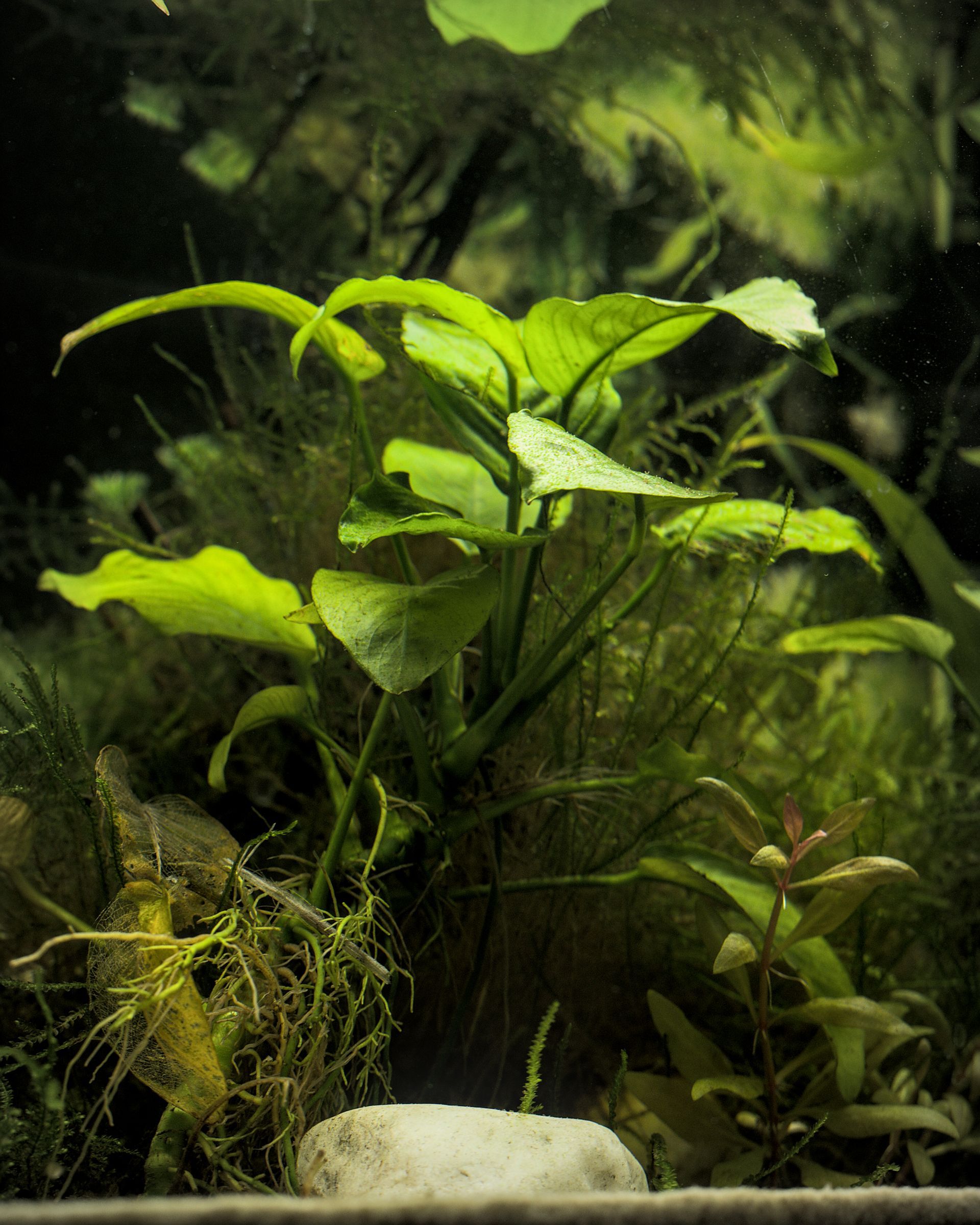
- Plants. They can remove ammonia and nitrite, which can prevent the cycle from completing.
- Low oxygen or no flow. The bacteria need at least 80% oxygen saturation, and strong aeration speeds things up. They also need a surface to grip and water moving across it.
SRAC adds two more. New filter media can be hard to colonize, possibly because the surface is still slick, and the second start-up usually goes faster. And system water should be free of residual chlorine before you begin 3. If your tap water uses chloramine, our chlorine and chloramine guide shows how to dose a conditioner that handles it. Neither Dr. Tim’s nor Aquarium Science covers chloramine in the pages we read.
For temperature, the sources disagree on how warm to go. We covered that in the temperature section of the cycle-time guide, so we won’t repeat the numbers.
The fastest fix SRAC mentions is moving biomedia from an established system 3. A sponge or a handful of ceramic media from a friend’s healthy tank saves weeks. Only take it from a tank with no disease.
Do water changes help or hurt?
They split the sources. Dr. Tim’s uses a water change to fix low pH and to dilute ammonia or nitrite 1. Aquarium Science says water changes remove the ammonia the bacteria feed on and tells you not to do them while cycling 2.
Both can be right. If the pH is fine and the numbers are in range, skip the water change. If pH is under 7.0 or nitrite is above 5 ppm, the change helps more than it costs. After the change, re-dose ammonia to your target so the bacteria still have food.
What we’d do
This is our reading of the sources, not a published procedure.
- Count the days. Under three weeks, be patient. Aquarium Science would not test at all that early, so check pH only if you see it falling.
- Test pH. Under 7.0, change 20 to 25% of the water and bring pH back above 7.0.
- Test nitrite. Above 5 ppm nitrite-nitrogen, dilute it and stop dosing until it falls.
- Check your dosing. Aim for 2 to 3 ppm ammonia-nitrogen, never above 5 ppm.
- Stop touching the filter. No rinsing, no new cartridges.
- Add used media if it’s still stuck after another week with pH in range.
FAQ
Why has my fishless cycle stalled? Dr. Tim’s says it is usually pH below 7.0 1. Aquarium Science also lists cleaning the filter, plants taking ammonia, and poor oxygen or flow 2.
How long should a fishless cycle take? Aquarium Science says colonies take 2 to 8 weeks to grow and that cycles run from days to months 2. Dr. Tim’s expects ammonia under 1 ppm around days 9 to 12 and a nitrite spike around days 14 to 20 with its no-bacteria method 1.
Is high nitrite a stall? Dr. Tim’s says nitrite-nitrogen above 5 ppm harms the second group of bacteria and recommends diluting it 1. Aquarium Science says high levels don’t stall a cycle 2. Either way, a water change to bring it under 5 ppm is low-risk.
Does cloudy water mean the bacteria are growing? No. Dr. Tim’s says nitrifying bacteria can’t grow fast enough to cloud the water 1. Our cloudy water guide covers what it is instead.
Should I add more ammonia to restart it? Not if ammonia or nitrite is still high. Dr. Tim’s says to stay at 2 to 3 ppm and never above 5 ppm 1.
Do I need baking soda? Only if pH or alkalinity is dropping. Aquarium Science uses one tablespoon per 25 gallons when pH falls 2, and SRAC starts alkalinity at about 150 mg/L 3.
How we got these numbers
We read Dr. Tim’s fishless cycling page, Aquarium Science’s fish-less cycling article and SRAC publication 4502 on October 20, 2026. Dr. Tim’s page reads “25% to 20%” for the water change, and we read it as 20 to 25%. None of the three pages dates its troubleshooting advice, and SRAC is a 2012 aquaculture sheet. Dr. Tim’s sells the products it describes, and Aquarium Science is one hobbyist’s site. The two disagree on water changes and on high ammonia and nitrite, and we’ve shown both. The baking soda conversion is our own arithmetic from the SRAC figure.
All the numbers, with sources
| What | Value | Type | Source |
|---|---|---|---|
| Dr. Tim's: a stall is usually caused by a pH below | 7.0 | Stated by source | [1] |
| Aquarium Science: pH must stay above (above 7.0 is better) | 6.5 | Stated by source | [2] |
| SRAC: best pH for starting a biofilter | 6.8 to 7.2 | Stated by source | [3] |
| SRAC: alkalinity to start with | About 150 mg/L (200 to 250 mg/L for nitrite bacteria) | Stated by source | [3] |
| Dr. Tim's: ammonia-nitrogen to dose to / never above | 2 to 3 ppm / 5 ppm | Stated by source | [1] |
| Dr. Tim's: nitrite-nitrogen above which it harms nitrite bacteria | 5 ppm | Stated by source | [1] |
| Dr. Tim's: ammonia typically below 1 ppm by (no-bacteria method) | Days 9 to 12 | Stated by source | [1] |
| Dr. Tim's: nitrite typically peaks between (no-bacteria method) | Days 14 to 20 | Stated by source | [1] |
| Aquarium Science: wait before doing any testing in a new tank | 3 weeks | Stated by source | [2] |
| Aquarium Science: oxygen the bacteria need | At least 80% saturation | Stated by source | [2] |
| Our calculation: baking soda to raise alkalinity 10 mg/L in 20 gal (76 L) | About 1 g | Our calculation | [3] |
Sources
- Dr. Tim's Aquatics (aquarium products maker) (n.d.). Fishless Cycling (methods and troubleshooting)
- Aquarium Science (aquariumscience.org, one hobbyist author) (n.d.). 2.1. Fish-less Cycling
- Southern Regional Aquaculture Center; DeLong and Losordo (2012). How to Start a Biofilter (SRAC Publication No. 4502; aquaculture, February 2012)