Fish Lying on the Bottom of the Tank: What It Means and What to Check First
Last reviewed · By Manel Vadillo
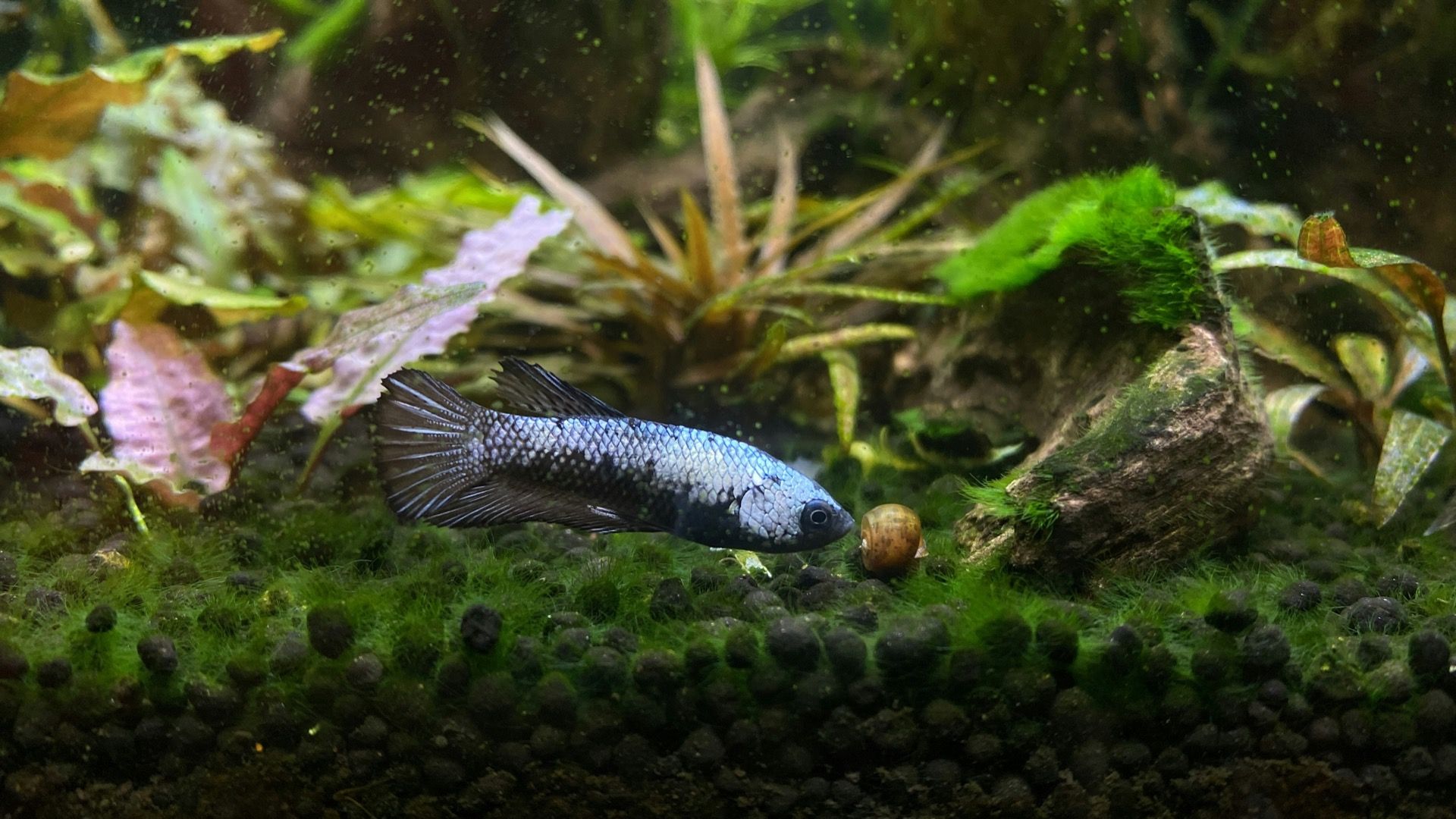
A fish on the bottom can be resting, or it can be telling you the water is wrong. Check what changed, then test, before you reach for a medicine. Water and buoyancy account for most of the causes our sources describe.
Quick answer
Test ammonia, nitrite and pH first. Merck links lethargic, off-food fish in a tank under about 6 weeks old to ammonia or nitrite poisoning. If the water tests clean and one fish sinks or tilts, it may be a swim bladder problem. Practical Fishkeeping says many such cases are untreatable.
First, is it a change?
Some fish feed near the bottom 3, so a fish resting low isn’t automatically sick. What matters is change. A fish that used to cruise the tank and now sits in a corner, lies on its side, or can’t hold a position is the one to worry about. That’s our reading, not a published rule. If you’re not sure what’s normal for the species, check its care guide before you act.
Test the water before anything else
Practical Fishkeeping’s Dr. Peter Burgess says outward signs rarely reveal the cause, and that water problems such as toxic ammonia can look like a buoyancy problem 4. Merck says the same for neurologic signs: test ammonia and pH whenever you see them 1.
- Ammonia and nitrite. Merck describes new tank syndrome: everything fine for weeks, then fish suddenly lethargic, off their food and often dying, usually within the first 6 weeks. Treatment is less feeding, water changes, chloride for nitrite poisoning and checking the biofilter. A tropical biofilter can take up to 8 weeks to establish 2. Our guides cover nitrite, cycling with fish in the tank and how to tell if a tank is cycled.
- Carbon dioxide. Merck says it is toxic above 12 mg/L, and affected fish look lethargic and unresponsive. The water often tests acidic. The treatment is vigorous aeration 1. Our pH guide covers what a low reading means.
- Warm, low-oxygen water. Merck notes warm water holds less oxygen, and that a tank in direct sun can warm up 3.
- Cold water. Aquarium Co-Op says a betta without a heater in a typical US room, 67 to 69 °F, is quite lethargic and may get sick from the constant cold 7. That is Co-Op’s point about bettas; for other tropical fish, check the thermometer too (our reading). Our betta guide covers a betta lying still at the bottom.
Quick triage
| What you see | What the sources point to | Check first |
|---|---|---|
| Lethargic, off food, tank new or recently changed | Ammonia or nitrite poisoning 2 | Ammonia and nitrite |
| Lethargic, unresponsive, acidic water | High carbon dioxide 1 | pH, aeration |
| Lethargic betta, no heater, cool room | Cold water 7 | Thermometer, heater |
| One fish sinks, tilts or can’t stay upright | Swim bladder problem 4 5 | Species, feeding, water |
| Lethargy, weight loss, white stringy feces | Intestinal parasites in cichlids, bettas, gouramis 1 | Appetite, feces |
| Lethargy, scratching, gray or yellowish film | Skin or gill parasites 1 | Look closely at the skin |
None of these is a diagnosis. Merck says several of these parasites can only be confirmed under a microscope 1.
When it’s a swim bladder problem
Burgess describes the swim bladder as a gas-filled sac that gives neutral buoyancy. If it is under-inflated, collapsed, ruptured or filled with fluid, the fish tends to sink to the bottom, and the belly can get scraped on the substrate. A key sign is a fish that floats or sinks, often suddenly. Typically only one fish is affected, and goldfish seem particularly prone 4.
He also says that not every odd swimming pattern is the swim bladder. Infections, ammonia and poisons can damage the nervous system and cause uncoordinated swimming. Gas in the gut can cause floating 4. The most reliable investigation is an x-ray at a vet, and many cases are untreatable 4.
Aquarium Science, one hobbyist author, says it is common in fancy goldfish, “balloon” mollies and bettas and rare in other fish. That pattern points to breeding for a rounded body and short spine. The same author says some fancy goldfish live productive lives with it 5.
Causes and fixes depend on which source you trust:
- Diet. Burgess says there is circumstantial evidence that diet or constipation causes some cases in goldfish, whose swim bladder connects to the gut. Fasting for a few days or feeding crushed fresh or cooked peas are harmless and worth trying 4.
- Infection. Burgess says bacterial infection might respond to an antibacterial or, ideally, a vet’s antibiotics 4. Aquarium Science recommends a hospital tub and medicated food made with Metroplex and an antibiotic 5. That is one hobbyist’s protocol.
- Water. Burgess says links to high nitrogen waste or a rapid temperature drop are mostly anecdotal 4.
- Shipping. Aquarium Science argues the pressure changes of air freight damage the swim bladder of many store fish 5. That is one site’s explanation. We found no test of it.
Both sources are blunt about the odds. Aquarium Science says most cases indicate organ failure and are incurable and fatal, though mild ones may resolve 5.
What we’d do
This is our reading, not a published protocol.
- Test ammonia, nitrite and pH now. If either nitrogen number is above zero, change water and feed less.
- If the water is clean and the fish is a goldfish or other cyprinid that floats or sinks, go a few days without food, or try a little crushed fresh or cooked pea, as Burgess suggests.
- Move the fish to a bare hospital tub if other fish are harassing it. One FishLore owner did that with a divider.
- Don’t start antibiotics from a forum thread. Burgess says a vet’s antibiotics are the ideal route if infection is suspected 4, so a fish vet is the next step if the water is fine and the fish keeps declining.
What hobbyists report
On FishLore, an owner found one of two goldfish sitting on the bottom after a weekend away with a delayed-release food block in a 10 gallon tank. It also did occasional backflips. Members guessed ammonia and told the owner to do 50% water changes. The owner’s kit didn’t test ammonia (nitrate 10 ppm, nitrite 0). After a roughly 40% change, the fish was swimming normally again. A week later it relapsed, with ammonia reading below 0.1, nitrate 10 and the other goldfish picking on it. Skinned peas didn’t help. It died a few days later. Members said repeatedly that the tank was too small for two goldfish 6.
FAQ
Is my fish dying? We can’t tell from a description. We’d treat a fish on its side that ignores food as urgent: test the water now and use the triage table above.
Can swim bladder disease be cured? Burgess says many cases are untreatable 4. Aquarium Science says most are fatal but mild ones may resolve 5.
Do peas work? Burgess says claims that peas and fasting help goldfish are common and the treatment is harmless, so worth a try 4.
Should I do a water change? Merck’s new tank syndrome treatment includes water changes 2. Our water change guide covers how much.
Why is my fish lying on its side? Burgess lists a swim bladder problem, infection, ammonia and other causes, and says outward signs rarely show which 4.
All the numbers, with sources
| What | Value | Type | Source |
|---|---|---|---|
| Merck: new tank syndrome usually appears within | The first 6 weeks | Stated by source | [2] |
| Merck: time for a tropical biofilter to establish, up to | 8 weeks | Stated by source | [2] |
| Merck: carbon dioxide that is toxic, and makes fish lethargic, above | 12 mg/L | Stated by source | [1] |
| FishLore owner: water change that perked up a goldfish on the bottom | About 40% | Stated by source | [6] |
Sources
- Merck Veterinary Manual (n.d.). Disorders and Diseases of Fish (Pet Owner Version)
- Merck Veterinary Manual (n.d.). Management of Aquarium Fish (new tank syndrome)
- Merck Veterinary Manual (n.d.). Providing a Home for Fish (Pet Owner Version)
- Practical Fishkeeping (UK magazine) (n.d.). What causes swim bladder disease? (Dr. Peter Burgess)
- Aquarium Science (aquariumscience.org, one hobbyist author) (n.d.). 11.6. Swim Bladder
- FishLore Aquarium Forum (n.d.). Goldfish laying on bottom of tank (forum thread, hobbyist experience)
- Aquarium Co-Op (fish and aquarium products retailer) (n.d.). Care Guide for Betta Fish: The Best Beginner Pet Fish