Ich Fish Treatment: How to Clear White Spot Disease From Your Tank
Last reviewed · By Manel Vadillo
Ich fish treatment comes down to timing. The parasite only dies while it is swimming free in the water. That one fact explains why a single dose never clears it and why the schedule matters more than the brand of medicine. The extension and veterinary sources agree on the schedule and split on salt versus medicine.
Quick answer
Treat the whole tank, not just the spotted fish, and repeat the treatment on a schedule. In warm water (75 to 79 °F), UF/IFAS says treat daily for at least 3 to 5 treatments. Salt at 4 to 5 g/L for 7 to 10 days also works, if your fish tolerate it. Keep treating until fish stop dying, plus a day after the last spot.
How to tell it’s ich
The classic sign is small white spots on the skin or fins. UF/IFAS adds that the spots often show up only after the fish is already very sick. The earlier signs are flashing (fish scraping against decor), extra mucus, weakness, a poor appetite and low activity 1. Merck lists lethargy, clamped fins and dark coloration, and says the white dots can also sit on the gills 2.
Two cautions. Gill-only infections may show no spots at all, just pale, swollen gills 1. And not every spotted fish has ich. Aquarium Co-Op describes “stress ich” as a lookalike that covers the whole body evenly instead of starting on the fins, keeps a steady spot count and isn’t contagious. It says that version won’t necessarily respond to ich treatment 3. If five days of treatment change nothing, Co-Op’s advice is to stop, assume the diagnosis was wrong and reassess 3.
UF/IFAS says to treat even when you find a single parasite 1. Waiting to see if it spreads is the wrong call.
Why one dose never works
The parasite has three stages. The trophont feeds under the skin and gill tissue and grows to 0.5 to 1.0 mm. When it matures it drops off, forms a gelatinous cyst called a tomont and divides, up to 10 times, into as many as 1,024 free-swimming theronts (also called tomites). At 74 °F (23 °C) the division takes 18 to 24 hours 1.
Only the free-swimming stage is vulnerable to chemicals. The stage on the fish is shielded by the fish’s own tissue and mucus, and the cyst resists treatment too 1 2. So a medicine can only kill the batch that happens to be swimming that day. The rest hatch later and you dose again.
That is also why temperature changes the whole plan. In warm water, 75 to 79 °F (24 to 26 °C), the full cycle takes about 3 to 6 days, and cooler water takes longer 1. Merck gives the same logic: free-swimming tomites have to find a fish within days in warmwater species and weeks in coldwater ones, and the intervals between treatments follow the water temperature 2.
| Water temperature | Treatment interval | Minimum number of treatments | Source |
|---|---|---|---|
| 75 to 79 °F (24 to 26 °C) | Daily | 3 to 5 | UF/IFAS 1 |
| 60 °F (16 °C) | Every 3 to 5 days | 5 | UF/IFAS 1 |
| Above about 79 °F (26 °C) | Daily, 3 to 7 treatments may be needed | 3 to 7 | Merck 2 |
UF/IFAS says to continue until all ich-related deaths stop, and to retest if needed 1.
Hobby guides often say to raise the temperature to speed the parasite through its cycle. The extension and veterinary sources we used don’t prescribe it, and they give no safe ceiling. We won’t put a number on it. If you warm the tank, keep the extra oxygen in mind and check what your fish can take (our heater size guide covers equipment, not species limits).
Ich treatment options
Here is what each source says. Co-Op is a retailer, so weigh its product advice accordingly.
| Option | What the sources say | The catch |
|---|---|---|
| Salt | UF/IFAS: 4 to 5 g/L for 7 to 10 days at 75 to 79 °F, if the species tolerates it. Theronts don’t tolerate 3 to 5 ppt, and most freshwater fish handle 5 ppt for several weeks 1. Merck: 5 g/L for one week at 75 °F or warmer, if the species tolerates it 2. | Co-Op says catfish and loaches can be more sensitive to salinity changes, and that salt is used with cichlids and goldfish 3. Live plants and some species may not like it (our reading, no source gives a list). |
| Formalin | UF/IFAS: 25 mg/L, which is 1 mL per 10 gallons, or half that (0.5 mL per 10 gallons) for sensitive species 1. Merck calls formalin or copper the drugs of choice 2. | Strong chemical. Read the label of the product you actually buy, because concentrations differ. Provide vigorous aeration during treatment 1, and do a water change if the fish show stress. |
| Copper | UF/IFAS: this is copper sulfate, not copper ion, and the dose in mg/L of copper sulfate is total alkalinity divided by 100. Never use it below 50 mg/L alkalinity or without an alkalinity test. It calls copper sulfate extremely toxic to fish and says overdosing should be expected to kill them 1. | Weigh it, keep emergency aeration ready and read the label of any aquarium copper product instead of using the pond formula. Our cherry shrimp guide covers why copper rules out invertebrates. |
| Malachite green (Ich-X) | Co-Op’s protocol: 5 mL per 10 gallons every 24 hours, with a one-third water change each day and a re-dose for the full tank volume. Half doses won’t kill ich 3. The maker’s label may differ (our water change guide quotes Hikari’s), and the label wins. | Merck says malachite green products work, but that veterinarians shouldn’t dispense it because of regulatory concerns 2. |
| Potassium permanganate | UF/IFAS: not recommended. More than once a week can damage skin, gills and eyes 1. | Skip it. |
Every dose above depends on a number you can’t guess: the volume of water in your tank. A 20 gallon tank holds less than 20 gallons once you subtract gravel, rocks and decor, so dose the real volume. Our aquarium volume calculator does the subtraction.
What we’d do
This is our reading of the table, not a published protocol.
- Confirm it. Spots that start on the fins, a steady rise in count, other fish flashing. If the whole body is evenly dusted and the count never changes, think stress, not ich 3.
- Pick salt if your fish allow it. It is the one option with no label to misread. Convert with the volume you calculated: 4 to 5 g/L works out to about 15 to 19 g per US gallon, so roughly 300 to 380 g for a 20 gallon tank before subtracting decor (our calculation from UF/IFAS 1). Dissolve it in a bucket of tank water first, not on the gravel. Our aquarium salt dose chart has the grams for every tank size and why labels disagree.
- If salt is out (catfish and other scaleless fish, loaches, dwarf and thick-lipped gouramis, shrimp, snails, a planted tank you care about; see the tolerance list in our aquarium salt dose chart), use a labeled ich medicine for the whole tank and follow its schedule to the letter.
- Keep treating past the last spot. Co-Op adds one extra day after the last visible spot, because cysts may be sitting in the substrate 3. UF/IFAS says to keep going until the deaths stop 1.
- Do water changes the label asks for. Medicines change the rules. Our water change guide quotes one maker’s Ich-X directions.
- Watch for secondary infections. Treated fish can have wounds and tissue damage, and Co-Op says bacterial or fungal infections may need their own treatment 3. Our fin rot guide covers the common one.
Cleaning the tank during an outbreak
This is the one time to clean harder than usual. Merck says cysts can be removed by thoroughly cleaning and removing debris from the gravel, and that leaving a system fallow (with no fish) breaks the life cycle. The parasite can’t survive without living fish 2. UF/IFAS says that in a pet tank you should clean every other day to remove cysts stuck to debris, and its summary says daily cleaning is also beneficial 1.
That advice runs against the usual “don’t over-clean” rule for filters. Vacuum the debris, but leave the filter media alone. Our tank cleaning guide explains the difference.
Don’t share nets or siphons between tanks. Co-Op says to disinfect reused tools with very hot tap water and chlorine, then dry them completely 3. Touching the water won’t infect you, but wash your hands and forearms 3.
Survivors can stay carriers. Merck says fish that survive an outbreak may resist later ones but can still infect fish that have never been exposed 2.
How to keep it out
UF/IFAS says to quarantine new fish for at least 30 days, and that symptoms can appear 1 to 3 weeks after shipping in warm water. It also says plants and structures can carry cysts, so keep plants in a fish-free tank before they go into the main one 1. Remove dead fish quickly 1.
Co-Op names buying fish without quarantine as a likely cause of outbreaks. It also points to fast changes in pH or temperature and poor maintenance. UF/IFAS agrees that outbreaks often follow rapid temperature swings 3 1. Whether ich is always present at low levels is debated. Co-Op’s answer is to run every tank as if it were 3.
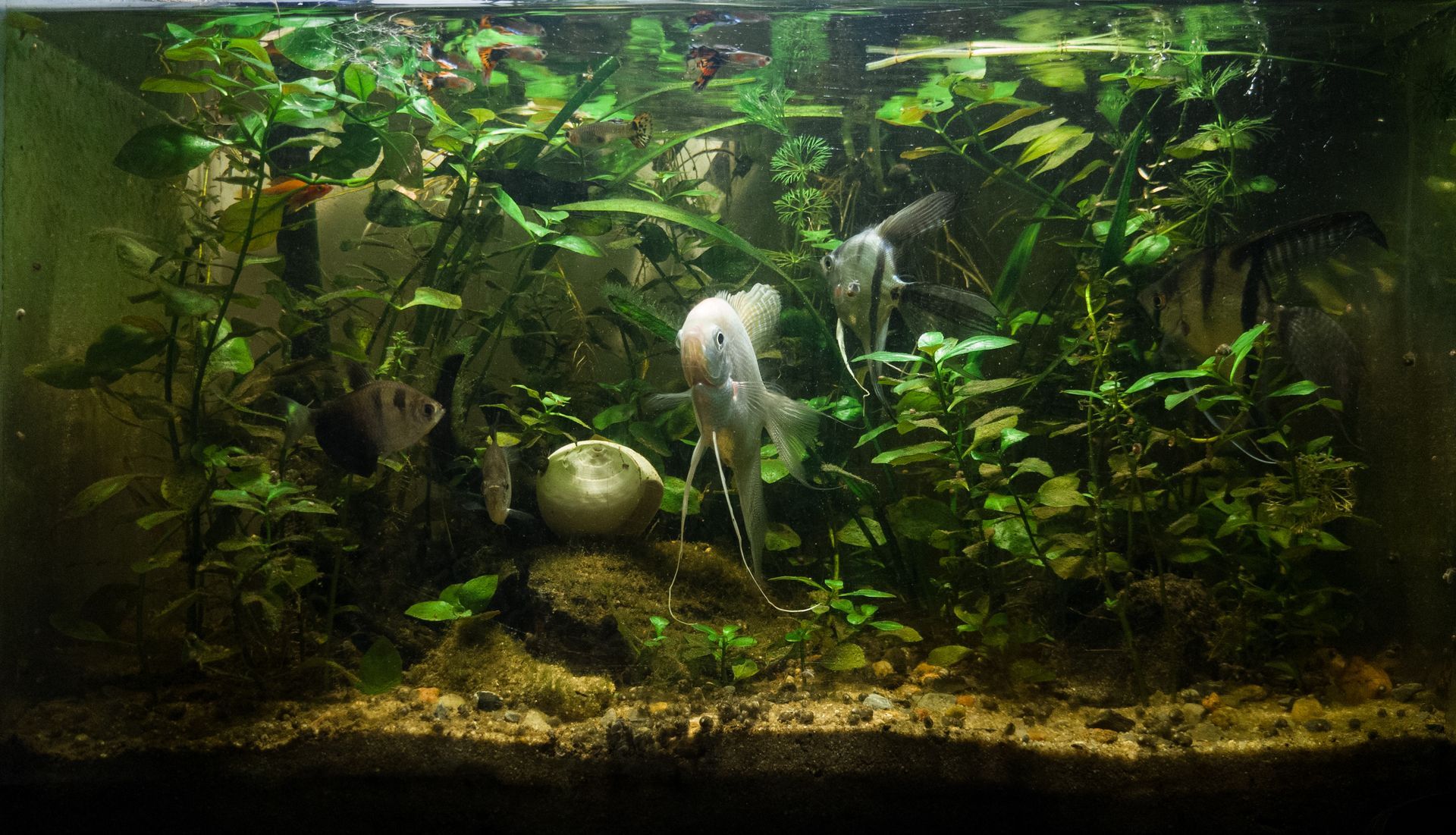
A new tank with new fish is the usual setting. If fish are dying in the first weeks, ich is one cause among several, and our guide to fish that died in a new tank walks through the others.
How we got these numbers
The parts that are ours: the conversion of 4 to 5 g/L to about 15 to 19 g per US gallon (multiply by 3.785 liters per gallon) and the step-by-step order. We read the UF/IFAS extension publication, the Merck Veterinary Manual chapter on parasitic diseases of fish and Aquarium Co-Op’s ich page on October 20, 2026. UF/IFAS shows no revision date on the page. Merck gives June 2026. The sources disagree on salt duration (7 to 10 days against one week) and on malachite green, and we’ve shown both. This page is general information and doesn’t replace an aquatic veterinarian, especially for valuable fish or a fast-moving outbreak.
FAQ
Is ich contagious? Yes. UF/IFAS calls it highly contagious, spreading directly from fish to fish without another host 1. Merck says it passes through contact with infected fish or equipment like nets 2.
How long does ich take to clear? It depends on temperature. In warm water UF/IFAS gives at least 3 to 5 daily treatments, and Merck says 3 to 7 may be needed 1 2. Co-Op adds one day after the last spot 3.
Can I treat ich with salt alone? UF/IFAS and Merck both list salt for freshwater fish that tolerate it: 4 to 5 g/L for 7 to 10 days, or 5 g/L for one week 1 2.
Can ich live in a tank without fish? Merck says it can’t survive without living fish, and that leaving a system fallow breaks the life cycle. It doesn’t give a number of days 2.
Is ich dangerous to people? Co-Op says touching the water won’t infect you. It still recommends washing your hands and forearms 3.
Is it ich or stress ich? Real ich starts on the fins and spreads, and the spot count rises. Co-Op says stress ich covers the whole body, holds a steady count and isn’t contagious 3.
All the numbers, with sources
| What | Value | Type | Source |
|---|---|---|---|
| UF/IFAS: full parasite life cycle in warm water | About 3 to 6 days at 75 to 79 °F (24 to 26 °C) | Stated by source | [1] |
| UF/IFAS: tomites released from one cyst | Up to 1,024 | Stated by source | [1] |
| UF/IFAS: treatment schedule in warm water | Daily, at least 3 to 5 treatments (75 to 79 °F) | Stated by source | [1] |
| UF/IFAS: treatment schedule in cool water | Every 3 to 5 days, at least 5 treatments (60 °F / 16 °C) | Stated by source | [1] |
| UF/IFAS: salt bath | 4 to 5 g/L for 7 to 10 days at 75 to 79 °F | Stated by source | [1] |
| Our conversion of that salt dose | About 15 to 19 g per US gallon | Our calculation | [1] |
| Merck: salt for freshwater fish | 5 g/L for one week at 75 °F (24 °C) or warmer | Stated by source | [2] |
| UF/IFAS: formalin in a tank | 25 mg/L, which is 1 mL per 10 gal (38 L) | Stated by source | [1] |
| Aquarium Co-Op: Ich-X dose | 5 mL per 10 gal (38 L) every 24 hours | Stated by source | [3] |
| UF/IFAS: minimum quarantine for new fish | 30 days | Stated by source | [1] |
Sources
- UF/IFAS Extension; Francis-Floyd, Yanong and Pouder (n.d.). Ichthyophthirius multifiliis (White Spot) Infections in Fish (CIR920/FA006)
- Merck Veterinary Manual (full review May 2022, last updated June 2026) (2026). Parasitic Diseases of Fish
- Aquarium Co-Op (aquarium retailer) (n.d.). How to Treat Ich or White Spot Disease on Freshwater Fish