Axolotl Care Guide: Cold Water, Tank Setup, Laws and Cost
Last reviewed · By Manel Vadillo
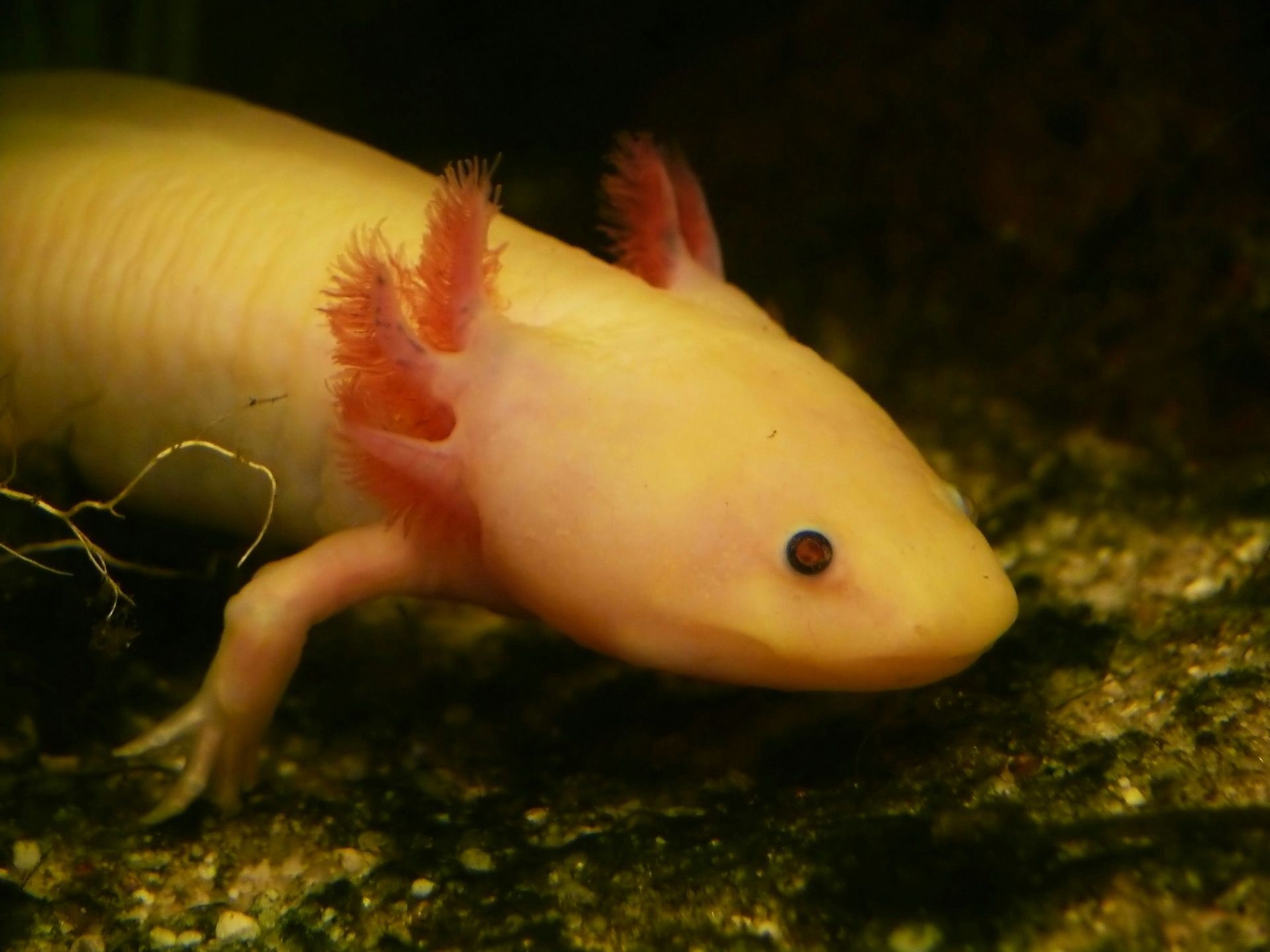
An axolotl isn't a fish, and it wants water colder than most homes. It lives for a decade or more, can't be bought legally everywhere, and swallows whatever fits in its mouth. Sort those out before you buy one.
Quick answer
Check your state's rules first. An axolotl is a cold-water salamander: plan a cycled 20 gallon long tank at 60 to 64 °F with fans or a chiller (never a heater), a bare bottom or fine sand, a sponge filter and no tankmates. Expect 10 to 15 years. Budget roughly $195 to $235 for the basics, and $645 or more if you need a chiller.
What is an axolotl, and why is it in a fish tank?
An axolotl (Ambystoma mexicanum) is a salamander that never leaves the water. It stays in its larval form for life, keeps its feathery external gills and is closely related to the tiger salamander 2.
That’s why it belongs in an aquarium. It needs a filtered, cycled, fully aquatic tank like a fish does, only colder and quieter, and it’s far less forgiving of mistakes.
Is a pet axolotl a good first pet?
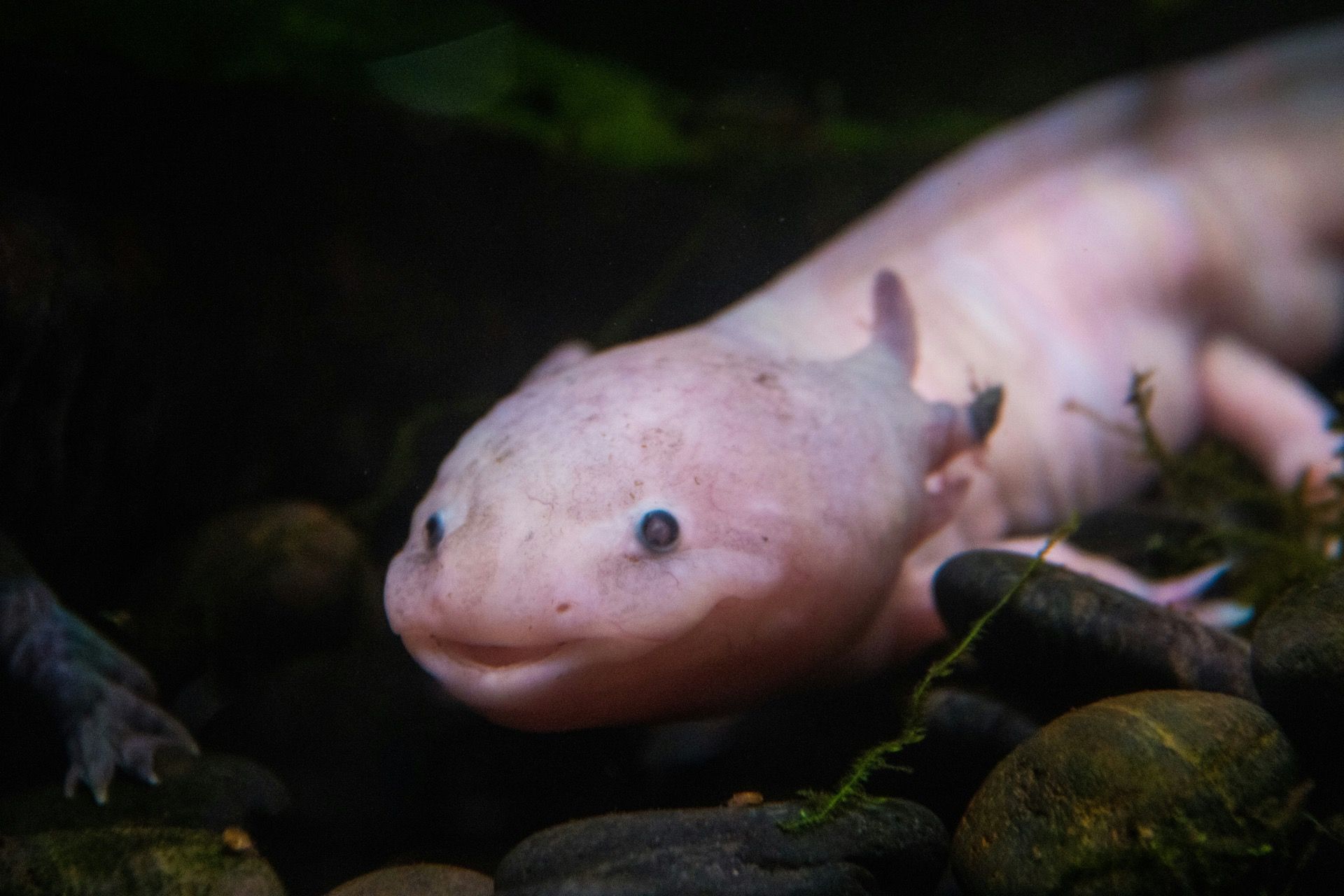
Not an easy one. Axolotl Central, a hobbyist care site, says outright that axolotls are harder to keep than some other animals. They need cold, clean water, often a dedicated chiller, they are prone to illness and injury, and many need to be fed with tongs 4. LafeberVet adds that many diseases in captive axolotls come from poor husbandry 2.
It’s not out of reach. If you’ve kept a cycled freshwater tank before, most of the routine will be familiar. What’s new is the temperature (see below) and the fact that you look and don’t touch. Vets advise against handling because the skin is delicate and the animal stresses easily 3.
It also lives 10 to 15 years, and some are reported to reach 20 2. Think of it as a 10-year-plus commitment with a weekly chore list, not a desk pet.
Are axolotls legal in the United States?
Check before you buy. Axolotls are legal in many states but not all, and some states build their own bans on top of a federal listing.
In January 2025 the Fish and Wildlife Service added the axolotl’s genus, Ambystoma, to the federal list of injurious salamanders in 50 CFR 16.14 8. The aim is to keep a salamander chytrid fungus out of the country 12.
The Ambystoma part was published as an interim rule, and a September 2025 Service bulletin still describes it as interim, so details may change 14.
The listing doesn’t ban owning one. The Service says it doesn’t affect ownership and doesn’t regulate breeding, sale, purchase or possession 12.
What it does prohibit is importing one into the United States and shipping one between the continental U.S., D.C., Hawaii, Puerto Rico and U.S. possessions. Moving one between states inside the continental U.S. isn’t prohibited by the statute, after a 2017 federal appeals court ruling 9.
In practice, a breeder in one continental state can ship to a buyer in another without a federal permit, but not to Hawaii, Puerto Rico or D.C., and not out of D.C. The Service’s own example is that you can’t ship a listed salamander from California to Hawaii 12.
What each state’s own rules say
States are where it gets tricky. Here is what we could confirm from official sources on October 5, 2026:
| State | Status | What the official source says |
|---|---|---|
| Arkansas | Prohibited | On the Game and Fish Commission’s Prohibited Captive Wildlife list since May 16, 2024. A free registration window for existing owners closed June 30, 2025, and no more may be obtained 6 |
| California | Restricted | Title 14 §671 names the genus Ambystoma in its list of restricted animals, and axolotls belong to it. Ask the Department of Fish and Wildlife before buying 7 |
| District of Columbia | Prohibited | Bans importing or possessing any living animal except a short list: dogs, cats, domesticated rodents and rabbits, captive-bred cage birds, non-venomous snakes, fish and turtles, ferrets and racing pigeons. Amphibians aren’t on it 21 |
| Hawaii | Permit, and no shipping from the mainland | The state’s Conditionally Approved list names Ambystoma mexicanum, and animals on that list need an import permit 22 23. The federal rule also blocks shipping one there 12 |
| Maine | Permit required | The state lists Ambystoma mexicanum as a Category 2 Restricted species, captive-bred only 18. A permit applicant must be an exhibitor, rehabilitator, USDA-registered lab, accredited research facility, or an individual with demonstrated experience caring for the species or a similar one, and must submit credentials and a plan for the animal if they are away, ill or die 17 |
| New Jersey | Permit required | As the rules read, a permit is needed for any exotic amphibian 15, and the axolotl isn’t among the state’s short list of exempt amphibians (frogs, toads, red newts, dusky salamanders) 16 |
| New Mexico | Not allowed for the general public | Any species missing from the Director’s Species Importation List is treated as Group IV, which is closed to the general public 19. We checked the current list and the axolotl isn’t on it 20 |
| Virginia | Legal | Since August 1, 2021 it’s legal to import, export, sell and possess axolotls, and no permit is required 5 |
Alabama deserves its own note. Its rule 220-2-.26 bars possessing, selling or importing any amphibian listed as injurious wildlife under the Lacey Act 13. The federal list covers every species in a listed genus, which by the rule’s wording would reach axolotls. Confirm with the Alabama Department of Conservation and Natural Resources before you buy 12.
We haven’t verified the other states, so don’t read silence as a green light. Laws change, and your state wildlife agency has the last word.
Axolotl water temperature: the number that matters
Cold. Sources give slightly different ranges, so here they are side by side:
| Source | Preferred or ideal | Warning line |
|---|---|---|
| LafeberVet (vets) | 60–64 °F (15.6–17.8 °C) | Under 75 °F necessary 2 |
| University of Kentucky stock center | 60–65 °F (15–18 °C) | Never above about 72 °F (22 °C) 1 |
| Tree of Life exotic-pet clinic | 60–68 °F | Above 72 °F can mean illness or death 3 |
| Axolotl Central | 53.6–68 °F (12–20 °C) | Over 71.6 °F for long stretches is stressful, over 75.2 °F can be fatal 4 |
Three of the four put the line at about 72 °F. We’d aim for 60 to 64, start cooling once the tank passes 68, and treat 72 as the limit.
This is the reverse of the other two fish in this series. A goldfish is fine at room temperature (goldfish care guide) and a betta needs a heater at about 78 °F (betta fish care guide). An axolotl is the one that struggles in a warm house.
Why heat is the number one mistake
An axolotl is ectothermic: its body temperature, metabolism and breathing follow the water. Warmer water speeds that up and holds less oxygen, so the animal burns more energy with less to work with, and its immune response weakens 4.
Overheating is a common cause of illness 3. Water above 75 °F can cause hyperthermia, with poor appetite, fluid in the belly, floating the animal can’t control and secondary infections 2.
Keeping the tank cool without a heater
You will not need a heater. You may need the opposite. In rough order of cost:
- Location. A cool room, out of direct sun, away from the TV, consoles and the fridge. A basement is often the coldest spot in a house. Air conditioning that holds the room near 70 °F makes every other method work better 24.
- Fans. Clip-on fans blowing across the surface cool by evaporation, by as much as about 6 °F. They do little in humid rooms or when the room itself is hot, and they raise the evaporation rate, so you’ll top off more often. A fan needs a breathable lid, such as egg-crate or acrylic cover, not a mesh reptile lid 24 4.
- Frozen bottles. Rinsed bottles filled three-quarters with dechlorinated water, swapped as they thaw. Axolotl Central calls it a pinch fix: it needs you there all day, and ice chills the water right around it, which can shock an animal swimming nearby 24.
- A chiller. The consistent fix. It’s an external unit the tank water runs through, so you also need a canister filter or a pump to feed it 24. Bulk Reef Supply’s sizing rule of thumb is tank gallons × 10 × the number of degrees you need to drop, in BTU per hour 35. For a 20 gallon tank that has to drop 10 °F, that works out to about 2,000 BTU/hr. That is our arithmetic from their formula, so check the rating on any unit you buy.
Whatever you use, put a thermometer in the tank. Axolotl Central found some digital ones reading nearly 10 °F off, so check one against a second. It also notes that the “safe zone” printed on many thermometers is for tropical fish and doesn’t apply here 24.
Axolotl tank setup
Size
A 20 gallon long is the minimum for one adult, and bigger is better. Length matters more than height, since axolotls walk the bottom 3. The clinic adds at least 10 gallons for each extra axolotl 3.
Guides differ. LafeberVet gives 10 gallons for a juvenile and 20 or more for an adult, noting that larger tanks hold stable water longer 2. Axolotl Central asks for 29 gallons as the absolute minimum and a 40 gallon breeder as a better one 4.
The Kentucky center houses two adults in a ten gallon, but that’s a lab rule of thumb with very frequent water changes 1. We wouldn’t copy it at home.
A lid helps. Some axolotls jump if the water level is too high 4.
Sand, gravel and impaction
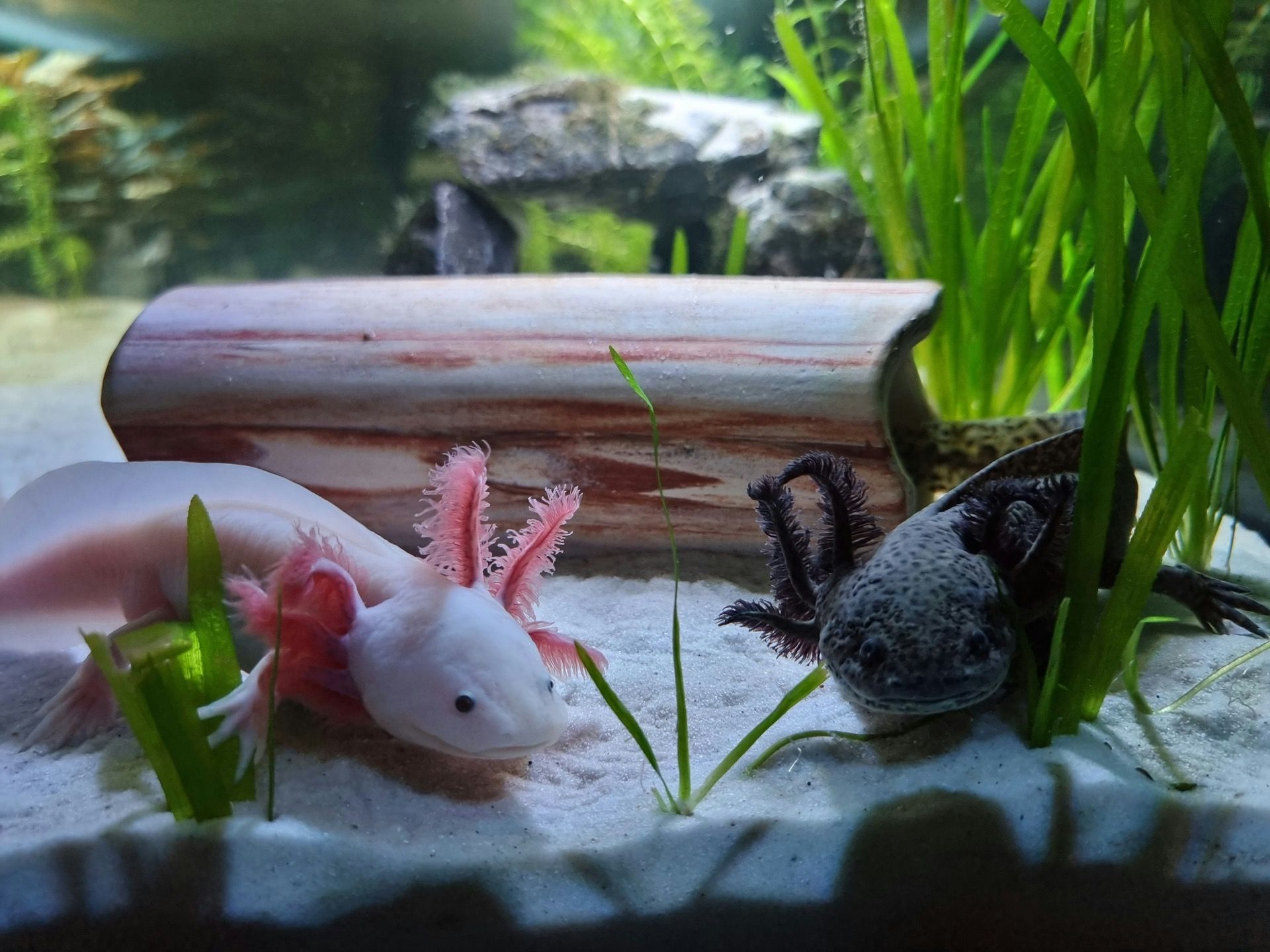
Use a bare bottom or fine sand for an adult. Skip gravel. An axolotl eats whatever it can fit in its mouth, and an exotic-pet vet clinic lists bare-bottom or fine sand as best, gravel and small pebbles as the thing to avoid 3.
Gravel is a real risk. Swallowed gravel or small decor can block the gut, cause serious problems or death, and sometimes needs surgery 2. Small stones can be regurgitated, but not always.
If you want sand, make it very fine. Axolotl Central says grains under 1 mm pose the least risk, and that anything over 2 mm is gravel. It also says to wait until the animal is at least 6 inches (15 cm) long, because younger ones can’t pass even fine sand safely 4. For stones, pick large river stones, not pebbles 2.
The Kentucky center is the odd one out. It says coarse gravel is acceptable if you must, though axolotls eat smaller, pea-sized gravel and regurgitate it eventually 1. We’d still go bare-bottom.
Hides, plants and light
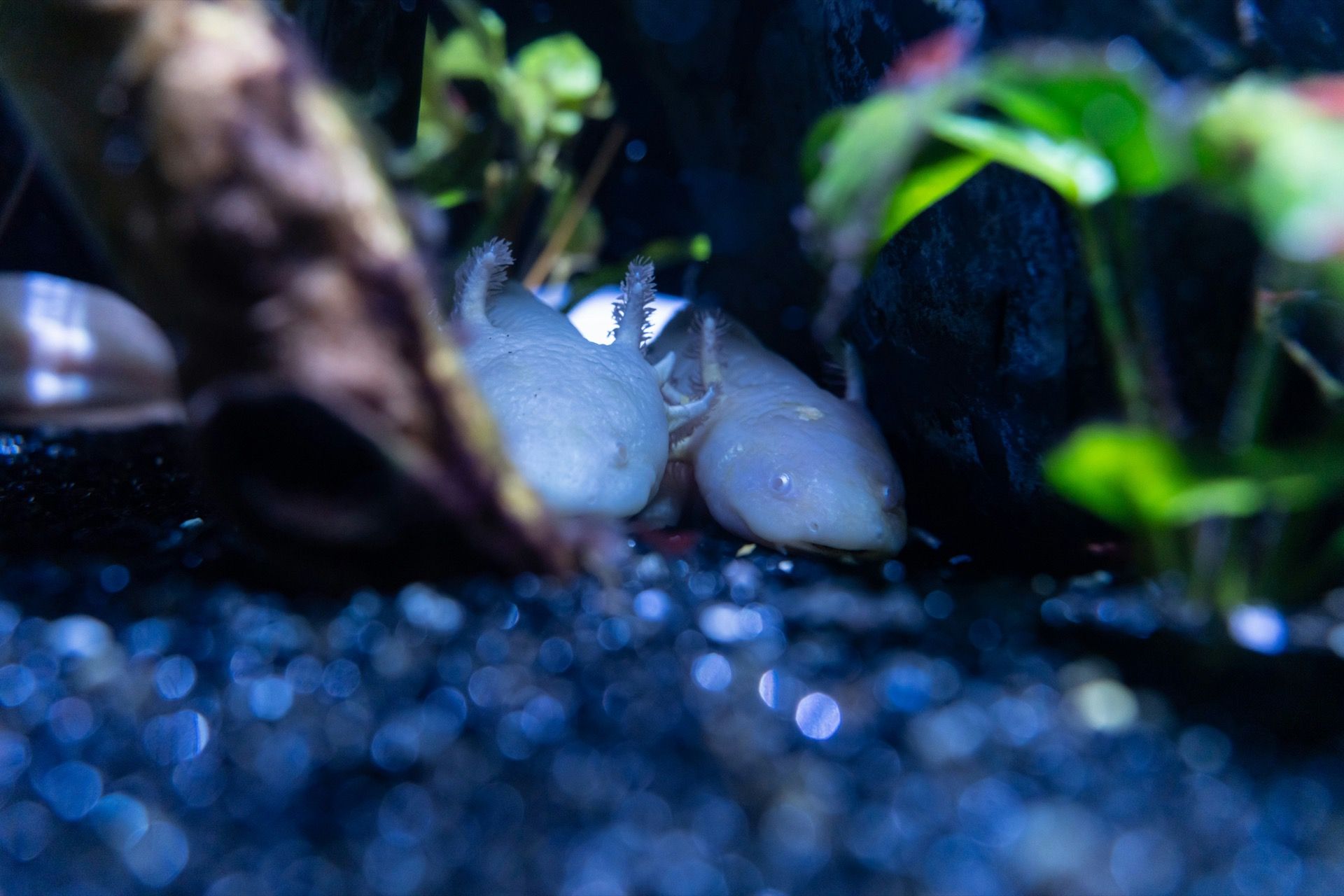
Give it smooth hiding places: PVC pipe or caves, and silk or live plants, with nothing sharp that could cut the skin 3. Axolotls have no eyelids and don’t like bright light, so keep the lighting low and pick plants that cope with dim, cold water, such as anubias, java fern, java moss or elodea. Skip fertilizers 4 2.
Water flow, filtration and cycling
Keep the flow gentle. Axolotls spend most of their time lying almost motionless on the bottom, and rapidly circulating water stresses them 1.
A sponge filter is the easy answer. A canister with a spray bar also works if you diffuse the current 2. Axolotl Central notes a sponge filter runs on an air pump and makes gentle bubbles at the surface, and calls it safe for axolotls of any size 4. A bubbler is fine as long as it doesn’t turn the tank into a washing machine.
Cycle the tank before the animal goes in. Start with our fishless cycle calculator, the fishless cycle guide and the guide to telling when a tank is cycled. If the terms are new, the nitrogen cycle explains what’s happening, and how long a cycle takes sets expectations. Axolotls are heavy waste producers, so nitrate climbs fast 4. Our setup guide puts the whole sequence in order.
Water parameters
| Parameter | Target | Source |
|---|---|---|
| Temperature | 60–64 °F preferred | 2 |
| pH | 7.4–7.6 preferred, 6.5–8.0 acceptable | 2 |
| Ammonia and nitrite | 0 ppm | 2 |
| Chlorine and chloramine | 0 ppm | 2 |
| Nitrate | Under 10 ppm preferred (LafeberVet); under 20 ppm (Axolotl Central); under 40 ppm (exotic-pet clinic) | 2 4 3 |
| Hardness | Not soft or distilled water; Axolotl Central gives 7–14 °dH (GH) as ideal | 1 4 |
Nitrate is where the sources disagree most. Higher levels over time can lead to eye problems and cloudy eyes 2, so we’d chase the lower number.
Change about 30% of the water weekly 2. Our water change guide covers the how. Treat tap water to remove chlorine and chloramine. Axolotl Central says to avoid conditioners with aloe or iodine, and names Seachem Prime as the one most often recommended 4. Don’t use distilled water. The Kentucky center says axolotls need hard water to keep their skin, their main defense against infection, in good shape 1.
Test weekly with a liquid kit and test your tap water too 4.
What do axolotls eat?
Sinking axolotl pellets and earthworms, with occasional bloodworms or blackworms. The clinic names Hikari Carnivore Pellets and Northfin Axolotl Pellets as staples, and earthworms as the best fresh food 3.
How much and how often:
- Juveniles: daily 3.
- Adults: every 2 to 3 days 3, or two to three times a week 2.
- Per meal: the Kentucky colony feeds animals about a year old three or four times a week, no more than five 3/16 inch (5 mm) pellets at a time. That’s a lab schedule, but it shows how little they eat 1.
- Leftovers: take out uneaten food after a few hours 3.
Don’t overfeed. Axolotls have a slow metabolism and low energy needs, so obesity is a real risk 2.
Cut large earthworms into pieces. LafeberVet cites a report of stomach perforation in two tiger salamanders after they swallowed whole nightcrawlers 2. The Kentucky center also lists aquarium-bred feeder guppies or goldfish, but warns never to use bait-shop minnows, which are usually loaded with parasites 1. We’d stay with pellets and worms.
Axolotl colors
You’ll see more than the wild look. The natural color runs from black to mottled brown. Breeding has added melanistic, leucistic and albino animals, and a transgenic line that glows green under UV light 2.
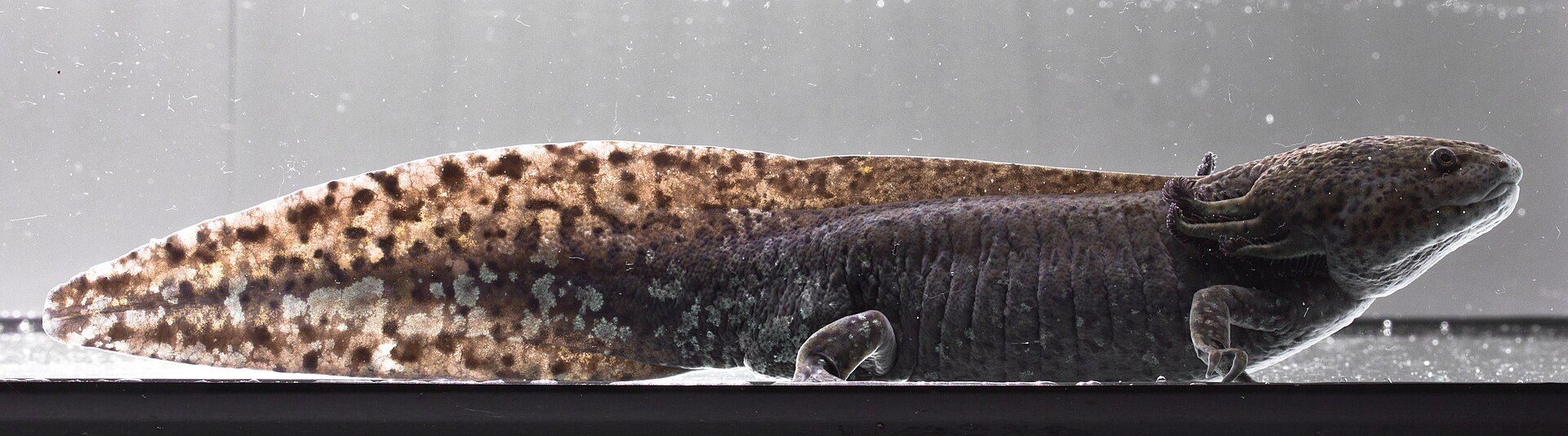
Color affects the price, not the care. One online seller lists wild type at $69.95, leucistic, melanoid and golden albino at $84.99, and copper at $99.99 34.
One buying tip: Axolotl Central says animals with a short, round body and a curved tail carry a dwarfism gene, are considered unethical to sell, and live an average of 3 to 6 years 4.
Axolotl tankmates
Alone is the answer. An exotic-pet clinic says to keep an axolotl alone or with similarly sized axolotls, and to avoid fish, which may nip the gills, and anything small enough to swallow 3.
Axolotl Central is blunter: they generally don’t do well with tankmates and mistake each other for food. Small shrimp are the safest, and new additions need 30 days of quarantine 4.
LafeberVet says juveniles are cannibalistic and adults may share a tank if there’s plenty of space 2. A male and a female together will breed, so decide that before you buy a pair 4.
The two other species in this series are out for their own reasons. A betta needs about 78 °F, well above what an axolotl tolerates, and a goldfish is a fish that may nip gills. Neither belongs here.
Common axolotl problems
- Shrinking or deteriorating gills. Along with lost appetite, this is the first sign of illness in the Kentucky center’s experience. Check the water and temperature before anything else 1.
- Gills curled forward. Hobbyists read gills curled far forward, with lethargy, refusing food, a bent tail tip or mucousy white patches, as heat stress 10. Check temperature, then flow and water quality.
- Floating. Uncontrollable floating shows up with overheating 2. Bloating also comes with bacterial or fungal infection, bad water and gut problems, so don’t assume it’s only heat 2.
- White cotton-like tufts. Water mold shows up this way on the skin 2. An exotic-pet clinic says fuzzy growth on the gills or skin needs prompt veterinary care 3.
- Not eating. LafeberVet ties it to infection, poor water or temperature, and swallowed foreign objects, which is another reason to avoid gravel 2.
- Cloudy eyes. Can follow long exposure to high nitrate 2.
Don’t reach for fish medications on your own. LafeberVet lists tetracyclines as contraindicated and calls malachite green and copper-based treatments unsafe for axolotls 2. Find an exotic-animal vet before you need one.
How much does an axolotl cost?
Prices below are what we saw listed on October 5, 2026. Stores run sales, so your numbers will move.
| Item | Listed price | Source |
|---|---|---|
| 20 gallon long glass tank | $39.99 (regular $79.99) | 26 |
| Sponge filter, 20–75 gal | $14.99 | 27 |
| Air pump | from $14.69 | 28 |
| Liquid test kit (API Freshwater Master) | $35.99 | 30 |
| Water conditioner (Seachem Prime, 8.45 fl oz) | $9.19 | 29 |
| Digital thermometer | $11.99 | 31 |
| Axolotl food (Dr. Tim’s pouch, 1.75 oz) | $7.39 | 32 |
| Basics subtotal | about $134 (our sum) | |
| The animal | $59.95 to $99.99 | 34 |
| Chiller, JBJ Nano Arctica E-Chiller (up to 20 gal) | $449.99 | 33 |
| Chiller, JBJ Arctica 1/15 HP | $735.77 | 32 |
That makes roughly $195 to $235 for tank, filter, tests and animal, and about $645 to $970 if the room runs warm and you need a chiller. None of these totals include a lid, hides, sand, plants, or the canister filter or pump a chiller needs. We haven’t priced those, so add them on top. If your home stays cool, fans and a cool room may be all you spend on temperature.
What hobbyists report
Three old Caudata.org threads, a long-running salamander forum, paraphrased. None involved a vet looking at the animals, so they show what keepers tried, not what’s proven. We tried to read Reddit’s r/axolotls for this, but Reddit blocks automated access, so these come from Caudata.
- A 20 liter tank at about 30 °C 10. A new owner in Rio de Janeiro wrote that the axolotl was eating well and showed no stress. Replies said that temperature is dangerously hot even without visible signs and the tank was far too small, with a 10 gallon (40 liter) minimum and a chiller as the best fix. Fans, a mesh lid, dim lights and damp towels were the fallbacks. One member warned that icing the tank causes swings that are themselves stressful.
- An Australian heat wave 11. A keeper came home to a tank at 30 °C and brought it to 20 in about three hours with fans and ice bottles, then replaced the bottles hourly. The axolotls ate normally. Replies said swings can bring stress and fungus, and to stay below 20 °C until the chiller arrived. Several members described keeping axolotls in lidded containers in a fridge at roughly 5 to 10 °C with daily water changes, as a cheaper stand-in for a chiller. The original poster tried it, then took them out again because the fridge temperature wasn’t steady. We don’t recommend the fridge method: sudden temperature changes stress axolotls, as the thread itself points out.
- A Florida keeper shopping for a chiller 25. Their 20 gallon tank passed 74 °F in summer even with bottle swaps, and a fan helped by only a few degrees and got loud. They hoped to spend about $200. Replies pointed to a small compressor chiller on sale at around $300, said cheaper thermoelectric options mean a lot of DIY, and suggested running the filter upstream of the chiller. The poster priced a 1/10 HP unit at $390 online and a 1/15 HP at $400 in a store, called the prices insane, and ended up moving the tank to a cooler room where it sat near 70 °F. That’s still above the range most sources want. A cooler room is a stopgap, not a plan.
FAQ
In what states is it illegal to own an axolotl? See the table above: Arkansas, California and D.C. prohibit it, and Maine, New Jersey and Hawaii require a permit. New Mexico closes it to the general public, and Alabama’s rule may reach it. We haven’t verified the other states, so ask your wildlife agency.
How much does an axolotl cost? About $60 to $100 for the animal, and roughly $195 to $235 with the basic setup. A chiller adds $450 or more. See the cost table above.
Can I put my axolotl in tap water? Only after removing chlorine and chloramine with a water conditioner 2. Don’t use distilled water; they need some hardness 1.
Can an axolotl live in 70 degree water? It’s under the 72 °F line the Kentucky center and the clinic use 1 3, but above what Axolotl Central and LafeberVet’s preferred range call comfortable 4 2. Long term, bring it down.
Can I have an axolotl in a 5 gallon tank? No. A juvenile gets 10 gallons and an adult 20 or more 2.
Should I get 1 or 2 axolotls? One is simpler. Extra animals need at least 10 more gallons each 3, may bite each other 4, and a male and female will breed 4.
Does my axolotl need a bubbler? An air pump running a sponge filter is a good setup, and its gentle bubbles are fine 4. Strong flow isn’t 2.
Why can’t you touch axolotls? Their skin is delicate and they stress easily, so vets avoid handling and use a soft net when they have to move one 2 3.
Can I buy axolotls at Petco? We couldn’t confirm any chain’s policy, and stock varies by store and state. Ask the store, and check your state’s rules before paying.
All the numbers, with sources
| What | Value | Type | Source |
|---|---|---|---|
| Lifespan, average | 10–15 years (some reported up to 20) | Stated by source | [2] |
| Water temperature, preferred (LafeberVet) | 60–64 °F (15.6–17.8 °C) | Stated by source | [2] |
| Temperature to stay below, University of Kentucky | 72 °F (22 °C) | Stated by source | [1] |
| Tank for one adult, exotic-pet vet clinic | 20 gal (76 L) long, minimum | Stated by source | [3] |
| Nitrate, LafeberVet | under 10 ppm preferred | Stated by source | [2] |
| Water change, LafeberVet | 30% weekly | Stated by source | [2] |
| Adult feeding, exotic-pet vet clinic | Every 2–3 days | Stated by source | [3] |
| Fan cooling, Axolotl Central | up to about 6 °F (3 °C) lower | Stated by source | [24] |
| Basic setup without a chiller, our sum of listed prices | about $134, plus the animal at $59.95–$99.99 | Our calculation | [26] |
| A chiller rated for up to 20 gal (Bulk Reef Supply) | $449.99 | Stated by source | [33] |
Sources
- Ambystoma Genetic Stock Center, University of Kentucky (n.d.). Guide to Axolotl Husbandry
- LafeberVet (Ryan O'Shea, CVT) (2025). Basic Information Sheet: Axolotl
- Tree of Life Exotic Pet Medical Center (n.d.). Axolotl (Ambystoma mexicanum) Care
- Axolotl Central (n.d.). Axolotl Care Guide
- Virginia Department of Wildlife Resources (2023). Mexican Axolotls in Virginia
- Arkansas Game and Fish Commission (2025). Axolotl registration required by June 30
- Cornell Legal Information Institute (current). Cal. Code Regs. Tit. 14, § 671, Importation, Transportation and Possession of Live Restricted Animals
- Electronic Code of Federal Regulations (current). 50 CFR 16.14, Importation of live or dead amphibians or their eggs
- U.S. Fish and Wildlife Service, Federal Register (2025). Injurious Wildlife Species; Listing Salamanders Due to Risk of Salamander Chytrid Fungus
- Caudata.org (2016). Hot Weather - Stressed Axolotl ? (forum thread, hobbyist experience)
- Caudata.org (2007). Tank got too hot, will they be okay? (forum thread, hobbyist experience)
- U.S. Fish and Wildlife Service (2025). Salamanders as Injurious Wildlife: What It Means for Owners and Scientists, FAQs
- Alabama Administrative Code, Department of Conservation and Natural Resources (2024). Rule 220-2-.26, Restrictions On Possession, Sale, Importation And/Or Release Of Certain Animals And Fish
- U.S. Fish and Wildlife Service, Office of Law Enforcement (2025). Ban on Importation and Interstate Transport of 36 Genera of Salamanders and Newts (Public Bulletin PB 25-005)
- Cornell Legal Information Institute (New Jersey Division of Fish and Wildlife rules) (current). N.J. Admin. Code § 7:25-4.2, Permit required
- Cornell Legal Information Institute (New Jersey Division of Fish and Wildlife rules) (current). N.J. Admin. Code § 7:25-4.4, Exempted species
- Cornell Legal Information Institute (Maine Department of Inland Fisheries and Wildlife rules) (current). 09-137 C.M.R. ch. 7, § 06, Classification of Species (conditions for Category 2 Restricted Species)
- Cornell Legal Information Institute (Maine Department of Inland Fisheries and Wildlife rules) (current). 09-137 C.M.R. ch. 7, § 18, Species Lists (Ambystoma mexicanum listed as Category 2 Restricted)
- New Mexico Department of Game and Fish (State Records Center and Archives) (2021). 19.35.7 NMAC, Importation of Live Non-Domesticated Animals, Birds and Fish
- New Mexico Department of Wildlife (formerly Game and Fish) (2026). Special Use Permits (links the Director's Species Importation List)
- Council of the District of Columbia, D.C. Law Library (current). D.C. Code § 8-1808, Prohibited conduct
- Hawaii Department of Agriculture, Plant Quarantine Branch (current). Non-Domestic Animal and Microorganism Lists
- Hawaii Department of Agriculture, Plant Quarantine Branch (2019). List of Conditionally Approved Animals (amphibians section)
- Axolotl Central (Adam Mickle) (2023). How to Lower the Temperature in an Axolotl Tank
- Caudata.org (2014). Chiller for 20 gallon tank?? (forum thread, hobbyist experience)
- PetSmart (2026). Aqueon Standard Glass Rectangle Aquarium, 20 Gal Horizontal (price seen October 5, 2026)
- PetSmart (2026). Top Fin Aquarium Sponge Filter, 20-75 Gallon (price seen October 5, 2026)
- PetSmart (2026). Fish Tank Filters & Aquarium Pumps, Top Fin Aquarium Air Pump (price seen October 5, 2026)
- PetSmart (2026). Seachem Prime Aquarium Water Conditioner, 8.45 fl oz (price seen October 5, 2026)
- PetSmart (2026). API Freshwater Aquarium Master Test Kit (price seen October 5, 2026)
- PetSmart (2026). Fish Tank & Aquarium Thermometers, Top Fin Digital Aquarium Thermometer (price seen October 5, 2026)
- Chewy (2026). Axolotl Care Sheet (product prices seen October 5, 2026)
- Bulk Reef Supply (2026). Aquarium Chillers (prices seen October 5, 2026)
- Axolotl Superstore (2026). Axolotls for Sale (prices seen October 5, 2026)
- Bulk Reef Supply (2026). How To Choose an Aquarium Chiller and How It Works