Angelfish Care: Tank Height, Group Size, Water and Tank Mates
Last reviewed · By Manel Vadillo
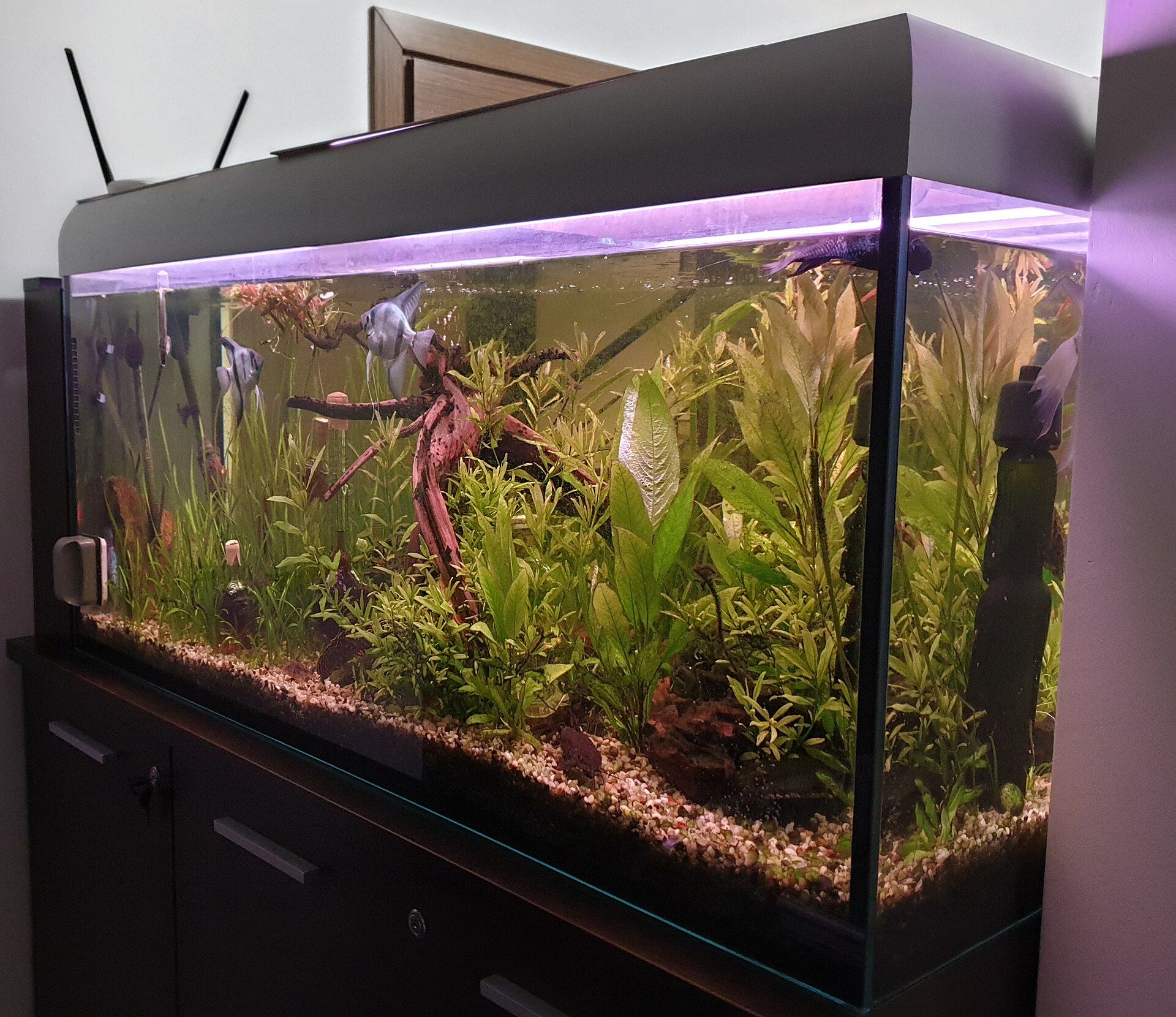
An angelfish in a pet store is a coin-sized fish with plenty of room to grow. A year later it is a disc 6 inches long and 8 inches tall. The care sheets disagree on how large a tank that takes, and on whether a community of small fish is safe around it.
Quick answer
Angelfish reach about 6 inches in body length and 8 inches in height with the fins, so tank height matters. Seriously Fish says a tank of at least 53 gallons, 20 inches tall. Aquarium Co-Op keeps up to four adults in 29 gallons. Both say to avoid small fish an adult can swallow, and Seriously Fish names tetras.
How big they get
Seriously Fish says adults reach 15 cm (about 6 inches) in body length and 20 cm (8 inches) or more in height, so they need a tall tank 1. Aquarium Co-Op gives the same 6 by 8 inches for Pterophyllum scalare, the species in nearly every store, and 7 inches long and 10 to 13 inches high for the rarer altum 3. FishBase lists a smaller maximum of 10.5 cm (about 4 inches) in total length in one place and 15 cm in another 2. We’d plan on the larger figure.
Seriously Fish adds that almost every angelfish on sale is mass-produced, in black, gold and koi strains as well as the standard silver 1.
Tank size: where the sources split
| Source | What it says |
|---|---|
| Seriously Fish | Smallest tank to consider: 39 x 16 x 20 in, about 53 gal. At least 20 inches tall for adults 1 |
| FishBase | Minimum aquarium size 100 cm (about 39 in), groups of 5 or more 2 |
| Aquarium Co-Op | 29 gal community with no more than four adults; start with five or six juveniles in 55 gal 3 |
The first two agree on a tank about 39 inches long. Co-Op’s 29 gallons is much smaller, and it comes from one breeder’s experience with community tanks. It says to remove some fish later if they get territorial and to increase water changes if the tank is crowded 3. Our reading: height is the part you can’t fudge, so we’d lean toward Seriously Fish’s figure for a pair or a small group, and treat 29 gallons as the floor for one or two adults alone. Our stocking guide shows how a tank fills up.
Seriously Fish suggests tall leafy plants such as Amazon swords and gentle flow 1. Co-Op says angelfish do fine in bare, community or planted tanks, and suggests java fern 3.
Water
| Measure | Seriously Fish | FishBase | Co-Op |
|---|---|---|---|
| Temperature | 75 to 86 °F | 75 to 86 °F (24 to 30 °C) | 78 to 86 °F |
| pH | 6.0 to 7.4 | 6.0 to 8.0 | 6.0 to 8.0 |
| Hardness | 0 to 15 dGH | dH 5 to 13 | Adapts to soft water |
Sources: Seriously Fish 1, FishBase 2, Aquarium Co-Op 3.
Co-Op says many captive-bred US angelfish come from Florida’s hard water, that they usually adapt to soft water, and that you can ask a local breeder for fish raised in water like yours. A breeder it interviewed keeps tanks at about 82 °F for breeding and raising fry 3. Our heater guide and pH guide cover the equipment and the numbers.
Group size and temperament
Seriously Fish calls the angelfish generally peaceful but says it may squabble with its own kind, so it’s best kept in small groups. It adds that they are cichlids, so some aggression should be expected 1. FishBase suggests five or more, and keeping pairs in small tanks for breeding 2. Co-Op says that in its experience a single angelfish doesn’t seem to suffer, and that one as a centerpiece is more easygoing and docile. It also notes that the chasing is mostly about breeding 3.
So three sources, three answers. We’d start with one, or with six juveniles in a big tank, and be ready to separate pairs. Co-Op’s way to get a pair is to buy six young fish, raise them and let them pair off 3.
Tank mates
Seriously Fish says angelfish may eat small fish such as tetras 1. Co-Op says to avoid fin nippers, fast fish that win at mealtimes, and anything small enough to be eaten, such as microrasboras or dwarf shrimp. It has had luck with black skirt tetras, adult cardinal tetras and cory catfish. It puts guppies and bettas on a “maybe” list 3.
That puts our own small-fish guides in a tricky spot. A neon tetra is about an inch long (see our neon tetra guide), and Seriously Fish’s warning is about exactly that size. Our guppy guide and cherry shrimp guide cover the other two. Cherry shrimp don’t belong with adult angelfish, per Co-Op’s advice about dwarf shrimp 3. Our corydoras guide covers the bottom-dwelling option.
Feeding
Seriously Fish says wild fish eat mostly small crustaceans and other invertebrates, and tank-bred fish take pellets and flakes and relish live or frozen food 1. Co-Op’s breeder uses krill flakes, freeze-dried bloodworms and tubifex, and sinking sticks, with frozen bloodworms to condition breeders 3.
Choosing fish
Co-Op suggests buying angelfish the size of a coin, 0.8 to 1.2 inches, and picking young, strong fish with a thick head and meaty body. It says to ask the store to feed them, so you can pick the best eaters, and to avoid cloudy or damaged eyes 3. Merck lists angelfish among the fish attacked by the microsporidian that causes neon tetra disease, which has no treatment, and says infected fish should be removed 4. See our neon tetra guide for what that looks like.
FAQ
How big a tank does an angelfish need? Seriously Fish says at least 39 x 16 x 20 inches (about 53 gallons) 1. FishBase says 100 cm long 2. Co-Op says 29 gallons for up to four adults in a community 3.
How long do angelfish live? Co-Op says up to 8 to 12 years in a clean, low-stress tank 3.
Can angelfish live with neon tetras? Seriously Fish warns they may eat small fish such as tetras 1. Co-Op reports luck with adult cardinal tetras 3.
Can I keep one angelfish alone? Co-Op says it doesn’t seem to harm them 3.
Do they need a heater? Their ranges start at 75 to 78 °F, so the question is whether your room stays that warm 1 2 3.
All the numbers, with sources
| What | Value | Type | Source |
|---|---|---|---|
| Seriously Fish: body length / height | 6 in (15 cm) / 8 in (20 cm) or more | Stated by source | [1] |
| Seriously Fish: smallest tank considered | 39 x 16 x 20 in, about 53 US gal | Stated by source | [1] |
| FishBase: minimum aquarium length | 100 cm (about 39 in) | Stated by source | [2] |
| Aquarium Co-Op: tank for adults in a community / starting group in 55 gal | 29 gal, up to 4 adults / 5 or 6 juveniles | Stated by source | [3] |
| Temperature: Seriously Fish and FishBase / Aquarium Co-Op | 75 to 86 °F (24 to 30 °C) / 78 to 86 °F | Stated by source | [1] |
| pH: Seriously Fish / FishBase and Co-Op | 6.0 to 7.4 / 6.0 to 8.0 | Stated by source | [1] |
| Hardness: Seriously Fish / FishBase | 0 to 15 dGH / dH 5 to 13 | Stated by source | [1] |
| Aquarium Co-Op: lifespan in a clean, low-stress tank | Up to 8 to 12 years | Stated by source | [3] |
Sources
- Seriously Fish (2026). Pterophyllum scalare (Angelfish)
- FishBase (n.d.). Pterophyllum scalare, Freshwater angelfish
- Aquarium Co-Op (fish and aquarium products retailer) (n.d.). Care Guide for Freshwater Angelfish
- Merck Veterinary Manual (n.d.). Disorders and Diseases of Fish (Pet Owner Version)